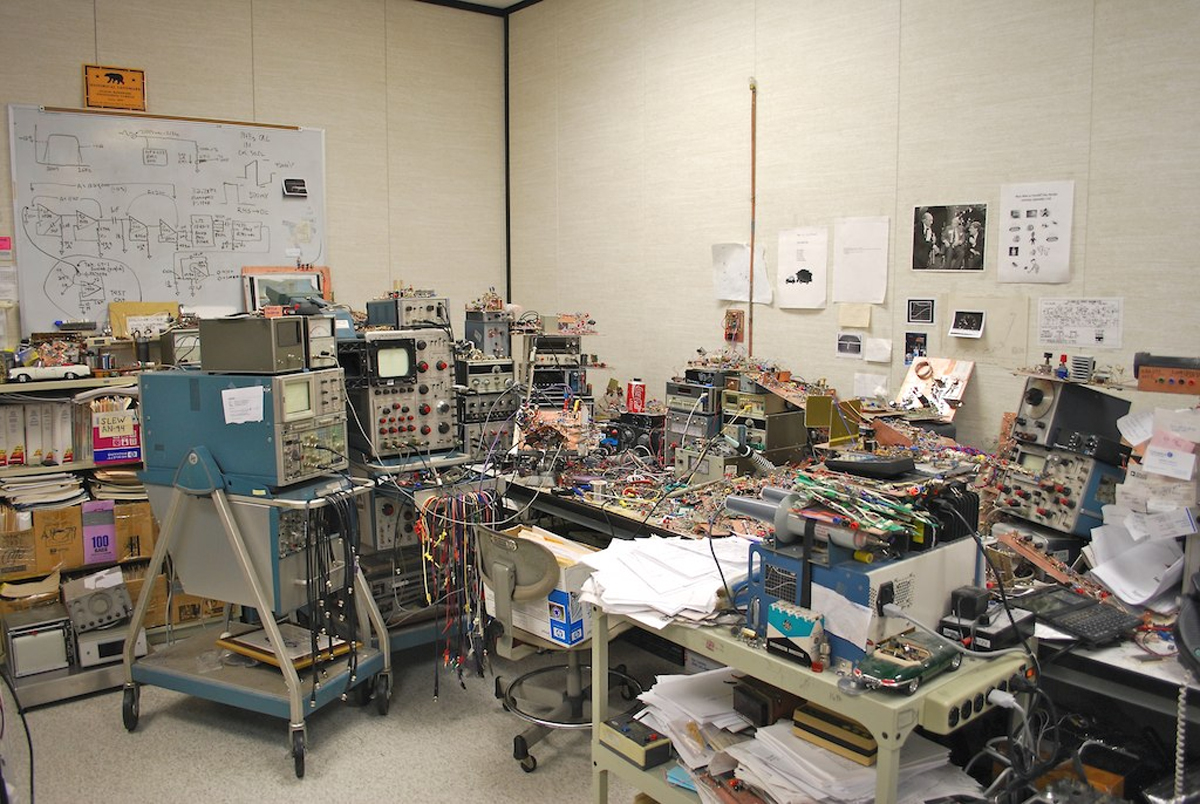
Some hackers build sharp, mildly toxic nests of parts, components, and thrifty finds around themselves. These nests, while not comfortable, are certainly comforting. They allow the hacker’s psyche to inhabit a locale as chaotic as their minds. Within these walls of stuff and clutter, stunning hacks pour out amid a small cloud of cursing. This article is not for them.
Very few of us can actually function in a workplace such like that of the venerable Jim Williams (photo from linked article). Thanks to the commenters for mentioning him in the previous article.
For the rest of us, clutter is a Zen destroying, seemingly unconquerable, monster that taunts our poor discipline and organizational skill from the dark corner of our minds. However, there is an easy solution that is oft overlooked. Somewhat obviously, most organization problems can be solved by simply not having things to organize.
It’s taken me a very long time to realize the source of my clutter woes. My first tactic was to blame myself for my inability to keep up with the mess. A more superior human would certainly be able to use their effortless discipline to keep a space organized. However, the clutter was a symptom of a problem completely separate from my actual ability to keep a space clean.
We are entering a new era of radio technology. A new approach to building radios has made devices like multi-band cell phones and the ubiquitous USB TV receivers that seamlessly flit from frequency to frequency possible. That technology is Software Defined Radio, or SDR.
A idealized radio involves a series of stages. Firstly, an antenna receives the radio signal, converting it into an electrical signal. This signal is fed into a tuned resonator which is tuned to a particular frequency. This amplifies the desired signal, which is then sent to a demodulator, a device which extracts the required information from the carrier signal. In a simple radio, this would be the audio signal that was encoded by the transmitter. Finally, this signal is output, usually to a speaker or headphones.
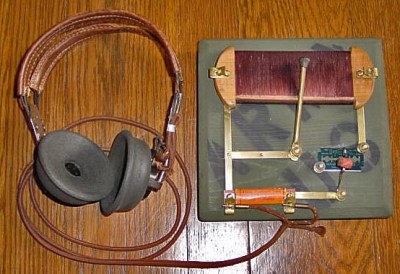
A replica foxhole crystal set. Photo: Bill Jackson
That’s how your basic crystal radio works: more sophisticated radios will add features like filters that remove unwanted frequencies or additional stages that will process the signal to create the output that you want. In an FM radio, for example, you would have a stage after the demodulator that detects if the signal is a stereo one, and separates the two stereo signals if so.
To change the frequency that this radio receives, you have to change the frequency that the resonator is tuned to. That could mean moving a wire on a crystal, or turning a knob that controls a variable capacitor, but there has to be a physical change in the circuit. The same is true of the additional mixing stages that refine the signal. These circuits may be embedded deeply in the guts of the radio, but they are still there. This is the limitation with normal receivers: the radio can’t receive a signal that is outside the range that the resonator circuit can tune to, or change the way it is demodulated and processed. If you want to receive multiple frequency bands or different types of signals, you need to have separate pathways for each band or type of signal, physically switching the signal between them. That’s why you have physical AM/FM switches on radios: they switch the signal from an AM radio processing path to an FM one.
Software Defined Radios remove that requirement. In these, the resonator and demodulator parts of the radio are replaced by computerized circuits, such as analog to digital converters (ADCs) and algorithms that extract the signal from the stream of data that the ADCs capture. They can change frequencies by simply changing the algorithm to look for another frequency: there is no need for a physical change in the circuit itself. So, an SDR radio can be tuned to any frequency that the ADC is capable of sampling: it is not restricted by the range that a resonator can tune to. Similarly, the demodulator that extracts the final signal you want can be updated by changing the algorithm, changing the way the signal is processed before it is output.
This idea was first developed in the 1970s, but it didn’t really become practical until the 1990s, when the development of flexible field-programmable gate array (FPGA) chips meant that there was enough processing power available to create single chip SDR devices. Once programmed, an FPGA has no problem handing the complex tasks of sampling, demodulating and processing in a single device.
Most modern SDRs don’t just use a single chip, though. Rather than directly converting the signal to digital, they use an analog front end that receives the raw signal, filters it and converts it down to a fixed frequency (called the intermediate frequency, or IF) that the ADCs in the FPGA can more easily digitize. This makes it cheaper to build: by converting the frequency of the signal to this intermediate frequency, you can use a simpler FPGA and a cheaper ADC, because they don’t have to directly convert the maximum frequency you want to receive, only the IF. As long as the front end can convert a band of signals down to an intermediate frequency that the FPGA can digitize, the SDR can work with it.
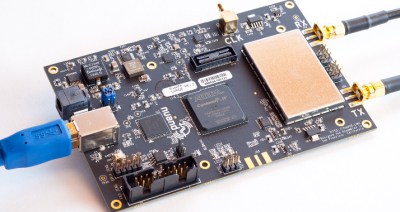
The BladeRF, a modern SDR device that can receive and transmit signals between 300 MHz and 3 GHz
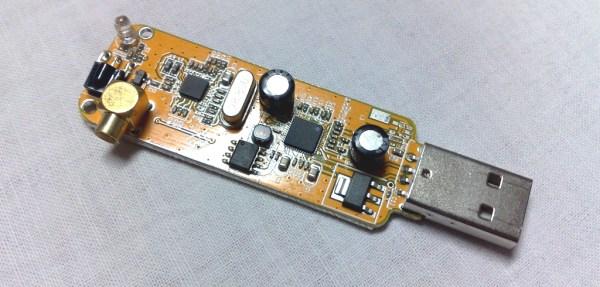
This flexibility means that SDR devices can handle a huge range of signals at relatively low cost. The $420 BladeRF, for instance, can receive and transmit signals from 300 MHz to 3.8 GHz at the same time, while the $300 HackRF One can work with signals from 1 MHz up to an incredible 6 GHz. The ability of the BladeRF to both receive and transmit means that you can use it to build your own GSM phone network, while the low cost of the HackRF One makes it a favorite of radio hackers who want to do things like make portable radio analyzers. Mass produced models are even cheaper: by hacking a $20 USB TV receiver that contains an SDR, you can get a radio that can, with a suitable antenna, do things like track airplanes or receive satellite weather images. And all of this is possible because of the idea of Software Defined Radio.
So you’ve built a central server and filled your house with WiFi-connected nodes all speaking to each other using the MQTT protocol. In short, you’ve got the machine-to-machine side of things entirely squared away. Now it’s time to bring the humans into the loop! We’re going to explore a couple graphical user interfaces.
You could build a physical knob and/or LED display for every little aspect of your entire system, but honestly, this is where GUIs really shine. In this installment of Minimal MQTT, we’re going to look at human-friendly ways of consuming and producing data to interact with your connected sensors, switches, and displays. There are a ton of frameworks out there that use MQTT to build something like this, but we’re going to cut out the middle-man and go straight for some GUI MQTT clients.
Rudis – A small wooden sword given to a Gladiator as proof of his achieved freedom. It signifies his ascent from being a slave to becoming a free man.
One thing is certain – anything that runs on electricity can be connected to the internet. The only obstacle is cost. And as costs come down, the reality of The Internet of Things will be upon us. Everything from cars to curling irons will be connected to the Internet. With this newly connected world will come a new breed of hacker. The Black Hats will move out from behind their keyboards and spill into the streets, only to be met by the White Hats as they battle for control over our endlessly connected world.
And such was the case on the morning of October 16, 2029. The air was cool and breezy when Randall C. Tubbs, a senior police officer at the Bronx 49th precinct, received a call over his radio to check out a tripped alarm at a nearby cell tower. Barely a minute had passed by when he pulled in to the Tower Road cul-de-sac on the day our story begins. The cell tower dominated the horizon, and was silhouetted against a cloudless blue sky. The trees of the forest surrounding the area were just starting to show their colors, with the yellow oak leaves being most vibrant. A narrow gravel driveway led to a small, brown, nondescript building at the base of the tower. At first glance, Officer Tubbs could see no sign of anything unusual. There was no service truck in sight, and the gate to the ten-foot-tall chain link fence surrounding the tower was latched shut and securely locked.
It wasn’t until he unlocked the gate that he first noticed something odd. A security camera on the right corner of the building was pointing toward the forest. He glanced around and quickly spotted two other cameras, each of them pointing away from the tower building. Clearly, they should have been pointing toward the tower and the door to the building… a door that Officer Tubbs now realized was slightly open. He could barely make out shadows moving around from the small sliver of light that was peeking ominously through the opening, suggesting someone was inside. Suddenly, the sound of his footsteps on the gravel seemed to become amplified, and his breathing so loud that for a split second he held his breath. He reached down and turned the volume of his radio to silent, and slowly began making his way to the open door.
Last weekend was Hamvention, the place you want to be on the third weekend in May. It is the world’s largest gathering of amateur radio enthusiasts, and an exceedingly large flea market containing all sorts of electronica.
The booths of Hamvention include a few notable Open Hardware folk, but for the most part, you’re looking a few big booths from Yaesu, an entire section dedicated to everything ARRL, and a few pop-ups from the usual suspects. Rigol was there, showing off their test equipment and selling the DS1052E oscilloscope for far more than it’s worth. The Rigol Zed is a much better buy, anyway.
As with any gathering of hams, antennas are everywhere. The largest by far was the tower at right. With a little more equipment, this antenna could do a moon bounce. It’s a shame the moon was full this weekend, and everyone went to bed early.
Giant antennas and an amateur radio trade show notwithstanding, the biggest draw is the flea market. You’re looking at about two football fields worth of parking spaces, filled with cars, tents, and collapsible tables and the strangest electronic devices you’ve ever seen. What was that like? Read on below.
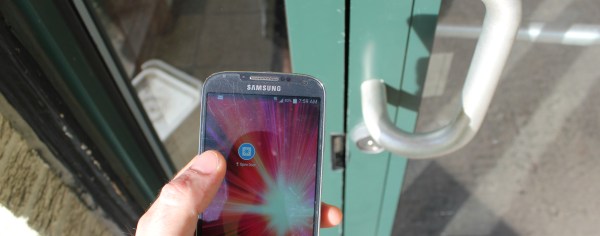
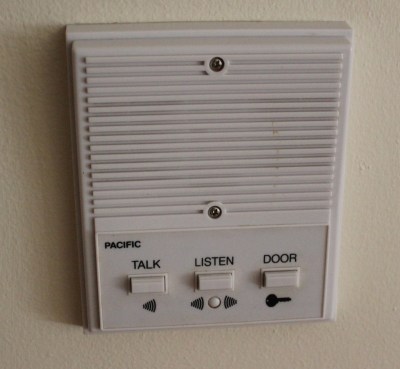
If you’ve been to an apartment complex with a locked front door, you’ve seen the buzzer systems. You press the corresponding button for the apartment you want and can talk to the resident. They can press a button to unlock the door briefly, and then you go up to their apartment and they don’t have to come down to let you in. But what if you’re the resident and you want to go for a run without your keys jingling in your pocket? What if you want to open it using just your smartphone?
I knew this was a silly problem, and everyone I told about it thought that for the amount of time and effort it might save, it was hardly worth it.
Challenge accepted.
How fast can I put this together using only parts I have around the apartment? Turns out about 2 hours.
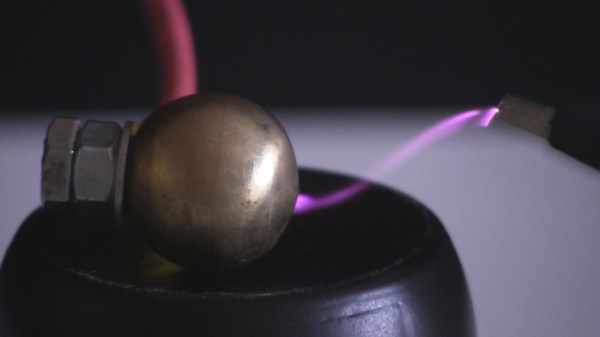
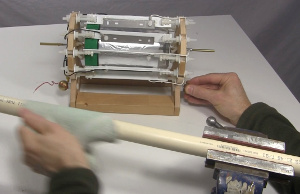
Having hacked away with high voltage for many years I’ve ended up using a large number of very different high voltage sources. I say sources and not power supplies because I’ve even powered a corona motor by rubbing a PVC pipe with a cotton cloth, making use of the triboelectric effect. But while the voltage from that is high, the current is too low for producing the necessary ion wind to make a lifter fly up off a tabletop. For that I use a flyback transformer and Cockcroft-Walton voltage multiplier power supply that’s plugged into a wall socket.
So yes, I have an unorthodox skillset when it comes to sourcing high voltage. It’s time I sat down and listed most of the power sources I’ve used over the years, including a bit about how they work, what their output is like and what they can be used for, as well as some idea of cost or ease of making. The order is from least powerful to most powerful so keep reading for the ones that really bite.
Triboelectric Effect
Triboelectric series table
You’ve no doubt encountered this effect. It’s how your body is charged when you rub your feet on carpet and then get a shock from touching a door knob. When you rub two specific materials together there’s a transfer of electrons from one to the other. Not just any two materials will work. To find out which materials are good to use, have a look at a triboelectric series table.
Materials that are on the positive end of the table will become positively charged when rubbed against materials on the negative end of the table. Those materials will become negatively charged. The further apart they are in the table, the stronger the charging.
Powering corona motor with triboelectricity
An example of where I’ve used this is to power the corona motor shown here. I vigorously rub a PVC pipe with a cotton cloth, and as the pipe emerges from the cloth, a sharp wire a few millimeters away takes the charge from the pipe. You can see this corona motor being powered by other power sources in the video here.
This would be considered an electrostatic power source because charge is accumulated on surfaces. Being insulating materials, that charge can’t move around.