When we last checked in with the Philadelphia Maker Faire in 2019, one couldn’t help but be impressed with what the organizers had pulled off with just a fraction of the budget and resources it took to put on the defunct World Maker Faire in New York. We came away absolutely certain the event was on the verge of explosive growth, and that next year would be even bigger and better.
But of course, that didn’t happen. The COVID-19 pandemic meant that by the time the 2020 Faire should have kicked off, the logistics of holding a gathering much larger than a family dinner had become a serious hurdle. Philadelphia implemented strict rules on indoor and outdoor events to try and contain the spread of the virus, to the point that even when they were relaxed in 2021, it still didn’t make sense to try and put on a Faire under those conditions.
Thankfully things are largely back to normal-ish now, and as such the Philadelphia Maker Faire had something of a rebirth this year. Organizers decided to move the event to the Independence Seaport Museum, with vendor and exhibitor tables distributed throughout the museum’s three floors. This made the ticket price a great two-for-one value, especially if you had enough time left over to head out to the docks so you could explore the 130-year-old cruiser USS Olympia, and the USS Becuna, one of the last surviving WWII Balao-class submarines.
As you’d expect, the event was packed with fascinating projects and demonstrations, to the point that trying to list them all here would be impossible. But for those who couldn’t make the trip out to see what the 2022 Philadelphia Maker Faire had to offer, let’s take a look at a handful of the standout exhibits.
Seasoned Hackaday readers may have noticed over the years, that some of us who toil under the sign of the Jolly Wrencher have a penchant for older tech. After all, what’s not to like in a dirt cheap piece of consumer electronics from decades past that’s just begging for a bit of hardware hacking? For me at the moment this is manifesting itself in a selection of 8mm movie cameras, as I pursue a project that will eventually deliver a decent quality digital film cartridge.
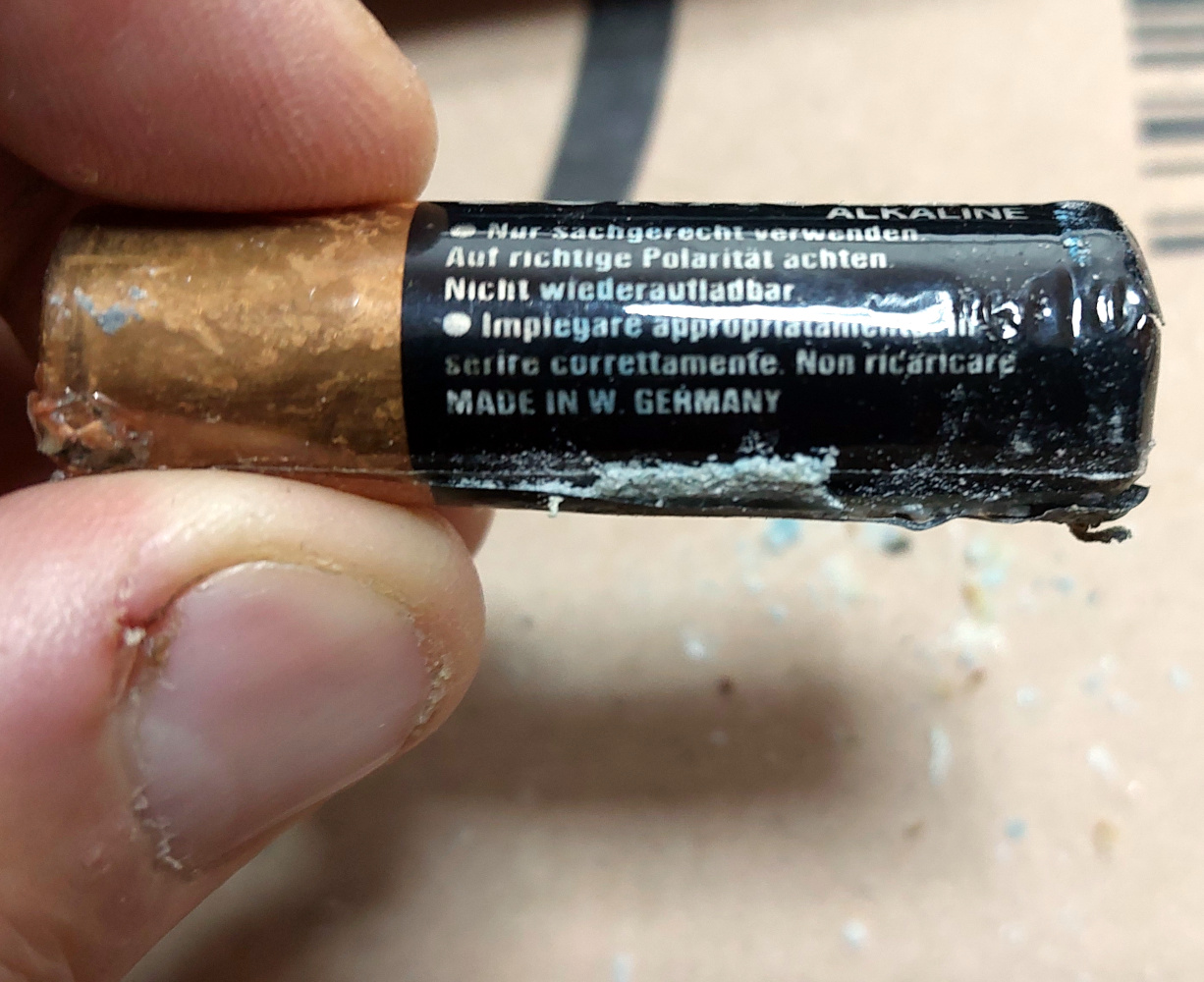
When A Cell Is From West Germany, You Know It’s Old
“Made in West Germany”
The trouble with scouring junk shops for a technology superseded four decades ago is that the cameras I find have in most cases been sitting in a drawer since the early 1980s. They were a valuable item back in the day so of course they were hung on to, then they were forgotten about until one day the grown-ups who were once the kids featured in the home movies are clearing the house, and they start their journey to my bench.
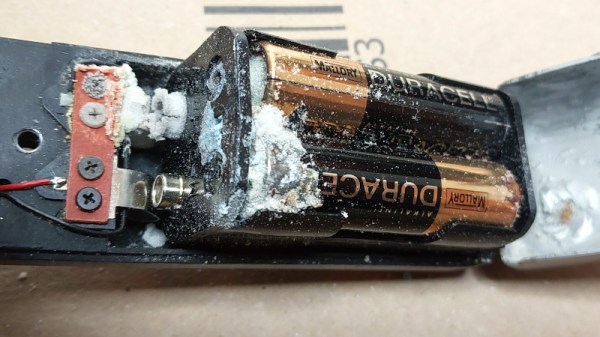
The problem is that very few owners of 8mm cameras had the good sense to remove their batteries before putting them away, so I inevitably end up with a battery compartment full of crusty 1980s Duracells and rusted contacts. This has left me curious, just what has happened here and how can I fix it?
What’s The Leaky Stuff?
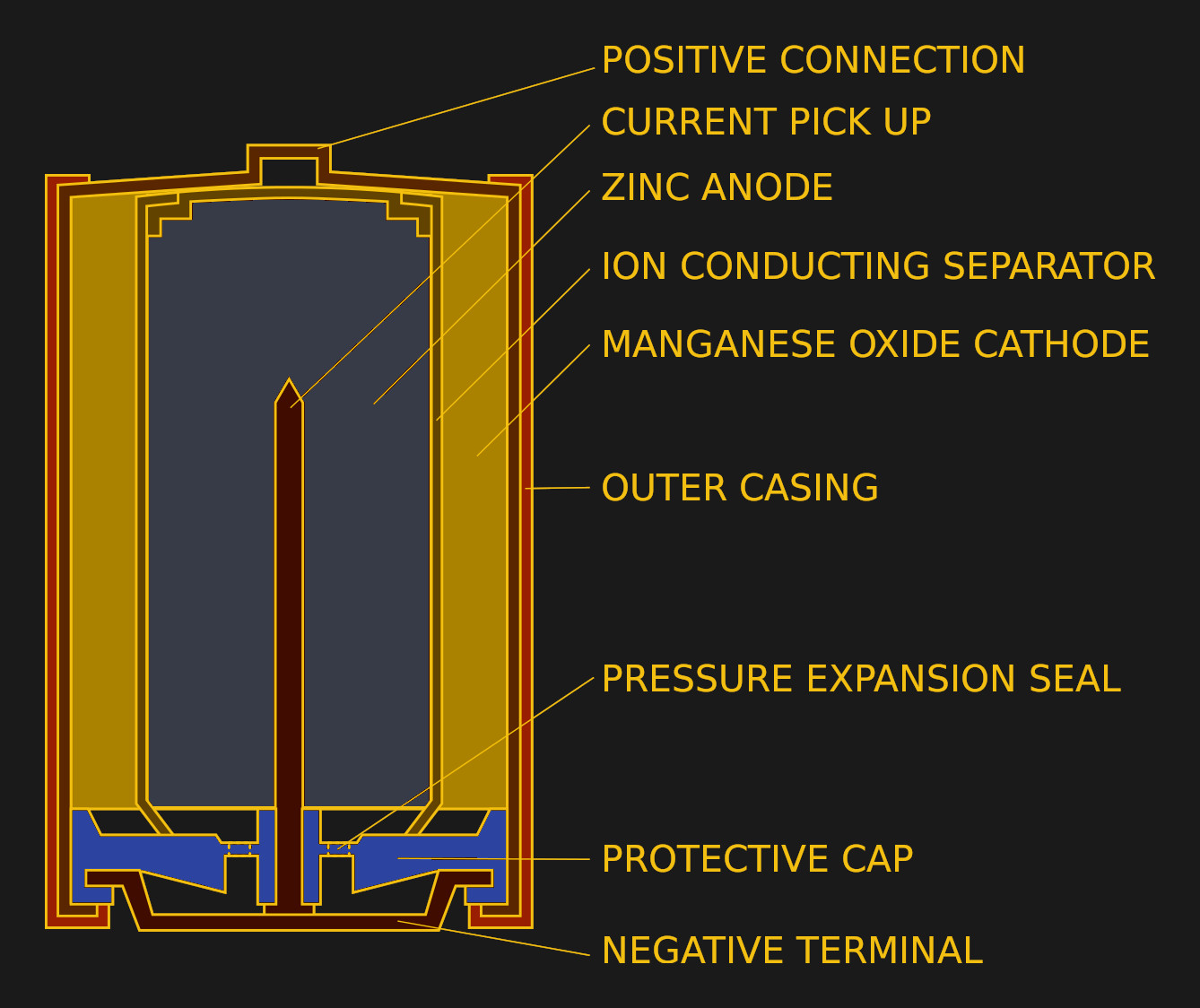
Construction of a zinc-manganese “alkaline” cell. Tympanus, Public domain.
Non-rechargeable cells come in a variety of chemistries, but the commercial ones we’re most familiar with are zinc-carbon “dry cells”, and “Alkaline” zinc-manganese dioxide cells. The zinc-carbon variety are becoming less common here in 2022 and have an acidic zinc chloride or ammonium chloride electrolyte, while the alkaline cells have a higher capacity and a basic potassium hydroxide electrolyte. They both have different failure modes that result in the leaky cells, so it’s worth taking a look at each one.
The failure mode of a zinc-carbon cell is a chemical one, the acidic electrolyte reacts with the zinc can anode, and eventually eats through it. The leaking electrolyte then attacks the surrounding circuitry and battery clips. It’s hardly a concentrated acid, but it’s enough to do plenty of damage over the years.
Meanwhile an alkaline cell has a build-up of hydrogen as it degrades. It incorporates a vent which allows the hydrogen to escape, however the hydrogen pressure can instead force the electrolyte out through this vent. The electrolyte will then corrode the battery terminals and any other electronics it touches. A feature of alkaline cell leakage is a white crust, this is potassium carbonate formed from the reaction between the potassium hydroxide electrolyte and carbon dioxide in the air.
The Global Parts Bin To The Rescue
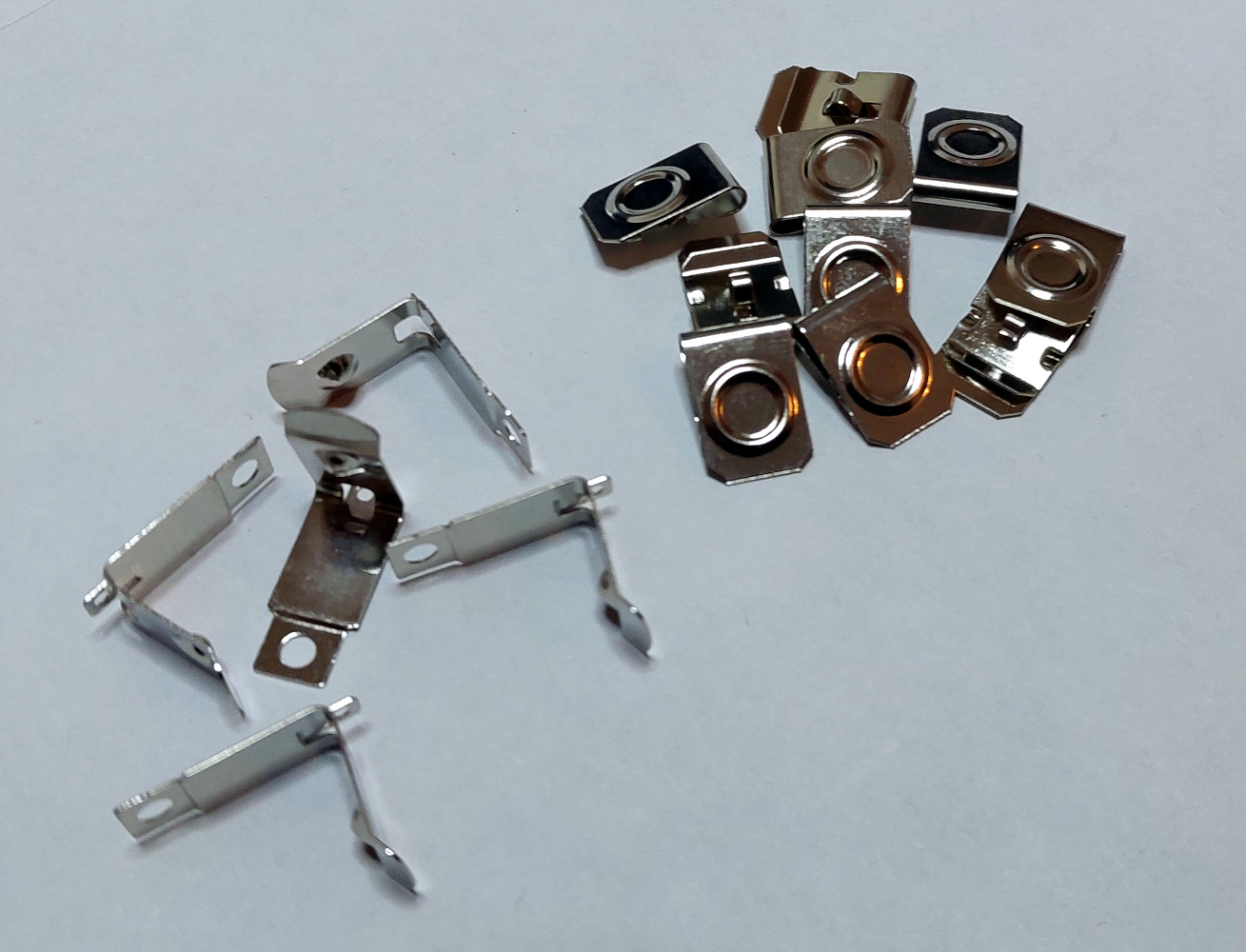
Fresh and new battery clips for AA holders
How much damage has been done is usually a function of how long the leaking batteries have been in the device. Sometimes one is lucky and the battery contacts are salvageable, otherwise they are too far gone and a replacement has to be found. A past me tried all sorts of home-made solutions using stiff copper wire and other materials, but today thanks to the miracle of international commerce it’s usually possible to find a contact the same as or very similar to the old one. A quick AliExpress search on terms such as “AA battery spring” will return numerous options, and it’s simply a case then of paging through to find the one you need on the terms you like.
So those of you who like retro tech will find something familiar in the last few paragraphs, but there’s a lesson to be found in dealing with ancient batteries. Here in 2022 we’re more likely to have lithium polymer cells in our consumer devices and so the need to keep a pile of Duracells at hand is reduced. But the thought of today’s equivalent of a Super 8 camera lying forgotten in a drawer for decades with a cheap li-po pouch cell inside it is far more frightening than something with some crusty manganese cells. Have we just found the root cause of house fires in the 2040s?
The story of humankind is largely a tale of conflict, often brought about by the uneven distribution of resources. For as long as we’ve been down out of the trees, and probably considerably before that too, our ancestors have been struggling to get what they need to survive, as often as not at the expense of another, more fortunate tribe. Food, water, land, it doesn’t matter; if They have it and We don’t, chances are good that there’s going to be a fight.
Few resources are as unevenly distributed across our planet as cobalt is. The metal makes up only a fraction of a percent of the Earth’s crust, and commercially significant concentrations are few and far between, enough so that those who have some often end up at odds with those who need it. And need it we do; what started in antiquity as mainly a rich blue pigment for glass and ceramics has become essential for important industrial alloys, high-power magnets, and the anodes of lithium batteries, among other uses.
Getting access to our limited supply of cobalt and refining it into a useful metal isn’t a trivial process, and unfortunately its outsized importance to technological society forces it into a geopolitical role that has done a lot to add to human misery. Luckily, market forces and new technology are making once-marginal sources viable, which just may help us get the cobalt we need without all the conflict.
Science fiction is full of things you don’t want to think too hard about. Why do starships with transporters have brigs with forcefields? Why not just beam a prisoner into an enclosed space? Why do Cylons fly ships with human controls? Why not have a plug in their… well, you get the idea. For that matter, why do Cylons (and Kaylons, and Gort) even look human at all? Why aren’t some Cylons just ships?
Of course, the real reason is so we can identify with them and actors can play them with some cosplay gear and makeup. But real-life robots that are practical rarely look like humans at all.
No one is going to confuse a robot factory arm or a Roomba with a person, yet they are perfectly suited for their purpose. Yet we are fascinated with human-looking robots and continue to build them, like Nadia from IHMC Robotics in the video below. Continue reading “In Our Own Image: Do We Need Humanoid Robots?”→
Given how many incredible builds we’ve covered over the last couple of years, we knew that an official Cyberdeck Contest would certainly receive some impressive entries. But never in our wildest dreams could we have predicted that more than 100 decks would end up crossing the finish line, or that of them, the vast majority would be never-before-seen designs. In fact, the response to this contest was so overwhelming that the judging process took far longer than we originally anticipated.
Ultimately, we decided that there were simply too many phenomenal builds entered into the contest to award $150 Digikey spending sprees to just three of them. So as an added bonus, we’ve rustled up some $50 Tindie gift certificates that will go to the four special category honorable mentions.
With that, let’s take a look at the cyberdecks that took top honors as decided by our panel of judges.
Apple has been busy adding new features to its smartphone and smartwatch offerings. Its new iPhone 14 and Apple Watch 8 now feature a safety system that contacts emergency services in the event the user is in a automobile accident.
As with so many new technologies though, the feature has fallen afoul of the law of unintended consequences. Reports are that the “crash detection system” is falsely triggering on rollercoasters and in other strange circumstances. Let’s take a look at how these systems work, and why this might be happening.
If you plan to attend Supercon or some other hacker conference, know that you’re going to get a badge with a SAO (Simple Add-On) connector, a 4-pin or 6-pin connector that you can plug an addon board onto. There’s myriads of SAOs to choose from, and if you ever felt like your choice paralysis wasn’t intense enough, now you have the option of getting a Jolly Wrencher SAO board!
This board gives you an SMD prototyping space, with 1.27mm (0.05″ pitch) pads, suitable for many passive components, ICs and even modules like the ESP32 WROOM. Those pads are diagonally interspersed with ground-fill-connected pads – if you want to bodge something on the spot, you don’t need to pull separate GND wires. Given the Supercon badge specifics, the SAO-standard SDA and SCL pins have RX and TX labels as well. For bonus points, the eyes are transparent, with LED footprints behind them – it’s my first time designing a PCB where the LED shines through the FR4, and I hope that the aesthetics work out!
This design is open with gerber files available for download, so if you thought of making a quick PCB order, I’m giving you one more .zip file to add to it. Otherwise, it’s possible that you will find a Wrencher board lying around at Supercon! Now, I’d like to tell you how KiCad 6 made it super easy to design this PCB – after all, there’s never enough SAOs, and it’s quite likely you’ll want to design your own special SAO, too.


 But of course, that didn’t happen. The COVID-19 pandemic meant that by the time the 2020 Faire should have kicked off, the logistics of holding a gathering much larger than a family dinner had become a serious hurdle. Philadelphia implemented strict rules on indoor and outdoor events to try and contain the spread of the virus, to the point that even when they were relaxed in 2021, it still didn’t make sense to try and put on a Faire under those conditions.