How To Be A Stinkin’ Chess Cheat — Sockfish

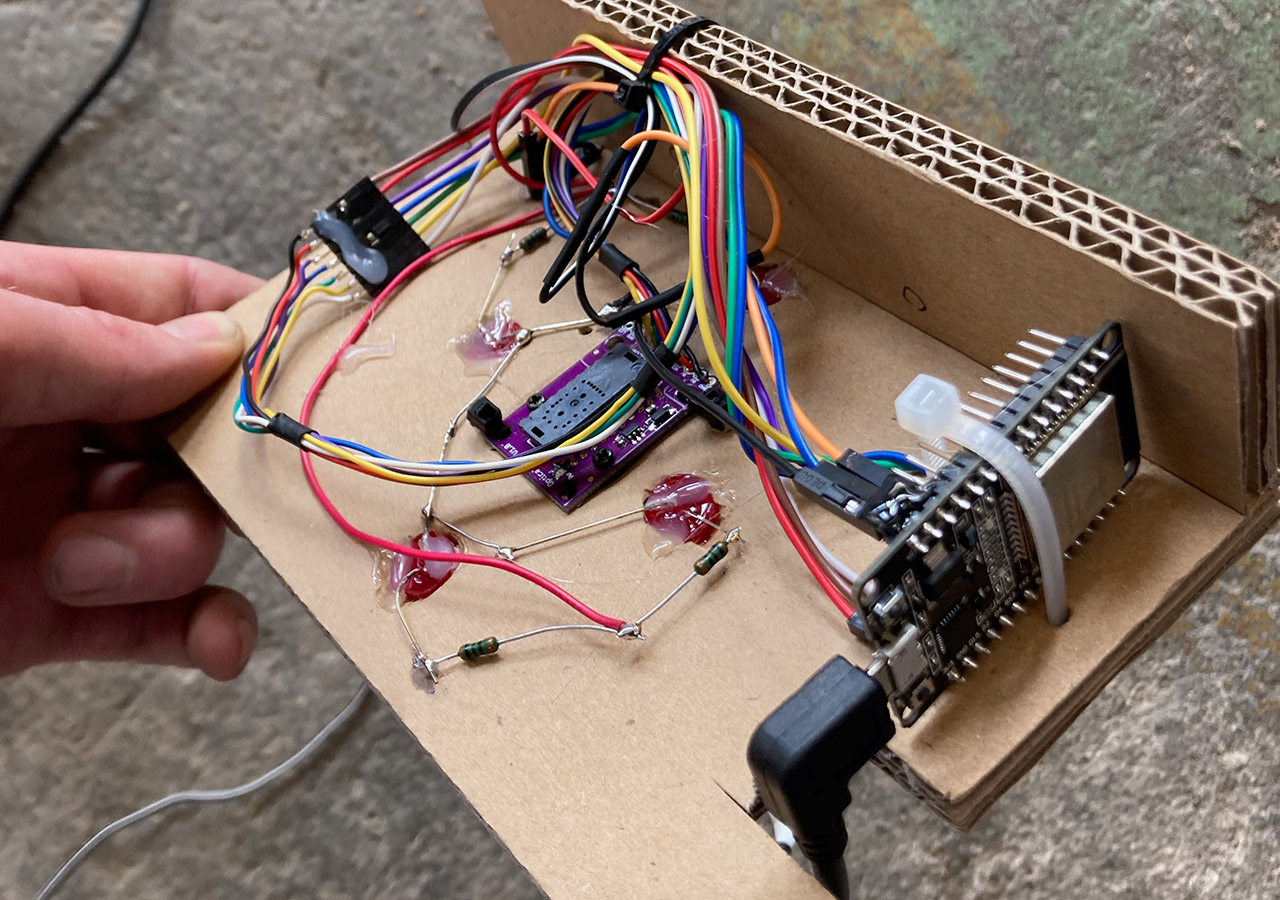
[James Stanley] enjoys chess, isn’t terribly good at it, and has some dubious scruples. At least, that’s the setup for building Sockfish, a shoe-to-Pi interface to let you cheat at chess. We’re pretty sure only the first point is true, but the build is impressive all the same. It’s a pair of 3D printed shoe inserts, with two pressure-sensitive inputs on each insert, coupled with a vibration motor in each. Tap out your opponent’s moves during the game, and the Stockfish software will buzz instructions back to you. Just follow the instructions, and you too can be a chess master.

In practice things went a bit awry, as poking in encoded move data with one’s feet isn’t the easiest task, and discerning the subtle tickles on the toes is error-prone at best. [James] arranged a match against an unsuspecting friend (in the name of science), and managed to fat-finger (fat-toe?) the inputs on both games, leading to Sockfish instructing him to make illegal moves.

This seemed like too much cheating, even for [James], so he played the rest of each game on his own abilities, winning one of the two. Once the deed was done, our anti-hero gladly doffed his shoes to show off his gadgetry. After some debate, they concluded the device might “bring the game into disrepute” if used for greater evil. Naturally [James] is already working on an improved version.

Thanks to [Abe Tusk] for the tip!

Why You’ve Never Heard About Nintendo’s U-Force

90’s kids think that the Power Glove was the coolest game peripheral of the epoch. We might have thought so too, until we heard about Don’t Touch: The Story of the U-Force from [The Gaming Historian].

The device itself folded up like a laptop, and on the two surfaces had four IR LED/sensor pairs. All of these combined would localize your fist in space for playing Mike Tyson’s Punch Out, or would work with various other passive controller add-ons like a flight yoke for playing Top Gun. (One of the coolest bits is the flip-out IR reflectors triggered by the buttons in the yoke.)

All-in-all, the video’s take is that a number of factors doomed the U-Force to play second fiddle to the Power Glove. Battling Mattel’s marketing prowess is obvious, but other things like manufacturing problems due to bad hinges and inconsistent IR sensors delayed release and added cost. In the end, though, [Dave Capper], the U-Force’s inventor, puts it down simply to non-convincing gameplay. There were no blockbuster games that used it to its full potential.

At the time, the U-Force utilized more IR LEDs than any other consumer electronic device.

We think there’s interesting hacker potential in a simple interface like this. Perhaps its biggest Achilles heel outside of the lack of a killer application was the fact that it required calibration. We can imagine all sorts of awesome interactions, and we’re not afraid of a little tweaking. Or maybe we would update the sensors to something more modern, like those inexpensive time-of-flight distance units.

Thanks [Karl Koscher] for bringing this documentary to our attention in the comments about the very similarly interesting laser theremin project we featured last year. It’s definitely opened our eyes to an old interaction of the past that would seem no less magical today.

Continue reading “Why You’ve Never Heard About Nintendo’s U-Force”

A Primer For The Homebrew Game Boy Advance Scene

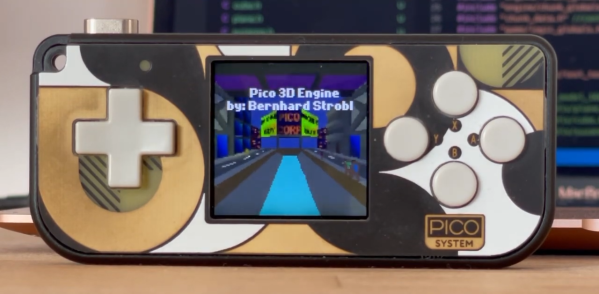
As video game systems pass into antiquity, some of them turn out to make excellent platforms for homebrew gaming. Not only does modern technology make it easier to interact with systems that are now comparatively underpowered and simpler, but the documentation available for older systems is often readily available as well, giving the community lots of options for exploration and creativity. The Game Boy Advance is becoming a popular platform for these sorts of independent game development, and this video shows exactly how you can get started too.

This tutorial starts with some explanation of how the GBA works. It offered developers several modes for the display, so this is the first choice a programmer must make when designing the game. From there it has a brief explanation of how to compile programs for the GBA and execute them, then it dives into actually writing the games themselves. There are a few examples that [3DSage] demonstrates here including examples for checking the operation of the code and hardware, some simple games, and also a detailed explanation the framebuffers and other hardware and software available when developing games for this console.

While the video is only 10 minutes long, we recommend watching it at three-quarters or half speed. It’s incredibly information-dense and anyone following along will likely need to pause several times. That being said, it’s an excellent primer for developing games for this platform and in general, especially since emulators are readily available so the original hardware isn’t needed. If you’d like to build something from an even more bygone era than the early 2000s, though, take a look at this tutorial for developing games on arcade cabinets.

Continue reading “A Primer For The Homebrew Game Boy Advance Scene”

A tennis racket and a tennis ball with a spinning motor inside

A Self-Spinning Tennis Ball To Surprise Your Opponent

In many ball sports like golf, football and tennis, controlling the ball’s spin is an important skill. Expert players can make golf balls curve around obstacles, launch footballs towards goal posts from impossible angles, or confuse their opponents by making a tennis ball bounce in a completely unexpected direction.

[Luis Marx], by his own admission, is not an expert tennis player at all, so when he found himself humiliated on the court by his roommate he set about finding a different way to win. In other words, to cheat. The basic idea was to make a tennis ball that would start spinning at the push of a button, rather than by skillful wielding of a racket: a spinning ball that flies through the air will follow a curved trajectory, so if you can make a ball spin at will, you can change its direction in mid-air.

Making a ball spin by itself is not as hard as it may sound. All you need is an electric motor that’s small enough to fit inside, along with a power source and some way to turn it on. When the motor inside the ball starts to spin, Newton’s third law ensures that the outside will spin in the opposite direction. [Luis] found a suitable DC motor and mounted it on a small custom-designed PCB along with an ESP8266 controller and powered it with a tiny lithium battery. A pushbutton mounted on his tennis racket operates the wireless interface to turn the motor on and off.

Although getting this setup to work wasn’t as easy as [Luis] had hoped, turning it into a ball that’s good enough to play tennis with was not straightforward either. [Luis] decided to 3D-print the outer shell using flexible filament in order to create something that would have the same amount of bounce as an ordinary rubber tennis ball. It took several rounds of trial and error with various types of filament to end up with something that worked, but the final result, as you can see in the video (in German, embedded below), was quite impressive.

Tests on the tennis court showed that [Luis] could now easily beat his roommate, although this was mostly due to the erratic bouncing caused by the ball’s spin rather than any aerodynamic effects. Still, the magic tennis ball achieved its objective and even survived several games without breaking. If you’re looking for a more brute-force approach to cheating at tennis, this 180 mph tennis ball trebuchet might come in handy.

Continue reading “A Self-Spinning Tennis Ball To Surprise Your Opponent”

TVout Library Brings Cardboard Arcade To Life

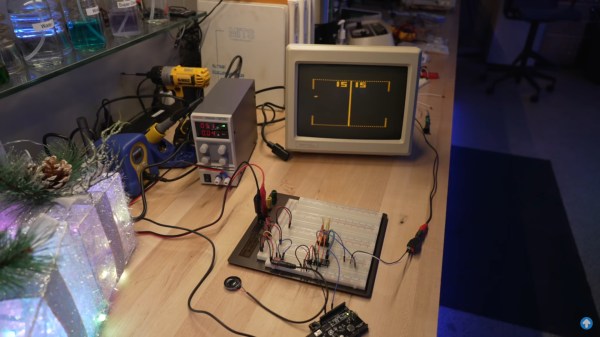
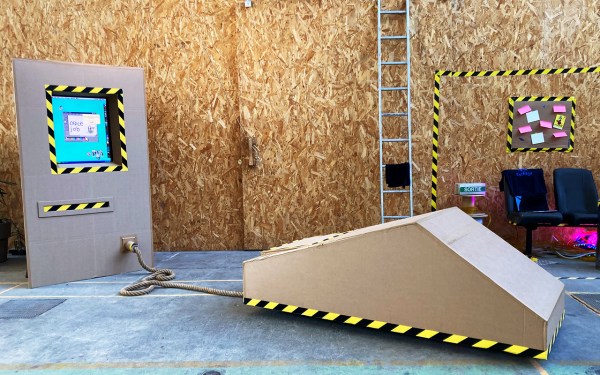
Recycling old CRTs is a true Hackaday tradition, and [Rob’s] mini arcade is sure to grab your attention.

First of all, you’ll probably appreciate [Rob] circumventing the supply shortage by getting all his components from recycled material. That’s probably the only way to get anything these days. He salvaged a small CRT from an old-school video intercom system and snagged the buttons, speakers, and switches from other unused devices laying around. Not all is lost, however, as [Rob] was able to purchase an Arduino Nano and a few resistors online. So maybe things are turning around in that category, who knows?

You’ll probably also appreciate how remarkably simple this hack is. No need for a Raspberry Pi as your standard 8-bit microcontroller will do the trick. And, fortunately, [Rob] found a nice library to help him generate the composite video signal, doing most of the work for him. All that was left to do was to build the arcade cabinet. Recreating the classic design was a pretty easy step, but you might opt for something a little nicer than cardboard though. But, hey, if it does the trick, then why not?

Cool project, [Rob]! We’re definitely happy to add this project to our retro collection here at Hackaday.

Continue reading “TVout Library Brings Cardboard Arcade To Life”

Was There A Programmable PONG Chip?

Students of game console history will reach back into the 1970s for the primordial machines, tracing from the Magnavox Odyssey onwards, and thence via the Fairchild Channel F into the world of microprocessors and the chain of machines that lead us to those we enjoy today. In the early days there was a parallel evolution for a few years of dedicated video game consoles with no interchangeable cartridges or microprocessors, these took their inspiration from the legendary PONG arcade game and used dedicated non-programmable hardware in custom chips to create their video. But was there a programmable PONG chip lurking among all the others? [Old VCR] takes a look.

Many readers will be familiar with MOS Technology as the originator of the 6502 processor used in so many 8-bit home computers. But perhaps many of our attention spans will have passed over another of their products, the MOS 7600 and 7601. These were the chip company’s entry into the surprisingly congested mid-70s PONG-in-a-chip market, and the article investigates the question of whether they might in fact be mask-programmed microcontrollers masquerading as dedicated chips.

It’s a fascinating tour through the mid-70s in terms of games consoles, MOS, and through their eventual takeover, Commodore. The possibility of a mask-programmed PONG chip is explored in detail and discounted, though like [Old VCR], we’d love to see one decapped and reverse engineered. For us a stronger line of evidence comes in asking why MOS would stop at PONG if they had a mask-programmed microcontroller in their catalogue, and that our not having seen MOS microcontrollers appearing all over Commodore’s subsequent products suggests that it may be simply another dedicated PONG chip like all the others.

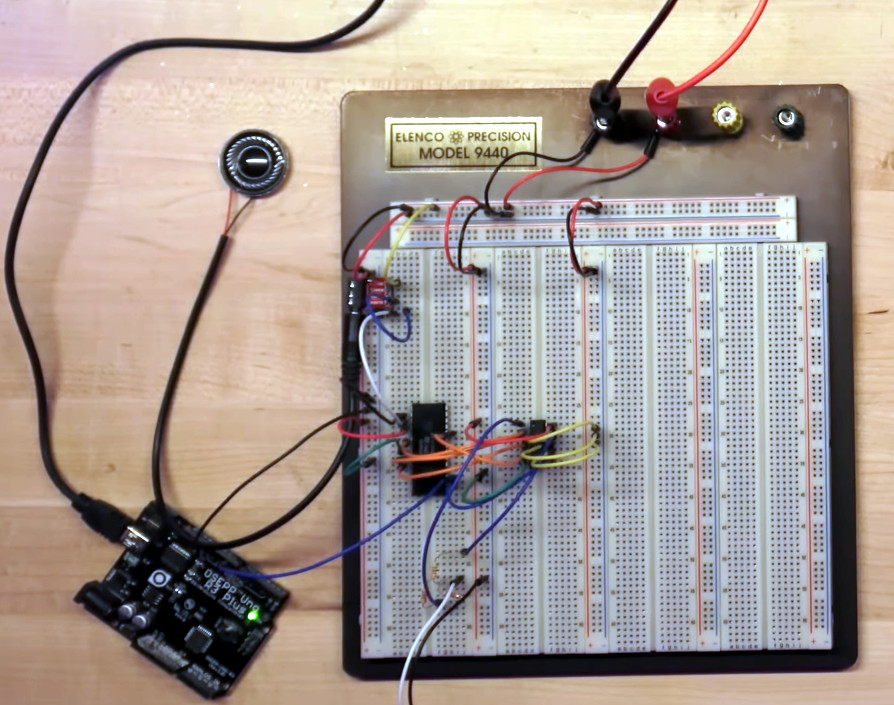
We’ve seen quite a few variants of this iconic game over the years, but few as impressive as one made from discrete components.