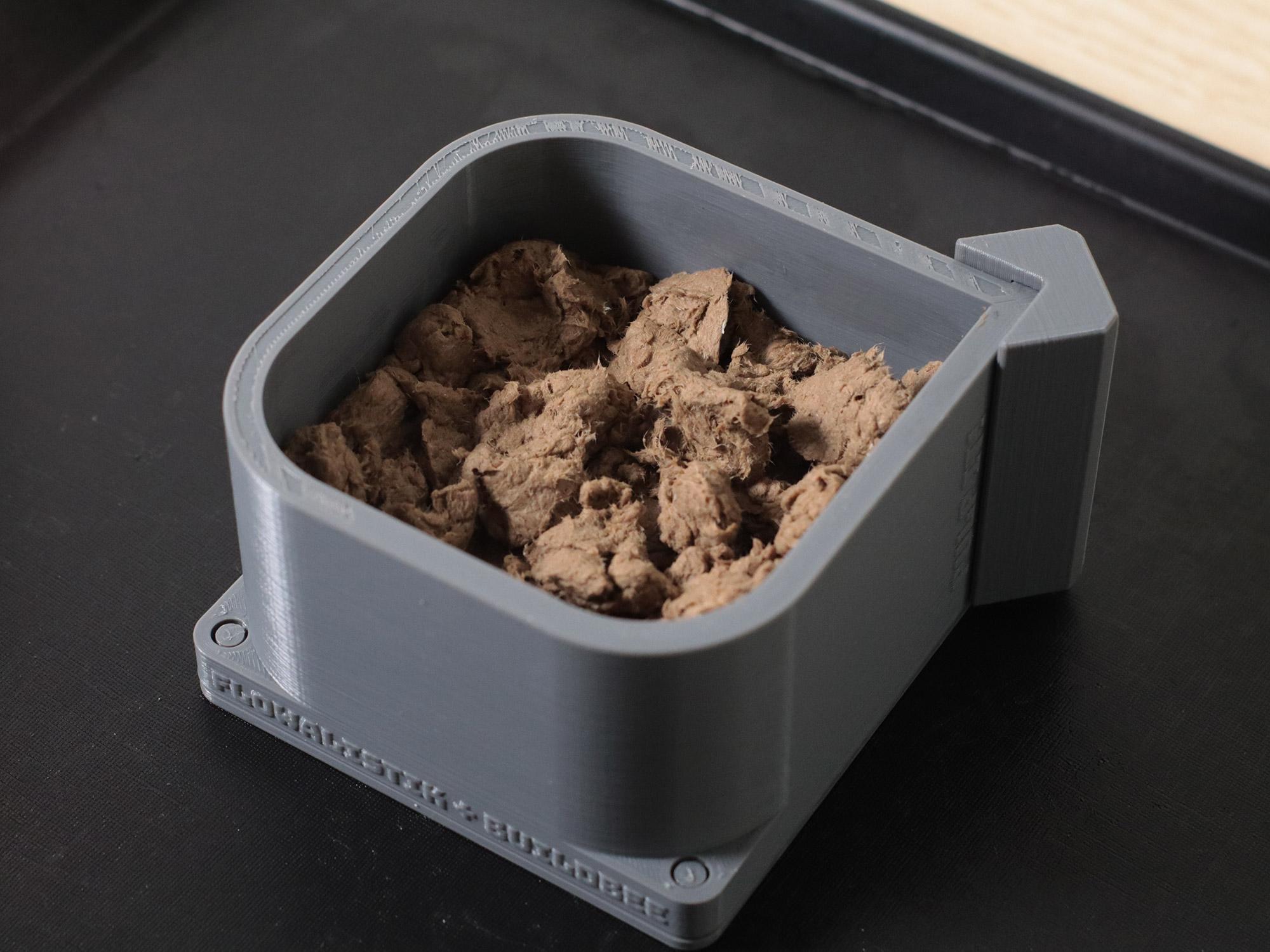
Going Forward To The Land: Technology For Permaculture

It’s usual for a Hackaday scribe to read hundreds of web pages over a typical week as we traverse the world in search of the good stuff to bring you. Sometimes they’re obvious Hackaday stories but as you’ll all no doubt understand we often end up on wild tangents learning about stuff we never expected to be excited about. Thus it was last week that I happened upon a GQ piece charting the dwindling remains of the communes set up in rural California by hippies during the counterculture years.

With only a few ageing residents who truly embraced the back-to-the-land dream remaining, these adventurously-designed home-made houses are gently decaying into the forest. It’s a disappearing world, but it’s also close to home for me as someone who crew up on a self-sufficiency smallholding in the 1970s. My parents may not have been hippies in the way those of everyone else in that scene at the time seemed to be, but I learned all my curiosity and hacking skills in the many opportunities presented to a small child by an unruly combination of small farm and metalworking business. There’s part of me that would build a hippy home in a Californian forest in a heartbeat, and throw myself with gusto into subsistence vegetable growing to get me through each winter.

Continue reading “Going Forward To The Land: Technology For Permaculture”

Turning Old Masks Into 3D Printer Filament

Disposable masks have been a necessity during the COVID-19 pandemic, but for all the good they’ve done, their disposal represents a monumental ecological challenge that has largely been ignored in favor of more immediate concerns. What exactly are we supposed to do with the hundreds of billions of masks that are used once or twice and then thrown away?

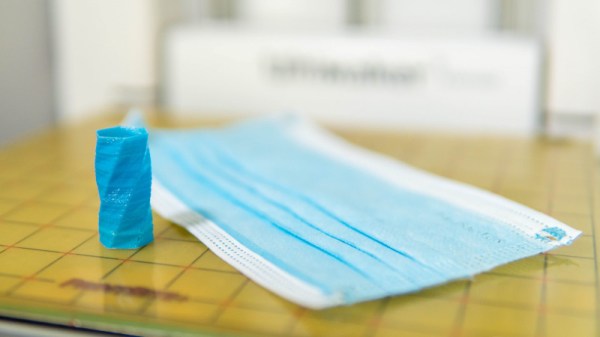
If the research being conducted at the University of Bristol’s Design and Manufacturing Futures Lab is any indication, at least some of those masks might get a second chance at life as a 3D printed object. Noting that the ubiquitous blue disposable mask is made up largely of polypropylene and not paper as most of us would assume, the team set out to determine if they could process the masks in such a way that they would end up with a filament that could be run through a standard 3D printer. While there’s still some fine tuning to be done, the results so far are exceptionally impressive; especially as it seems the technique is well within the means of the hobbyist.

From masks to usable filament.

The first step in the process, beyond removing the elastic ear straps and any metal strip that might be in the nose, is to heat a stack of masks between two pieces of non-stick paper with a conventional iron. This causes the masks to melt together, and turn into a solid mass that’s much easier to work with. These congealed masks were then put through a consumer-grade blender to produce the fine polypropylene granules that’re suitable for extrusion.

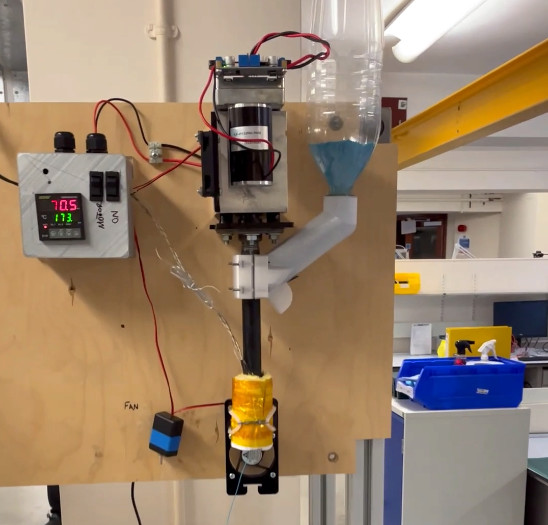
Mounted vertically, the open source Filastruder takes a hopper-full of polypropylene and extrudes it into a 1.75 mm filament. Or at least, that’s the idea. The team notes that the first test run of filament only had an average diameter of 1.5 mm, so they’re modifying the nozzle and developing a more powerful feed mechanism to get closer to the goal diameter. Even still, by cranking up the extrusion multiplier in the slicing software, the team was able to successfully print objects using the thin polypropylene filament.

This is only-during-a-pandemic recycling, and we’re very excited to see this concept developed further. The team notes that the extrusion temperature of 260 °C (500 °F) is far beyond what’s necessary to kill the COVID-19 virus, though if you planned on attempting this with used masks, we’d imagine they would need to be washed regardless. If the hacker and maker community were able to use their 3D printers to churn out personal protective equipment (PPE) in the early days of the pandemic, it seems only fitting that some of it could now be ground up and printed into something new.

Making Coffee With Hydrogen

Something of a Holy Grail among engineers with an interest in a low-carbon future is the idea of replacing fossil fuel gasses with hydrogen. There are various schemes, but they all suffer from the problem that hydrogen is difficult stuff to store or transport. It’s not easily liquefied, and the tiny size of its molecule means that many containment materials that are fine for methane simply won’t hold on to it.

[Isographer] has an idea: to transport the energy not as hydrogen but as metallic aluminium, and generate hydrogen by reaction with aqueous sodium hydroxide. He’s demonstrated it by generating enough hydrogen to make a cup of coffee, as you can see in the video below the break.

It’s obviously very successful, but how does it stack up from a green perspective? The feedstocks are aluminium and sodium hydroxide, and aside from the hydrogen it produces sodium aluminate. Aluminium is produced by electrolysis of molten bauxite and uses vast amounts of energy to produce, but since it is often most economic to do so using hydroelectric power then it can be a zero-carbon store of energy. Sodium hydroxide is also produced by an electrolytic process, this time using brine as the feedstock, so it also has the potential to be produced with low-carbon electricity. Meanwhile the sodium aluminate solution is a cisutic base, but one that readily degrades to inert aluminium oxide and hydroxide in the environment. So while it can’t be guaranteed that the feedstock he’s using is low-carbon, it’s certainly a possibility.

So given scrap aluminium and an assortment of jars it’s possible to make a cup of hot coffee. It’s pretty obvious that this technology won’t be used in the home in this way, but does that make it useless? It’s not difficult to imagine energy being transported over distances as heavy-but-harmless aluminium metal, and we’re already seeing a different chemistry with the same goal being used to power vehicles.

Continue reading “Making Coffee With Hydrogen”

Can We Repurpose Old Wind Turbine Blades?

Wind turbines are a fantastic, cheap, renewable source of energy. However, nothing lasts forever, and over time, the blades of wind turbines fatigue and must be replaced. This then raises the question of what to do with these giant waste blades. Thankfully, a variety of projects are exploring just those possibilities.

A Difficult Recycling Problem

Around 85% of a modern wind turbine is recyclable. The problem is that wind turbine blades currently aren’t. The blades last around 20 to 25 years, and are typically made of fiberglass or carbon fiber. Consisting of high-strength fibers set in a resin matrix, these composite materials are incredibly difficult to recycle, as we’ve discussed previously. Unlike metals or plastics, they can’t just be melted down to be recast as fresh material. Couple this with the fact that wind turbine blades are huge, often spanning up to 300 feet long, and the problem gets harder. They’re difficult and expensive to transport and tough to chop up as well.

Continue reading “Can We Repurpose Old Wind Turbine Blades?”

Researchers monitor calves as they use the MooLoo, a special pen for urination.

Toilet-Training Cows Is No Bull

Human activity may be the main cause of climate change, but all these cows milling and mooing about don’t help, either. Everyone knows that cows produce methane-laden flatulence, but there’s another problem — their urine contains ammonia. The nitrogen leeches into the soil and turns into nitrous oxide, which is no laughing matter. So what’s the answer, giant diapers? No, just train them to use a toilet instead of the soil-let.

A pair of researchers from the University of Auckland traveled to a research institute’s farm in Germany with the hope of training a group of 16 calves to do their business in a special pen. The “MooLoo” is painted bright green and carpeted with artificial turf so it’s less weird for the cows. First they left the calves in the pen until they peed, and then gave it a reward of sugar water. From there, they started extended the animals’ distance from the MooLoo. Whenever the calves thought outside the box, they would be sprayed with water for three seconds. The results are kind of surprising: within an average of 15-20 urination sessions, 11 of the 16 cows had been trained successfully and were using the MooLoo 75% of the time. Watch a calf earn some sugar water after the break.

German cows mostly live in barns, but millions of other cows spend much of their time outside. So, how would that work? The researchers believe that cows could be trained to go when they gather for milking time. Makes sense to us, but how do you train cows on a large scale? Maybe with bovine VR?

Continue reading “Toilet-Training Cows Is No Bull”

The World’s First Autonomous Electric Cargo Ship Is Due To Set Sail

Maritime shipping is big business, with gigantic container ships responsible for moving the vast majority of the world’s goods from point A to points B, C and D. Of course, there’s a significant environmental impact from all this activity, something ill befitting the cleaner, cooler world we hope the future will be. Thus, alternatives to the fossil fuel burning ships of old must be found. To that end, Norwegian company Yara International has developed a zero-emission ship by the name of Yara Birkeland, which aims to show the way forward into a world of electric, autonomous sea transport. 

Continue reading “The World’s First Autonomous Electric Cargo Ship Is Due To Set Sail”

Arduino Powered Heat Pump Controller Helps Warm Your Toes

Heat pump heating technology is starting to pop up more and more lately, as the technology becomes cheaper and public awareness and acceptance improves. Touted as a greener residential heating system, they are rapidly gaining popularity, at least in part due to various government green policies and tax breaks.

[Gonzho] has been busy the last few years working on his own Arduino Powered Open Source heat pump controller, and the project logs show some nice details of what it takes to start experimenting with heat pumps in general, if that’s your game. Or you could use this to give an old system a new lease of life with an Arduino brain transplant.

In essence they are very simple devices; some kind of refrigerant is passed through a source of heat, absorbing some of it, it then flows elsewhere, and is compressed, which increases its temperature, before that increased heat is lost where the increase in temperature is desired.

This heat source could be a river, a mass of pipes buried in the ground, or simply the air around you. The source and quality of the heat source as well as the desired system operating temperature dictate the overall efficiency, and with ground-source systems it’s even possible to dump excess heat directly into the ground and store it for when required later. This could be the result of a residential cooling system, or even directly sourced from a solar heated setup.

This heat pumping process is reversible, so it is possible to swap the hot and cold ends, just by flipping some valves, and turn your space heater into a space cooler. This whole process can trace its roots back to the super talented Scottish professor, William Cullen who in 1748 was the first person on record to demonstrate artificial refrigeration.

The power needed to run the compressor pump and control gear is usually electrically derived, at least in non-vehicular applications, but the total power required is significantly less than the effective heating (or cooling) power that results.

We’ve covered a few heat pump hacks before, like this guy who’s been heating his house geothermally for years, but not so many platforms designed for experimentation from the ground up.

The associated GitHub project provides the gerber files as well as the Arduino code, so you’ve got a great starting point for your own heat pumping builds.