New Renewable Energy Projects Are Overwhelming US Grids

It’s been clear for a long time that the world has to move away from fossil energy sources. Decades ago, this seemed impractical, when renewable energy was hugely expensive, and we were yet to see much impact on the ground from climate change. Meanwhile, prices for solar and wind installations have come down immensely, which helps a lot.

However, there’s a new problem. Power grids across the US simply can’t keep up with the rapid pace of new renewable installations. It’s a frustrating issue, but not an insurmountable one.

Continue reading “New Renewable Energy Projects Are Overwhelming US Grids”

Hackaday Links Column Banner

Hackaday Links: April 16, 2023

The dystopian future you’ve been expecting is here now, at least if you live in New York City, which unveiled a trio of technology solutions to the city’s crime woes this week. Surprisingly, the least terrifying one is “DigiDog,” which seems to be more or less an off-the-shelf Spot robot from Boston Dynamics. DigiDog’s job is to de-escalate hostage negotiation situations, and unarmed though it may be, we suspect that the mission will fail spectacularly if either the hostage or hostage-taker has seen Black Mirror. Also likely to terrify the public is the totally-not-a-Dalek-looking K5 Autonomous Security Robot, which is apparently already wandering around Times Square using AI and other buzzwords to snitch on people. And finally, there’s StarChase, which is based on an AR-15 lower receiver and shoots GPS trackers that stick to cars so they can be tracked remotely. We’re not sure about that last one either; besides the fact that it looks like a grenade launcher, the GPS tracker isn’t exactly covert. Plus it’s only attached with adhesive, so it seems easy enough to pop it off the target vehicle and throw it in a sewer, or even attach it to another car.

Continue reading “Hackaday Links: April 16, 2023”

Sufficiently Advanced Tech: Has Bugs

Arthur C. Clarke said that “Any sufficiently advanced technology is indistinguishable from magic”. He was a sci-fi writer, though, and not a security guy. Maybe it should read “Any sufficiently advanced tech has security flaws”. Because this is the story of breaking into a car through its headlight.

In a marvelous writeup, half-story, half CAN-bus masterclass, [Ken Tindell] details how car thieves pried off the front headlight of a friend’s Toyota, and managed to steal it just by saying the right things into the network. Since the headlight is on the same network as the door locks, pulling out the bulb and sending the “open the door” message repeatedly, along with a lot of other commands to essentially jam some other security features, can pull it off.

Half of you are asking what this has to do with Arthur C. Clarke, and the other half are probably asking what a lightbulb is doing on a car’s data network. In principle, it’s a great idea to have all of the electronics in a car be smart electronics, reporting their status back to the central computer. It’s how we know when our lights are out, or what our tire pressure is, from the driver’s seat. But adding features adds attack surfaces. What seems like magic to the driver looks like a gold mine to the attacker, or to car thieves.

With automotive CAN, security was kind of a second thought, and I don’t mean this uncharitably. The first goal was making sure that the system worked across all auto manufacturers and parts suppliers, and that’s tricky enough. Security would have to come second. And more modern cars have their CAN networks encrypted now, adding layers of magic on top of magic.

But I’m nearly certain that, when deciding to replace the simple current-sensing test of whether a bulb was burnt out, the engineers probably didn’t have the full cost of moving the bulb onto the CAN bus in mind. They certainly had dreams of simplifying the wiring harness, and of bringing the lowly headlight into the modern age, but I’d bet they had no idea that folks were going to use the headlight port to open the doors. Sufficiently advanced tech.


Fail Of The Week: Car Starter Motors Aren’t The Best Fit For EBikes

A lot of what real engineering is all about is designing to the limits of your materials, with a healthy margin for error. On the other hand, seat-of-the-pants engineering often takes the opposite tack — working with the materials you have and finding their limits after the fact. While the former is more rigorous and better suited to anything where life and limb are on the line, there’s something to be said for the flexibility that informal engineering offers.

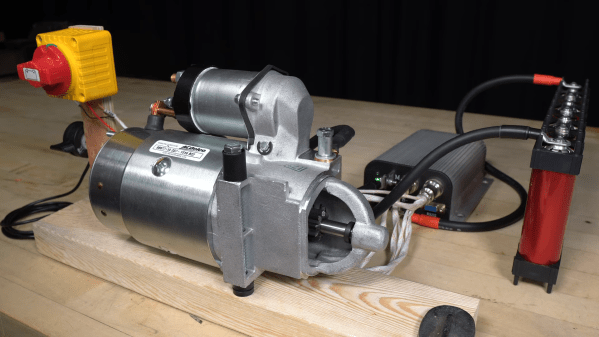
[Austin Blake]’s latest eBike is a case study in informal engineering. [Austin] started out wondering if a starter motor from a car engine would make a decent electric bike motor. Our first instinct before watching the video below was to answer that question with a resounding “No!” Yes, starter motors seem like a natural for the job, delivering high torque in a compact package. But starting a car engine is the very definition of a low-duty-cycle application, since it should only take a second or two of cranking to get an engine started. Pressing a motor designed for such a task into continuous duty seems like, well, a non-starter.

And to be fair, [Austin] fully acknowledges this from the start. He even retrofits the motor, wisely replacing the shaft bushings with proper bearings in an attempt to get a better duty cycle. And it works, at least for a while — with the motor, a homebrew battery, and an ESC mounted to a bike frame, the bike was actually pretty peppy. But bearings aren’t the only thing limiting a starter motor to intermittent duty operation. The short drive really heated up the motor, and even with a few ventilation holes knocked in the motor housing, it eventually released the Magic Smoke. The video has all the gory details.

As always, we like to stress that “Fail of the Week” is not necessarily a badge of shame. We appreciate it whenever someone shows us the way not to go, as [Austin] did here. And let’s keep in mind that he’s had success with this approach before, albeit with a much, much bigger starter motor.

Continue reading “Fail Of The Week: Car Starter Motors Aren’t The Best Fit For EBikes”

Retro Gadgets: The 1983 Pocket Oscilloscope

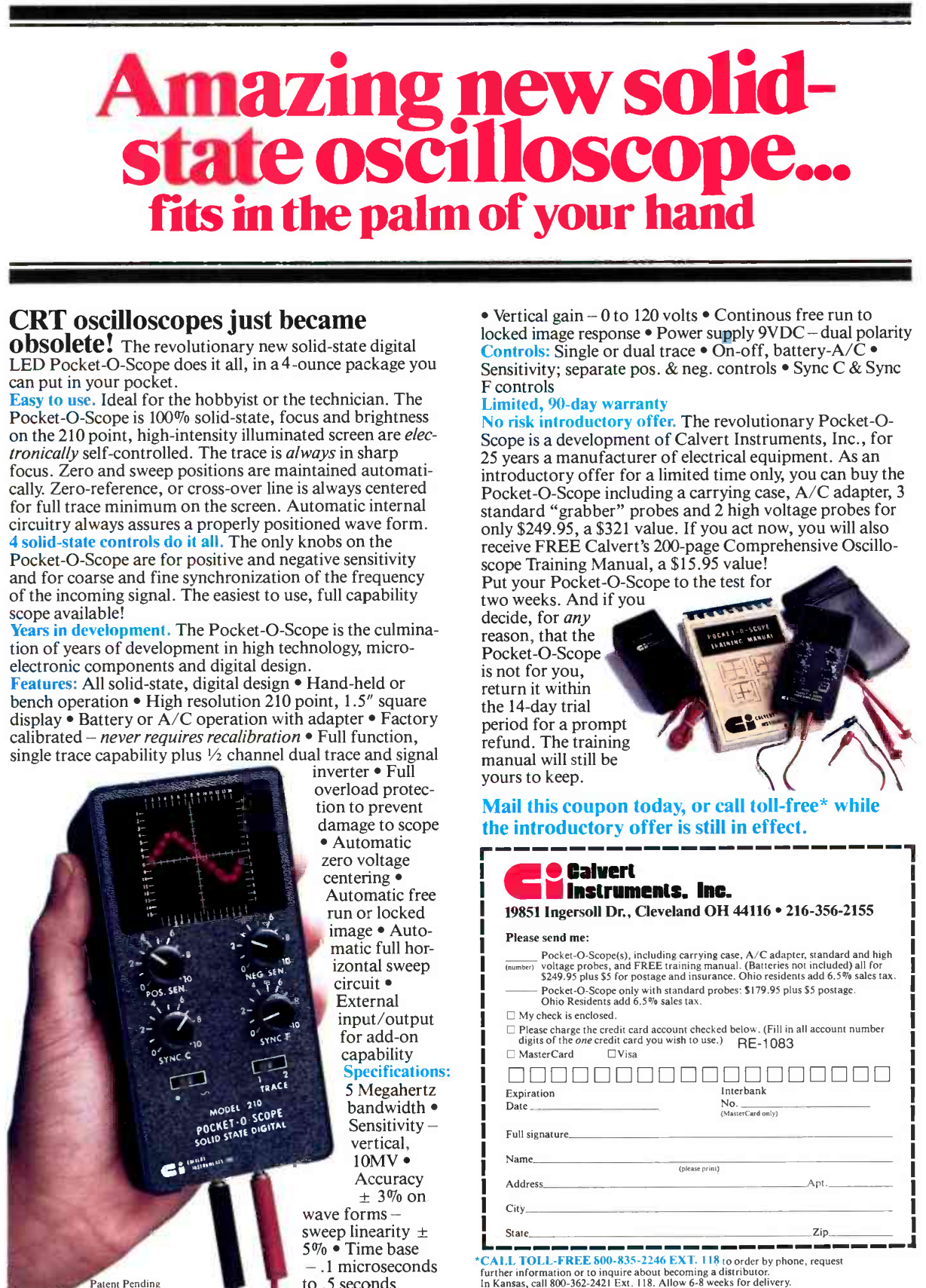
In the 1980s, an oscilloscope was typically a bulky affair with a large CRT, and a heavy power supply. So it probably grabbed a lot of attention in 1983 when Calvert Instruments Incorporated ran an ad in magazines like Radio Electronics. The ad touted a 5 MHz scope that was pocket-sized and weighed 4 ounces. The ad proudly proclaimed: CRT oscilloscopes just became obsolete!

Indeed they would, but if you are wondering who Calvert Instruments was, so are we. We have never heard of them before or since, and we don’t know for certain if any of these devices were ever actually produced. What did it use instead of a CRT? The CI Model 210 Pocket-O-Scope was not only solid state but used an LED screen 1.5 inches square. That’s small, but it packed in 210 LEDs for “high resolution.” We assume that was also the genesis of the model number. Judging from the product picture, there were 14 LEDs in the X direction and 15 in the Y direction. High resolution, for sure!

There were some early LCD scopes (like the Iskrascope and one from Scopex) around the same time, but it would be the 1990s before we would see LCD oscilloscopes and even longer before CRTs were totally squeezed out.

Continue reading “Retro Gadgets: The 1983 Pocket Oscilloscope”

Hackaday Podcast 214: Jet Engine Hair Dryer, Comic Sans Type Balls, And Belief In Graphene

This week, Editor-in-Chief Elliot Williams and Contributor Emeritus Kristina Panos gushed about all the best hacks of the previous week. But first, a contest! That’s right — hot on the heels of the Low Power Challenge comes the Op Amp Challenge, sponsored by Digi-Key. You have between now and June 6th to dip your toes into the warm waters of analog and show us what you’ve got. Will it be a musical hack? Will you seek high analog precision? We can’t wait to see.

Kristina definitely did not get What’s That Sound this week, which honestly reminded her of a cartoon character getting a piano dropped on them, except the sounds were in reverse order. Then it’s on to the hacks, beginning with a way to make an IBM Selectric typewriter use Comic Sans, a project that’s sure to make you a believer in graphene, and a miniature MNT for every (cargo) pocket.

From there we take a look at a really cool indicator from a 1960s RAF aeroplane and investigate why your multimeter might be lying to you. Finally, we discuss the gargantuan task of building an AR system to rival Google Glass, and the merits of taking a lot of pictures as you go about your hacks.

Check out the links below if you want to follow along, and as always, tell us what you think about this episode in  the comments!

Download and savor at your leisure.

Continue reading “Hackaday Podcast 214: Jet Engine Hair Dryer, Comic Sans Type Balls, And Belief In Graphene”

Congratulations Low-Power Winners

Congratulations to the winners of the 2023 Hackaday.io Low Power Contest! We challenged you to show us how much you could do with how little, and you did not disappoint. Our judges have put their heads together, and thanks to Digi-Key, our contest sponsor, the top three entries will be taking home a $150 gift certificate for yet more hacking supplies.

We saw a great diversity of ideas here, all on the low-power theme. So without further ado…

The Prize Winners

[Christoph]’s Ultra Low Power RF-Sensor arose out of necessity. Having just repaired a shower drain, he couldn’t be sure that it wouldn’t start leaking again at some point in the future, but couldn’t go ripping up the floor under the shower tray every week to check. He needed a remote moisture sensor that would do the job for a long time with no intervention.

This superb solution combines an Atmel ATmega328P, an HDC1080 humidity sensor, a 433 MHz radio transmitter, and an RTC to keep power consumption super-low when everything else is shut down. Idling at 600 nA total most of the time, taking a reading every 15 minutes, this device should last for 12 years, and it’s been installed and running for five so far, so we’d say that it’s already proven itself very worthy of taking home the prize here.

[BleakyTex]’s Compact, low-power Geiger counter is absolutely the lowest power Geiger counter we’ve ever seen and maybe also the cutest. With the ambitious goal of running up to two years on two tiny LR44 batteries and a proven runtime of about six months by now, this is the radiation detector you can take with you every day, should you need to. The key is a custom HV section that’s designed for efficiency and the screen – even today, it’s still hard to beat the low power consumption of the humble LCD screen. All this, and it still makes those satisfying clicks when it’s enabled. [BleakyTex] says he might make a kit from this, and we absolutely hope he does!

[mircemk]’s Microwatt Pulse Motor took one of our suggestions in the announcement of the contest and ran with it. This eight-pole handmade electric motor doesn’t actually do anything other than spin, but it does that when hooked up to a literal potato. Pulling around 40 mA at 600 mV, it can easily run on solar power with enough power left over to charge up a battery for when the sun doesn’t shine. All of this is made with extremely simple circuitry and parts scavenged from old relays with a sewing needle held up by a magnet for the bearing. This is pure ingenuity and a sweet low-power demo.

Continue reading “Congratulations Low-Power Winners”