Steamy Hack Chat Vents Some High Pressure Wisdom

Ask the average person about steam power and they’ll probably imagine a bygone era, a time when the sky was thick with smoke belched out by coal-burning locomotives and paddle-wheel ships. Steam is ancient technology they’ll say, and has as much to do with modern living as the penny-farthing.

Naturally, the real story is a bit more complex than that. Sure the reciprocating steam engine has fallen out of favor as a means of propulsion, but the concept of running machinery with steam is alive and well. In fact, unless you’re running on wind or solar power, there’s an excellent chance that a steam turbine is responsible for keeping the lights on in your house.

In honor of all things steam, we invited Quinn Dunki to host this week’s Hack Chat. Those who follow her exploits on YouTube will know that over the last several years she’s built a number of steam engines, from miniature scratch-built models to commercial kits that can do useful work. Who better to answer your burning steaming questions?

The first questions in the Chat were logical enough, with several users wanting to know just how hard it is to build a functional steam engine if you don’t have access to a mill or other means of high precision machining. According to Quinn, while better equipment will certainly allow you to build a more powerful and efficient engine, the basic premise is so simple that it doesn’t take much to get one going. If you’ve got a mini lathe and some bar stock, you’re half way there. In fact, they are so forgiving that she opines you’d struggle to build a steam engine that didn’t at least turn over — though that doesn’t mean it will necessarily run well.

Naturally some comparisons were drawn between the complexity of building a steam engine and putting together a small internal combustion engine (ICE). But while they might seem conceptually similar, Quinn cautions that building a working ICE from scratch is far more difficult and dangerous. She explains that steam engines have a tendency to fail gracefully, that is, mistakes in the design or poor tolerances generally result in little worse than wasted steam and extra noise. Comparatively, a faulty ICE design could easily turn into a bomb on your workbench.

Of course, that’s not to say working with steam is without danger. You certainly don’t want to underestimate high pressure steam, which is why boilers that are over 6 in (15 cm) in diameter or that produce more than 100 PSI will often require the operator to be licensed. They may also need to be inspected, though Quinn notes that your local government official probably won’t be able to make heads or tails of your homebrew build — so if you need an official stamp of approval, your best bet is to find a local model engineering club or society that would have the appropriate connections. All that being said, most hobbyists make it a point to try and get their engine running at the lowest pressure possible, so unless you’ve got something really massive in mind, you’ll probably never need to build up more than 60 PSI or so.

A DIY electric boiler and small steam engine.

Another topic of discussion was how to fuel the boiler itself. An electrically powered boiler is perhaps the easiest option, but is somewhat counterproductive if you hope to put your steam engine to useful work. Coal and wood fires are an option, and indeed were commonly used in the old days, but the soot and ash they produce can be a problem.

Quinn also notes that if you’re using such fuels, you need a way to quickly remove the firebox from the boiler in an emergency; something she likens to the starship Enterprise having to eject its warp core before it explodes. For her own projects, Quinn says she uses either an electric element or a camping gas burner.

While most of the questions during this Hack Chat had to do with the work Quinn has already featured on her blog and YouTube channel, naturally there were questions about where things go from here. After she completes the steam engine kit she’s working on currently, she says she’ll likely to back to another scratch-built engine. She also plans on coupling some of her engines to generators, as she’s gotten many requests about seeing these machines put to useful work. Looking further ahead Quinn says she’s interested in casting her own bronze and aluminum components, and specifically wants to work with “lost PLA” casting, which is a variant of lost wax casting that uses a mold based on a 3D printed part.

We’d like to thank Quinn Dunki for stopping by the Hack Chat and sharing some insights into this unique hobby. While a handcrafted boiler or a desktop steam reciprocating engine might not be on the average Hackaday reader’s list of future projects, it’s still fascinating to see how they work. We owe much of our modern life to steam power, so the least we can do is show it some respect.


The Hack Chat is a weekly online chat session hosted by leading experts from all corners of the hardware hacking universe. It’s a great way for hackers connect in a fun and informal way, but if you can’t make it live, these overview posts as well as the transcripts posted to Hackaday.io make sure you don’t miss out.

Hackaday Podcast 182: Sparkpunk Photography, Anti-Xiomi Air Filters, And Keyfob Foibles

Editor-in-Chief Elliot Williams and Managing Editor Tom Nardi are here to bring you the best stories and hacks from the previous week (and maybe a little older). Things kick off with news that the Early Bird tickets for the 2022 Hackaday Supercon tickets sold out in only two hours — a good sign that the community is just as excited as we are about the November event. But don’t worry, regular admission tickets are now available for those who couldn’t grab one out of the first batch.

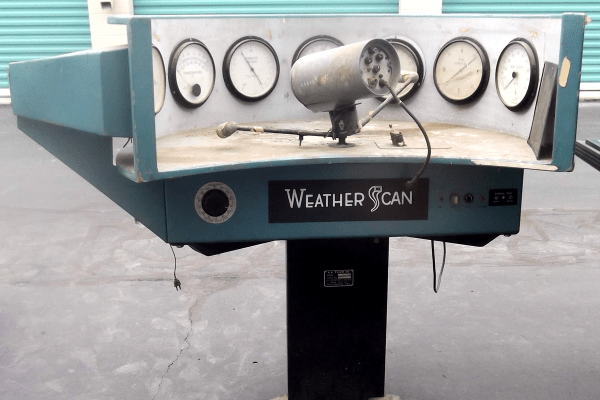
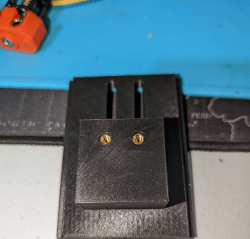
This week there’s plenty of vehicular hacks to talk about, from John Deere tractors running DOOM to a particularly troublesome vulnerability found in many key fobs. We’ll also lament about the state of 3D CAD file formats, marvel at some retro-futuristic photography equipment, and look at the latest in home PCB production techniques. Wrapping things up there’s a whole lot of cyberdeck talk, and a trip down silicon memory lane courtesy of Al Williams.

Direct download it for yourself right here.

Check out the links below if you want to follow along, and as always, tell us what you think about this episode in the comments!

Continue reading “Hackaday Podcast 182: Sparkpunk Photography, Anti-Xiomi Air Filters, And Keyfob Foibles”

This Week In Security: Secure Boot Bypass, Attack On Titan M, KASLR Weakness

It’s debatable just how useful Secure Boot is for end users, but now there’s yet another issue with Secure Boot, or more specifically, a trio of signed bootloaders. Researchers at Eclypsium have identified problems in the Eurosoft, CryptoPro, and New Horizon bootloaders. In the first two cases, a way-too-flexible UEFI shell allows raw memory access. A startup script doesn’t have to be signed, and can easily manipulate the boot process at will. The last issue is in the New Horizon Datasys product, which disables any signature checking for the rest of the boot process — while still reporting that secure boot is enabled. It’s unclear if this requires a config option, or is just totally broken by default.

The real issue is that if malware or an attacker can get write access to the EFI partition, one of these signed bootloaders can be added to the boot chain, along with some nasty payload, and the OS that eventually gets booted still sees Secure Boot enabled. It’s the perfect vehicle for really stealthy infections, similar to CosmicStrand, the malicious firmware we covered a few weeks ago.
Continue reading “This Week In Security: Secure Boot Bypass, Attack On Titan M, KASLR Weakness”

Chips Remembered: The Scenix/Ubicom/Parallax SX

If you are a bibliophile, going to a used bookstore is a distinctly pleasant experience. Sure, you might discover an old book that you want to read. But at least some of the endorphin rush comes from seeing old friends. Not humans, but books you read years or even decades ago. Most often, you don’t buy the book — you probably have one stashed in a box somewhere. But it is a happy feeling to see an old friend and maybe thumb through it reading a passage or two among shelves of musty books. I wish we had something like that for chips. Outside of a few notable exceptions, chips tend to have a short life span of popularity and then give way to other chips. This is especially true of CPUs. One that I especially miss is the Scenix/Ubicom/Parallax SX chip.

I had a bookstore-like experience with this processor the other day. I produced a few products based around these chips and I have a small stash of them left. I jealously guard the hardware needed to program them “just in case.” Well, naturally, someone needed a few for some reason so I had to dig it all up. Knowing these might be some of the last of the unprogrammed SX chips in the world made me a little nostalgic.

The Story

In the late 1990s, a company called Scenix started producing a microcontroller called the SX in a few footprint sizes. So the SX18 was, for example, an 18-pin part. By 1999, they were already in full swing with the SX18 and SX28 and they introduced the SX52.

Of course, a lot of companies produced microcontrollers. The Scenix offering was a bit special. In those days, the Microchip PIC was the king of the hill. The PIC is an odd beast that evolved from a very limited controller made to be small and inexpensive. Notably, while it could support relatively high clock frequencies — 20 MHz was common — each normal instruction took 4 clock cycles. So when your crystal said 20 MHz, you were running instructions at 5 MHz.

Continue reading “Chips Remembered: The Scenix/Ubicom/Parallax SX”

We’re Hiring: Come Join Us!

You wake up in the morning, and check Hackaday over breakfast. Then it’s off to work or school, where you’ve already had to explain the Jolly Wrencher to your shoulder-surfing colleagues. And then to a hackspace or back to your home lab, stopping by the skull-and-cross-wrenches while commuting, naturally. You don’t bleed red, but rather #F3BF10. It’s time we talked.

The Hackaday writing crew goes to great lengths to cover all that is interesting to engineers and enthusiasts. We find ourselves stretched a bit thin and it’s time to ask for help. Want to lend a hand while making some extra dough to plow back into your projects? We’re looking for contributors to write a few articles per week and keep the Hackaday flame burning.

Contributors are hired as private contractors and paid for each article. You should have the technical expertise to understand the projects you write about, and a passion for the wide range of topics we feature. You’ll have access to the Hackaday Tips Line, and we count on your judgement to help us find the juicy nuggets that you’d want to share with your hacker friends.

If you’re interested, please email our jobs line (jobs at hackaday dot com) and include:

  • One example article written in the voice of Hackaday. Include a banner image, at least 150 words, the link to the project, and any in-links to related and relevant Hackaday features. We need to know that you can write.
  • Details about your background (education, employment, interests) that make you a valuable addition to the team. What do you like, and what do you do?
  • Links to your blog/project posts/etc. that have been published on the Internet, if any.

What are you waiting for? Ladies and Gentlemen, start your applications!

Ask Hackaday: How Can You Store Energy At Home?

Amidst the discussions about grid-level energy storage solutions, it is often easy to forget that energy storage can be done on the level of a single house or building as well. The advantages here are that no grid management is needed, with the storage (electrical, thermal, etc.) absorbing the energy as it becomes available, and discharging it when requested. This simplifies the scale of the problem and thus the associated costs significantly.

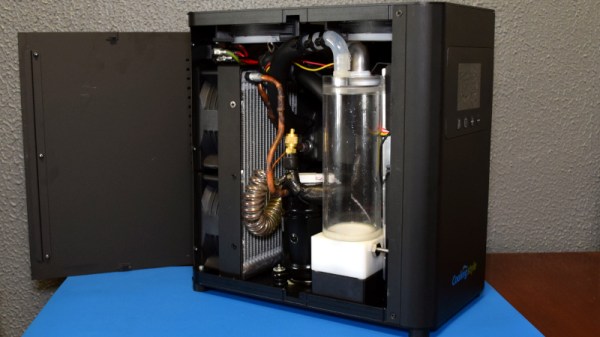
Perhaps the most common examples of such systems are solar thermal collectors with an associated hot water storage tank, and of course batteries. More recently, the idea of using a battery electric vehicle (BEV, ‘electric car’) as part of a home storage solution is also gaining traction, especially for emergencies where the grid connection has failed due to a storm or similar emergencies. But all-in-all, we don’t see many options for home-level energy storage.

Continue reading “Ask Hackaday: How Can You Store Energy At Home?”

Steam Power Hack Chat

Join us on Wednesday, August 17 at noon Pacific for the Steam Power Hack Chat with Quinn Dunki!

The steam power age may be behind us now, but that doesn’t mean that the engineering that went into steam engines isn’t worth exploring. In a lot of ways, the steam age is what made modern engineering what we know it as today. Where wind- and water-powered devices could often work well enough with a couple of inches of tolerance, steam engines required parts measured to the hundredth or even thousandth of an inch. Optimizing steam engines required a deep understanding of thermodynamics, too, which unveiled more about the way the universe works than had ever been realized before. And the need for parts strong enough to withstand steam pressure and the lubricants needed to keep the wheels turning paved the way for advances in materials science and chemical engineering that are still paying dividends today.

Celebrating the achievements of steam power may seem anachronistic, but in light of everything steam has done for us, it makes a lot of sense. And that’s not to mention the cool aesthetics of steam engines, with beefy castings and brass parts sliding back and forth, complicated linkages doing who-knows-what to make the engine work on nothing more than a little bit of boiling water. There’s the attraction of danger, too; improperly built boilers can be a disaster, so building one that’s safe to use can be quite a challenge.

join-hack-chatAll this and more is what the steam hobby is all about, an area that Quinn Dunki has been exploring for a while now. Over on her YouTube channel, Quinn has documented the process of turning raw metal into a working steam engine and boiler, and is currently working on a bigger, more powerful engine. We’ve invited her on the Hack Chat to talk about all things steam — where to get started in the hobby, what kinds of things you can learn by building your own steam engines, and how her current builds are going. If you’ve ever wanted to explore steam power, here’s your chance to ask a real steam aficionado.

Our Hack Chats are live community events in the Hackaday.io Hack Chat group messaging. This week we’ll be sitting down on Wednesday, August 17 at 12:00 PM Pacific time. If time zones have you tied up, we have a handy time zone converter.