Homemade Integrated Circuits Hack Chat

Join us on Wednesday, August 14th at noon Pacific for the Homemade Integrated Circuits Hack Chat with Sam Zeloof!

While most of us are content to buy the chips we need to build our projects, there’s a small group of hackers more interested in making the chips themselves. What it takes the big guys a billion-dollar fab to accomplish, these hobbyists are doing with second-hand equipment, chemicals found in roach killers and rust removers, and a lot of determination to do what no DIYer has done before.

Sam Zeloof is one of this dedicated band, and we’ve been following his progress for years. While he was still in high school, he turned the family garage into a physics lab and turned out his first simple diodes. Later came a MOSFET, and eventually the Z1, a dual-differential amp chip that is the first IC produced by a hobbyist using photolithography.

Sam just completed his first year at Carnegie-Mellon, and he’s agreed to take some precious summer vacation time to host the Hack Chat. Join us as we learn all about the Z1, find out what improvements he’s made to his process, and see what’s next for him both at college and in his own lab.

join-hack-chatOur Hack Chats are live community events in the Hackaday.io Hack Chat group messaging. This week we’ll be sitting down on Wednesday, August 14 at 12:00 PM Pacific time. If time zones have got you down, we have a handy time zone converter.

Click that speech bubble to the right, and you’ll be taken directly to the Hack Chat group on Hackaday.io. You don’t have to wait until Wednesday; join whenever you want and you can see what the community is talking about.

What Happens To Tesla When The Sleeping Auto Giants Awake?

The history of automotive production is littered with the fallen badges of car companies that shone brightly but fell by the wayside in the face of competition from the industry’s giants. Whether you pine for an AMC, a Studebaker, or a Saab, it’s a Ford or a Honda you’ll be driving in 2019.

In the world of electric cars it has been a slightly different story. Though the big names have dipped a toe in the water they have been usurped by a genuinely disruptive contender. If you drive an electric car in 2019 it won’t be that Ford or Honda, it could be a Nissan, but by far the dominant name in EV right now is Tesla.

Motor vehicles are standing at the brink of a generational shift from internal combustion to electric drive. Will Tesla become the giant it hopes, or will history repeat itself?

Continue reading “What Happens To Tesla When The Sleeping Auto Giants Awake?”

Hackaday Links Column Banner

Hackaday Links: August 11, 2019

By the time this goes to press, DEFCON 27 will pretty much be history. But badgelife continues, and it’d be nice to have a way of keeping track of all the badges offered. Martin Lebel stepped up to the challenge with a DEF CON 27 badgelife tracker. He’s been tracking the scene since March, and there are currently more than 170 badges, tokens, and shitty add-ons listed. Gotta catch ’em all!

Nice tease, Reuters. We spotted this story about the FAA signing off on beyond-visual-line-of-sight, or BVLOS, operation of a UAV. The article was accompanied by the familiar smiling Amazon logo, leading readers to believe that fleets of Amazon Prime Air drones would surely soon darken the skies with cargoes of Huggies and Tide Pods across the US. It turns out that the test reported was conducted by the University of Alaska Fairbanks along an oil pipeline in the Last Frontier state, and was intended to explore medical deliveries and pipeline surveillance for the oil industry. The only mention of Amazon was that the company reported they’d start drone deliveries in the US “in months.” Yep.

Ever wonder what it takes to get your widget into the market? Between all the testing and compliance requirements, it can be a real chore. Nathaniel tipped us off to a handy guide written by his friend Skippy that goes through the alphabet soup of agencies and regulations needed to get a product to market – CE, RoHS, WEEE, LVD, RED, CE for EMC. Take care of all that paperwork and you’ll eventually get a DoC and be A-OK.

A French daredevil inventor made the first crossing of the English Channel on a hoverboard on Sunday. Yes, we know it’s not an “actual” hoverboard, but it’s as close as we’re going to get with the physics we have access to right now, and being a stand-upon jet engine powered by a backpack full of fuel, it qualifies as pretty awesome. The report says it took him a mere 20 minutes to make the 22-mile (35-km) crossing.


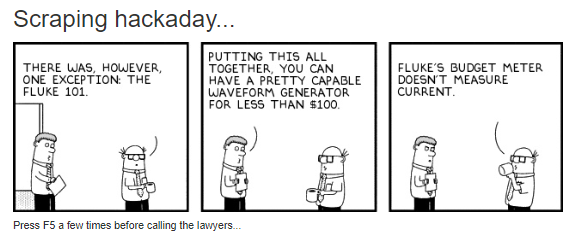
We had a grand time last week around the Hackaday writing crew’s secret underground lair with this delightful Hackaday-Dilbert mashup-inator. Scroll down to the second item on the page and you’ll see what appears to be a standard three-panel Dilbert strip; closer inspection reveals that the text has been replaced by random phrases scraped from a single Hackaday article. It looks just like a Dilbert strip, and sometimes the text even makes sense with what’s going on in the art. We’d love to see the code behind this little gem. The strip updates at each page load, so have fun.

And of course, the aforementioned secret headquarters is exactly what you’d picture – a dark room with rows of monitors scrolling green text, each with a black hoodie-wearing writer furiously documenting the black arts of hacking. OpenIDEO, the “open innovation practice” of global design company IDEO, has issued a challenge to “reimagine a more compelling and relatable visual language for cybersecurity.” In other words, no more scrolling random code and no more hoodies. Do you have kinder, gentler visual metaphors for cybersecurity? You might win some pretty decent prizes for your effort to “represent different terms and ideas in the cybersecurity space in an accessible and compelling way.”

Eric Weinhoffer Covers Enclosure Design And Manufacturing Tech During Hackaday Prize Mentor Session

Eric Weinhoffer has had plenty of experience in the product design arena, and this hard-earned knowledge is readily apparent in his mentor session for The Hackaday Prize. These serve to link up Prize entrants with industry experts in order to help them take their projects into production. You still have time to get in on the 2019 Hackaday Prize which is accepting entries until August 25th.

Eric’s work as a Prototype Engineer at Bolt stands him in good stead to deliver valuable advice on manufacturing techniques and prototyping. With projects as diverse as CNC milling machiness and ISS payloads under his belt, Eric was able to help out these entrants with a series of tricky problems that will be familiar to anyone who has tried to take a project out of the lab and into the market.

Let’s take a look at the projects and the advice that were shared during this session.

Continue reading “Eric Weinhoffer Covers Enclosure Design And Manufacturing Tech During Hackaday Prize Mentor Session”

Hackaday Podcast 030: Seven Years Of RTL-SDR, 3D Printing Optimized For The Eye, Sega Audiophile, Swimming In Brighteners

Hackaday Editors Mike Szczys and Elliot Williams curate the awesome hacks from the past week. On this episode, we marvel about the legacy RTL-SDR has had on the software-defined radio scene, turn a critical ear to 16-bit console audio hardware, watch generative algorithms make 3D prints beautiful, and discover why printer paper is so very, very bright white.

Take a look at the links below if you want to follow along, and as always tell us what you think about this episode in the comments!

Take a look at the links below if you want to follow along, and as always, tell us what you think about this episode in the comments!

Direct download (60 MB or so.)

Continue reading “Hackaday Podcast 030: Seven Years Of RTL-SDR, 3D Printing Optimized For The Eye, Sega Audiophile, Swimming In Brighteners”

This Week In Security: SWAPGS, Malicious Shaders, More IOS Woes, And WPA3

I’m sure you’ve heard of Spectre, which was the first of many speculative execution vulnerabilities found in modern processors. A new one just popped up this week. At Blackhat on Tuesday, CVE-2019-1125 was announced by Bitdefender as SWAPGS.

SWAPGS is an x86_64 instruction that is intended for use in context switching, that is when execution is transferred from a user-space program back into the kernel. Specifically, SWAPGS swaps the value of the GS register so that it refers to either a memory location in the running application, or a location in the kernel’s space. An unprivileged program can attempt to call this instruction and leak kernel memory contents as a result of the processor speculatively executing the instruction (this is similar to Spectre). Even though the instruction will ultimately not be executed, because a userspace program doesn’t have sufficient privilege to do so, the contents of the system cache have already been sufficiently altered, and an attack could feasibly leverage this to read arbitrary kernel memory.

While the initial reports have mentioned both AMD and Intel products, AMD has released a statement:

AMD is aware of new research claiming new speculative execution attacks that may allow access to privileged kernel data. Based on external and internal analysis, AMD believes it is not vulnerable to the SWAPGS variant attacks because AMD products are designed not to speculate on the new GS value following a speculative SWAPGS. For the attack that is not a SWAPGS variant, the mitigation is to implement our existing recommendations for Spectre variant 1.

Patches for Windows and Linux have been released, and Red Hat has an informative write-up on the vulnerability. I would have reviewed Bitdefender’s whitepaper on the vulnerability, but rather than make it freely available, they have opted to require a name and email address. While I would like to see their work, I refuse to sell my contact information in exchange for access.

A Malicious Shader?

This is the first time I can remember hearing of a malicious pixel shader. Cisco Talos announced a set of vulnerabilities targeting VMware and NVIDIA graphics drivers.

Shaders are specialized programs that run on a video card, and are generally used to apply effects like blur, lighting, bump mapping, and more. Most of the graphical improvements in the last few years of gaming is a result of shaders.

Talos researchers were specifically looking at how to compromise a VM Hyper-visor from inside a guest OS, and they discovered that when a host provides 3d acceleration to the guest, shaders are passed directly through to the system drivers without verification. Because the NVIDIA drivers are also vulnerable, this could allow a malicious program on the host to run arbitrary code on the hypervisor.

While this is troubling enough, the topper is that a malicious shader could potentially be run via WebGL. Taken together, this represents a real danger where simply loading a malicious WebGL enabled page could compromise not only a conventional machine, but could also compromise the bare-metal OS even when run on a guest instance.

Both NVIDIA and VMware have already released driver updates that fixes the flaw, so go update!

iOS Problems

Natalie Silvanovich of Google’s Project Zero released a set of 5 iOS vulnerabilities on Wednesday the 7th. These are not garden variety bugs, but so-called “zero click” problems where no user interaction is required for exploit.

The first exploit, for example, is a spoofed visual voicemail message. Visual voicemail notifications are sent as specially formatted text messages and contain information about the message and the address of an IMAP server to connect to and download the message. That information can be spoofed, leading a device to try to download a message from an IMAP server in the control of an attacker. From that point, finding a bug in the iOS IMAP handling code was relatively easy.

5 vulnerabilities have been fixed in iOS updates. There is a 6th vulnerability, CVE-2019-8641, that has yet to be fixed. While a few hints about this problem are given, the details have been withheld until an update has been released to fully fix the problem. One could be a bit cynical and point out that it’s the Google research team announcing these flaws. While there is certainly a self-serving angle to consider, it’s much better for iOS and consumers if flaws are fixed and publicized, rather than kept secret and sold to an offensive security vendor.

One more iOS story is Apple Bleee. Bluetooth Low Energy is an extremely useful communication protocol, allowing Apple devices to perform many of their seemingly magic functionality. The downside is that to make the magic happen, iOS devices are constantly sending BLE signals, probing for other devices. The researchers at Hexway realized that these signals leak lots of data about your device, potentially including your phone number.

iOS uses a SHA256 hash of the device’s phone number as an identifier when using AirDrop. A SHA256 is still a reasonably secure one-way hash, so there’s no problem, right? The clever realization is that while the hash is secure, and the output space is too large to attack, the input space is small enough to be manageable. An attacker could target the most common area codes in their area, limiting the target space further. From there, the SHA256 hashes for all valid numbers can be pre-calculated and stored in a lookup table.

More WPA3 Problems

We’ve discussed Dragonblood, a WPA3 analysis project. A new problem has been identified, a timing analysis attack that leaks information about the internal state of the encryption algorithm.


Espionage On Display As GCHQ Hosts A Temporary Exhibit

At the top of the British electronic intelligence agency is the Government Communications Headquarters (GCHQ), a very public entity whose circular building can easily be found by any inquisitive soul prepared to drive just off the A40 in Cheltenham which is about two hours west of London. But due to the nature of its work it is also one of the most secretive of UK agencies, from which very little public information is released. With over a century of history behind it and with some truly groundbreaking inventions under its belt it is rumoured to maintain a clandestine technology museum that would rewrite a few history books and no doubt fascinate the Hackaday readership.

Perhaps the most famous of all its secrets was the wartime Colossus, the first all-electronic stored program digital computer, which took an unauthorised book in the 1970s to bring to public attention. Otherwise its historical artifacts have been tantalisingly out-of-reach, hinted at but never shown.

A temporary exhibition at the Science Museum in London then should be a must-visit for anyone with an interest in clandestine technology. Top Secret: From ciphers to cyber security occupies the basement gallery, and includes among other exhibits a fascinating selection of artifacts from the Government agency. On a trip to London I met up with a friend, and we went along to take a look.

Continue reading “Espionage On Display As GCHQ Hosts A Temporary Exhibit”