These Twenty Projects Won The Musical Instrument Challenge In The Hackaday Prize

The Hackaday Prize is the greatest hardware competition on the planet. It’s the Academy Awards of Open hardware, and over the past few months we’ve challenged makers and artists to create the Next Big Thing. All things must come to an end, though, and last week we wrapped up the final challenge in the Hackaday Prize. The results were fantastic, with over one hundred entries to the Musical Instrument Challenge. Now, we’re ready to announce the winners.

Over the past few months, we’ve been running a series of five challenges, and picking the best twenty projects to come out of these challenges. The Musical Instrument Challenge was the final challenge in The Hackaday Prize, and now we’re happy to announce the winners. These projects have been awarded a $1,000 cash prize, and they’re moving onto the final round where one lucky winner will receive the Grand Prize of $50,000. Here are the winners of the Musical Instrument Challenge, in no particular order:

Musical Instrument Challenge Hackaday Prize finalists:

Continue reading “These Twenty Projects Won The Musical Instrument Challenge In The Hackaday Prize”

Cool Tools: Deus Ex Autorouter

The first thing you probably asked yourself when learning how to lay out PCBs was “can’t the computer do this?” which inevitably led to the phrase “never trust the autorouter!”. Even if it hooks up a few traces the result will probably be strange to human eyes; not a design you’d want to use.

But what if the autorouter was better? What if it was so far removed from the autorouter you know that it was something else? That’s the technology that JITX provides. JITX is a company that has developed new tools that can translate a coarse textual specification of a board to KiCAD outputs autonomously.

Continue reading “Cool Tools: Deus Ex Autorouter”

The Incredible Judges Of The Hackaday Prize

The last challenge of The Hackaday Prize has ended. Over the past few months, we’ve gotten a sneak peek at over a thousand amazing projects, from Open Hardware to Human Computer Interfaces. This is a contest, though, and to decide the winner, we’re tapping some of the greats in the hardware world to judge these astonishing projects.

Below are just a preview of the judges in this year’s Hackaday Prize. In the next few weeks, we’ll be sending the judging sheets out to them, tallying the results, and in just under a month we’ll be announcing the winners of the Hackaday Prize at the Hackaday Superconference in Pasadena. This is not an event to be missed — not only are we going to hear some fantastic technical talks from the hardware greats, but we’re also going to see who will walk away with the Grand Prize of $50,000.



Sherry Huss

Sherry Huss is the former vice president of Maker Media, and oversees the publishing of Make Magazine and Maker Faires across the globe. Sherry is a major advocate of ‘all things maker’ in the global community, and her vision and passion for the maker movement was instrumental in growing the Make: brand within the maker ecosystem. Under her guidance, the largest Maker Faires, the Bay Area and World Maker Faire in New York, have grown from just a few thousand people in 2006 to events with over 200,000 attendees each year. Sherry is a giant in the Maker world, and an unending advocate of maker, DIY, and everyone who makes, whether that’s through wood, code, metal, solder, or fabric.

Anool Mahidharia

Anool is an electrical engineer, and works in Test & Measurement at Lumetronics. He’s part of WyoLum, an international group of hardware nerds who are consistently pumping out projects that push the limits of how blinky, glowey, and interesting a thing can be. They’re behind some projects you may have caught at random hacker meetups, and the creators of an absurd RGB LED cube that’s also a die. Anool is, by every account, an extremely capable hardware engineer, a longtime writer for Hackaday, and is constantly travelling the world presenting the latest developments in electronics to the public.

Danielle Applestone

Before founding Other Machine Co., now Bantam Tools, makers of tiny desktop milling machines that make fantastic circuit boards, Danielle Applestone worked with DARPA to develop high-precision machines that were effectively made out of kitchen cutting boards. HDPE, it turns out, is extraordinarily mechanically stable, cuts and machines easily, and can make very rigid components. Danielle spun this research out into the Othermill, an actual successful hardware startup. Danielle talked about this experience at the Hackaday Superconference, and we’re thrilled to have her on board judging other makers in their efforts to create the next big hardware thing.

Kwabena Agyeman

Kwab is one of the leading experts in computer vision and machine learning applications, and specializes in FPGA and Chip design. His greatest contribution to Open Hardware is the OpenMV, a platform for Computer Vision, ‘at the edge’, or basically a very high performance microcontroller and camera module on a single board, that’s running computer vision algorithms. This project began as a Hackaday Prize project that was then bootstrapped into a successful business. Formerly of Planet Labs where he spent his time pulling off Apollo 13-level hacks on space assets, Kwab is among the most successful designers in the world of Open Hardware.

These are just a few of the amazingly accomplished judges we have lined up to determine the winner of this year’s Hackaday Prize. The winner will be announced on November 3rd at the Hackaday Superconference. There are still tickets available, but if you can’t make it, don’t worry. We’re going to be live streaming everything, including the prize ceremony, where one team will walk away with the grand prize of $50,000. It’s not an event to miss.


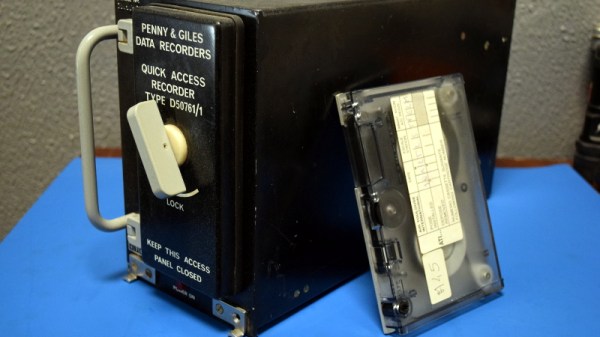
Teardown: D50761 Aircraft Quick Access Recorder

Everyone’s heard of the “black box”. Officially known as the Flight Data Recorder (FDR), it’s a mandatory piece of equipment on commercial aircraft. The FDR is instrumental in investigating incidents or crashes, and is specifically designed to survive should the aircraft be destroyed. The search for the so-called “black box” often dominates the news cycle after the loss of a commercial aircraft; as finding it will almost certainly be necessary to determine the true cause of the accident. What you probably haven’t heard of is a Quick Access Recorder (QAR).

While it’s the best known, the FDR is not the only type of recording device used in aviation. The QAR could be thought of as the non-emergency alternative to the FDR. While retrieving data from the FDR usually means the worst has happened, the QAR is specifically designed to facilitate easy and regular access to flight data for research and maintenance purposes. Its data is stored on removable media and since the QAR is not expected to survive the loss of the aircraft it isn’t physically hardened. In fact, modern aircraft often use consumer-grade technology such as Compact Flash cards and USB flash drives as storage media in their QAR.

Through the wonders of eBay, I recently acquired a vintage Penny & Giles D50761 Quick Access Recorder. This was pulled out of an aircraft which had been in service with the now defunct airline, Air Toulouse International. Let’s crack open this relatively obscure piece of equipment and see just what goes into the hardware that airlines trust to help ensure their multi-million dollar aircraft are operating in peak condition.

Continue reading “Teardown: D50761 Aircraft Quick Access Recorder”

Hackaday Links: October 14, 2018

Here’s something of interest of 3D printing enthusiasts. How do you print lightweight 3D objects? [Tom Stanton] does a lot of stuff with 3D printing and RC airplanes, so yeah, he’s probably the guy you want to talk to. His solution is Simplify3D, printing two layers for whatever nozzle diameter you have, some skills with Fusion360, and some interesting design features that include integrated ribs.

Moog released their first polyphonic analog synth in 35 years. It’s massive, and it costs eight thousand dollars.

There’s a RISC-V contest, sponsored by Google, Antmicro, and Microchip. The goal is to encourage designers to create innovative FPGA and soft CPU implementations with the RISC-V ISA. There are four categories, the smallest implementation for SpartFusion2 or IGLOO2 boards, and the smallest implementation that fits on an iCE40 UltraPlus board. The two additional categories are the highest performance implementation for these boards. The prize is $6k.

” I heard about polarization filters and now I’m getting a hundred thousand dollars” — some moron. IRL Glasses are glasses that block screens. When you wear them, you can’t watch TV. This is great, as now all advertising is on TVs for some inexplicable reason, and gives these people an excuse to use frames from John Carpenter’s masterpiece They Live in their Kickstarter campaign. Question time: why don’t all polarized sunglasses do this. Because there’s a difference between linear and circular polarized lenses. Question: there have been linear polarized sunglasses sitting in the trash since the release of James Cameron’s Avatar. Why now? No idea.

Alexa is on the ESP32. Espressif released their Alexa SDK that supports conversations, music and audio serivces (Alexa, play Despacito), and alarms. The supported hardware is physically quite large, but it can be extended to other ESP32-based platforms that have SPI RAM.

Retrotechtacular: Robots And Bowling Pins

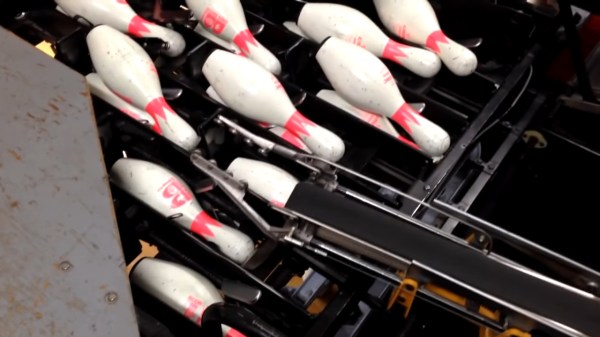
On a recent bowling excursion it occurred to us that this is one of the most advanced robotics systems most Americans will directly interact with. That’s a bold claim today, but certainly one that was correct decades ago. Let’s take a stroll back to 1963 for a look at the state of the art in bowling at the time, the AMF automatic pinspotter.

With their basis in industrial automation, bowling was a perfect problem for the American Machine and Foundry company (AMF) to take on. Their business began at the turn of the 20th century with automated cigarette manufacturing before turning their sights on bowling pins after the second world war. The challenge involves more than you might think as pinspotters are confined to a narrow area and need to work with oddly-shaped pins, the bowling ball itself, and deal with setting up fresh frames but also clearing out the field after the first roll.

Separating the ball from the pins is handled by gravity and an oscillating plunger that pushes errant pins back onto a conveyor. That conveyor stretches the width of the lane and moves pins back to a pin elevator — a wheel moving perpendicular to the ground with orients and raises them to a swiveling conveyor belt that can drop them into the setting jig waiting for the next full frame setup.

Everything in this promo video has jargon which is just delightful. We especially enjoyed the non-mechanical mention of how the machine “clears dead wood from the pin deck”. We could watch this kind of automation all day, and in fact found some other gems while searching about. Here’s a more recent look a the AMF 82-70 (the same model as in the promo video). We also wondered about manual pinspotting and found this manual-with-mechanical-assist setup to be interesting despite the audio.

Much to our surprise we’ve featured AMF in a Retrotectacular article before. Once their bowling automation started to take off, they set their sights on restaurant automation. Looks like Brian Benchoff’s visit to the robo-hamburger joint was actually a retro experience!

Continue reading “Retrotechtacular: Robots And Bowling Pins”

The 555 And How It Got That Way

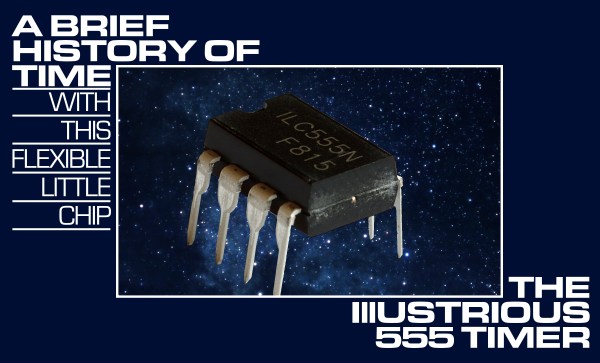
There’s a certain minimum set of stuff the typical Hackaday reader is likely to have within arm’s reach any time he or she is in the shop. Soldering station? Probably. Oscilloscope? Maybe. Multimeter? Quite likely. But there’s one thing so basic, something without which countless numbers of projects would be much more difficult to complete, that a shop without one or a dozen copies is almost unthinkable. It’s the humble 555 timer chip, a tiny chunk of black plastic with eight leads that in concert with just a few extra components can do everything from flashing an LED a couple of times a second to creating music and sound effects.

We’ve taken a look under the hood of the 555 before and featured many, many projects that show off the venerable chip’s multiple personalities quite well. But we haven’t looked at how Everyone’s First Chip came into being, and what inspired its design. Here’s the story of the 555 and how it got that way.

Continue reading “The 555 And How It Got That Way”