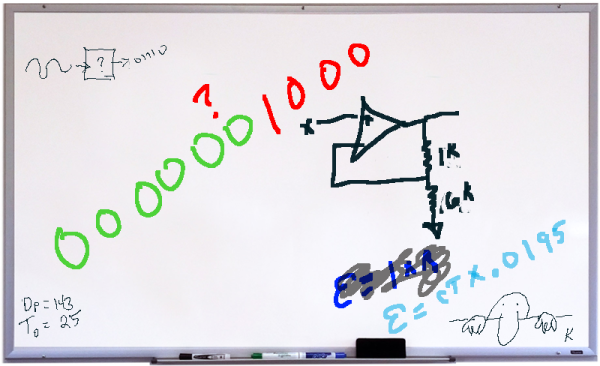
When Is A 10-bit A/D An 8-bit A/D?

Marketing guys love bigger numbers. Bigger is better, right? After all, Subway called it a “footlong” not an 11-incher. So when it comes to analog to digital (A/D) conversion, more bits are better, right? Well, that depends. It is easy to understand that an A/D will have a low and high measurement and the low will be zero counts and the high will result in the maximum count for the number of bits. That is, an 8-bit device will top out at 255, a 10-bit at 1023, and so on.

The question is: are those bits meaningful? The answer depends on a few factors. Like most components we deal with, our ideal model isn’t reality, but maybe it is close enough.

Continue reading “When Is A 10-bit A/D An 8-bit A/D?”

Joe Kim: Where Technology And Art Collide

The rewards of being a writer for Hackaday are many, but aside from the obvious perks like the secret Hackaday handshake and admission to the private writer’s washroom, having the opportunity to write original content articles is probably the best part of the job. It gets even better, though, because after you submit an article, you’ll eventually get an email from Supplyframe Art Director Joe Kim with a Dropbox link to the original art he has created to accompany your piece. No matter where I am when that email comes in, I click on the link immediately, eager to see what Joe has come up with. And I’m never disappointed.

Continue reading “Joe Kim: Where Technology And Art Collide”

The British Drone Law Reaches Parliament

We’ve brought you a variety of stories over the years covering the interface between multirotor fliers and the law, and looked at the credibility gap between some official incident reports and the capabilities of real drones. In the news this week is a proposed new law in front of the British House of Commons that would bring in a licensing scheme for machines weighing over 250 g, as well as new powers to seize drones. We’ve previously told you about the consultation that led up to it, and its original announcement.

As a British voter with some interest in the matter, I decided to write to my Member of Parliament about it, and since my letter says what I would have written to cover the story anyway it stands below in lieu of the normal Hackaday article format. If you are a British multirotor flier this is an issue you need to be aware of, and if you have any concerns you should consider raising them with your MP as well. Continue reading “The British Drone Law Reaches Parliament”

Hackaday Links Column Banner

Hackaday Links: December 3, 2017

Remember the Psion? Back when PDAs were a thing, the Psion was the best you could get. It was, effectively, a palm-top computer with a real qwerty keyboard. It didn’t have Bluetooth, it couldn’t browse the web, and it didn’t have WiFi, but this was an AA-powered productivity machine that could fit in your pocket. Now there’s a new palmtop from Psion engineers. The Gemini PDA is basically a smartphone with a real keyboard that runs Ubuntu. It’s also has a smaller battery than other devices with this form factor, meaning the TSA thinks it’s a smartphone. This thing is going to be cool.

TechShop, Inc. has reached an agreement to sell the company to TechShop 2.0, LLC. New ownership seeks to re-open, continue running makerspaces. Details coming soon.

Arcade monitors are cool, and vector monitors are even cooler. [Arcade Jason] created a gigantic 36″ vector monitor. It’s thirty-six inches of Gravitar, in all its vector glory.

A few links posts ago, I pointed out someone was selling really awesome, really cheap LED panels on eBay. I got my ten panels, and [Ian Hanschen] bought sixty or some other absurd amount. Now, these panels are going for $300 for a 10-pack instead of $50. Sorry about that. Nevertheless, the reverse engineering adventure is still ongoing, and eventually, someone is going to play Mario on these things.

The ESP32 is finding its way into all sorts of consumer electronics. Check this thing out. It’s an ESP32, four buttons, and a circular display. If you want to make your own Nest thermostat, or anything else that needs an awesome circular display, there you go.

Speaking of circular displays, are there any non-CRT displays that come with a polar coordinate system? Every circular LCD or OLED I’ve ever seen uses a Cartesian system, which doesn’t really make sense when you can’t see 30% of the pixels.

Hold the phone, this is far too clever. [Eduardo] needed to flash an ESP-12 module before soldering it onto a PCB. The usual way of doing this is with an absurd pogo pin jig. You know what’s cheaper than pogo pins? Safety pins. Clever overwhelming.

Christine Sunu Proves The Effect Of Being Alive On Hardware Design

Modeling machines off of biological patterns is the dry definition of biomimicry. For most people, this means the structure of robots and how they move, but Christine Sunu makes the argument that we should be thinking a lot more about how biomimicry has the power to make us feel something. Her talk at the 2017 Hackaday Superconference looks at what makes robots more than cold metal automatons. There is great power in designing to complement natural emotional reactions in humans — to make machines that feel alive.

We live in a world that is being filled with robots and increasingly these are breaking out of the confines of industrial automation to take a place side by side with humans. The key to making this work is to make robots that are recognizable as machines, yet intuitively accepted as being lifelike. It’s the buy-in that these robots are more than appliances, and Christine has boiled down the keys to unlocking these emotional reactions.

Continue reading “Christine Sunu Proves The Effect Of Being Alive On Hardware Design”

Statistics And Hacking: An Introduction To Hypothesis Testing

In the early 20th century, Guinness breweries in Dublin had a policy of hiring the best graduates from Oxford and Cambridge to improve their industrial processes. At the time, it was considered a trade secret that they were using statistical methods to improve their process and product.

One problem they were having was that the z-test (a commonly used test at the time) required large sample sizes, and sufficient data was often unavailable. By studying the properties of small sample sizes, William Sealy Gosset developed a statistical test that required fewer samples to produce a reasonable result. As the story goes though, chemists at Guinness were forbidden from publishing their findings.

So he did what many of us would do: realizing the finding was important to disseminate, he adopted a pseudonym (‘Student’) and published it. Even though we now know who developed the test, it’s still called “Student’s t-test” and it remains widely used across scientific disciplines.

It’s a cute little story of math, anonymity, and beer… but what can we do with it? As it turns out, it’s something we could probably all be using more often, given the number of Internet-connected sensors we’ve been playing with. Today our goal is to cover hypothesis testing and the basic z-test, as these are fundamental to understanding how the t-test works. We’ll return to the t-test soon — with real data. Continue reading “Statistics And Hacking: An Introduction To Hypothesis Testing”

Mathieu Stephan : The Making Of A Secure Open Source Hardware Password Keeper

Mathieu Stephan is an open source hardware developer, a Tindie seller who always has inventory, a former Hackaday writer, and an awesome all-around guy. One of his biggest projects for the last few years has been the Mooltipass, an offline password keeper built around smart cards and a USB interface. It’s the solution to Post-It notes stuck to your monitor and using the same password for all your accounts around the Internet.

The Mooltipass is an extremely successful product, and last year Mathieu launched the Mooltipass Mini. No, it doesn’t have the sweet illuminated touch-sensitive buttons, but it is a bit cheaper than its big brother and a bit more resistant to physical attacks — something you want in a device that keeps all your passwords secure.

Mathieu didn’t build the Mooltipass alone, though. This is an Open Source project that has developers and testers from around the globe. It may have started off as a Hackaday Post, but now the Mooltipass has grown into a worldwide development team with contributors across the globe. How did Mathieu manage to pull this off? You can check out his talk at the 2017 Hackaday Superconference below.

Continue reading “Mathieu Stephan : The Making Of A Secure Open Source Hardware Password Keeper”