Hackaday.io just welcomed the 200,000th registered user! We are the world’s largest repository of open hardware projects and Hackaday.io is proving its worth as the world’s most vibrant technology community. This is where you go to get inspiration for your next project, to get help fleshing out your product ideas, to build your engineering dream team, and to tell the tales of the workbench whether that be success, failure, or anything in between.
Over the past six months, as we’ve grown from the 150k member milestone to this one, our movement has enjoyed ever-increasing interaction among this amazing group of people. Thank you for spending so much time here and making Hackaday.io a great place for everyone!
Hack Chat Bring Experts from Many Fields
 It’s always great when you can watch a conference talk or interview online. But if you weren’t there in person the opportunity for meaningful interaction has already passed. With this in mind, we’ve been inviting experts from numerous fields to host discussions live in the Hackaday.io Hack Chat room.
This is a great way to further our goal of forming a global virtual hackerspace. It’s common to have talks and workshops at a hackerspace, where you can not only learn from and ask questions of the person leading the event, but meet others who share your interests. This has happened time and again with recent guests including Bunnie Huang who talked about making and breaking hardware, a group of Adafruit engineers who discussed their work extending the MicroPython libraries, Sprite_tm who covered the continuing development of ESP32 support, and many more.
This Friday at Noon PST Hackaday’s own Jenny List will be leading the Hack Chat on RF Product design. See you there!
Amazing Projects
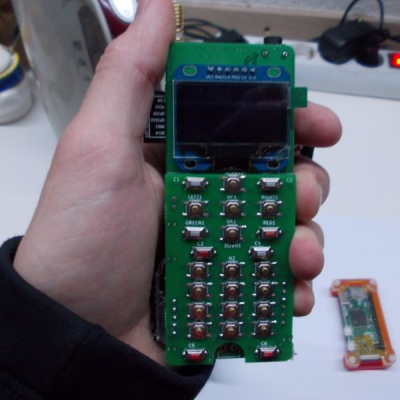
It’s pretty amazing to see a guide on building a smartphone for $50 in parts. If that exists anywhere, it’s probably on Hackaday.io — and it’s actually pushing about 80,000 views so far! Arsenijs is a regular around these parts and his ZeroPhone — a 2G communications device based on the Raspberry Pi Zero — is a project that he’s been updating as his prototype-to-production journey progresses. It has a big team behind it and we can’t wait to see where this one goes.
 Working on your own is still a great way to learn and we see all kinds of examples of that. Just4Fun is learning the dark arts that went into early personal computing with a $4 project to build a Z80 system on a breadboard.
We revel in the joy of seeing great hardware art come to life. FlipFrame is a great example; it’s a digital picture frame project that goes far beyond that simple description. It rotates the entire screen to fit the layout of the image while showing off all of the hardware that makes this possible rather than hiding it away inside a case.
In addition to our registered users milestone, we’re just about to pass our 20,000th published project. There are so many projects to celebrate and draw inspiration from, and that collection grows every day!
The Rise of Build Contests
This winter we’ve seen a ton of interest in the build contests hosted on Hackaday.io. Of course, nothing can compare to the reach of the Hackaday Prize, our worldwide engineering initiative that challenges people to Build Something That Matters. The 2016 winners were announced in November; even so, people have been tripping over themselves to get a project built for the numerous contests we’ve hosted since then.
 Of note is the 1 kB Challenge — a contest dreamed up by our own Adam Fabio which challenged entrants to build an embedded project whose compiled code was 1 kB or less. It was a joy to dive into the entries for this and it will certainly return again.
Running right now is the revival of my favorite build contest: the Hackaday Sci-Fi Contest. Bring your favorite Sci-Fi tech to life — it just needs to be recognizable from a book, movie, or TV show and include some type of electronics.
Meet Your Friends in Real Life
Some of my closest friends in life were first met online. But eventually, you just want to hang out in the same room. This is becoming more and more common with Hackaday.io. In November we celebrated our second Hackaday SuperConferece where hundreds of people who love hardware creation gathered in Los Angeles for two days of amazing talks, workshops, and hands-on hacking challenges. This is a good one to add to your calendar but tickets do sell out so consider some other options.
We have regular meetups in LA and New York. If you are ever traveling there, make sure to look up the schedule and see if it can be part of your trip. Perhaps the most interesting was World Create Day. In 2016, we had 80 groups across the world plan meetups on the same day so that the Hackaday community could hang out in real life. We’re not ready to share the details quite yet, but you should plan for that to happen again this year. Something to look forward to!