This excellent content from the Hackaday writing crew highlights recurring topics and popular series like Linux-Fu, 3D-Printering, Hackaday Links, This Week in Security, Inputs of Interest, Profiles in Science, Retrotechtacular, Ask Hackaday, Teardowns, Reviews, and many more.
The history of the diode is a fun one as it’s rife with accidental discoveries, sometimes having to wait decades for a use for what was found. Two examples of that are our first two topics: thermionic emission and semiconductor diodes. So let’s dive in.
Vacuum Tubes/Thermionic Diodes
Our first accidental discovery was of thermionic emission, which many years later lead to the vacuum tube. Thermionic emission is basically heating a metal, or a coated metal, causing the emission of electrons from its surface.
Electroscope
In 1873 Frederick Guthrie had charged his electroscope positively and then brought a piece of white-hot metal near the electroscope’s terminal. The white-hot metal emitted electrons to the terminal, which of course neutralized the electroscope’s positive charge, causing the leafs to come together. A negatively charged electroscope can’t be discharged this way though, since the hot metal emits electrons only, i.e. negative charge. Thus the direction of electron flow was one-way and the earliest diode was born.
Thomas Edison independently discovered this effect in 1880 when trying to work out why the carbon-filaments in his light bulbs were often burning out at their positive-connected ends. In exploring the problem, he created a special evacuated bulb wherein he had a piece of metal connected to the positive end of the circuit and held near the filament. He found that an invisible current flowed from the filament to the metal. For this reason, thermionic emission is sometimes referred to as the Edison effect.
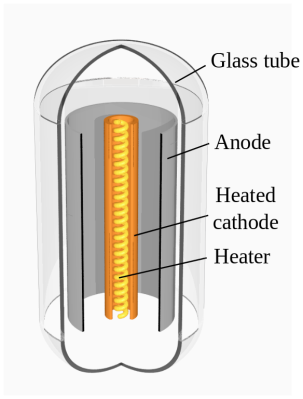
Thermionic diode. By Svjo [CC BY-SA 3.0], via Wikimedia CommonsBut it took until 1904 for the first practical use of the effect to appear. John Ambrose Fleming had actually consulted for the Edison Electric Light Company from 1881-1891 but was now working for the Marconi Wireless Telegraph Company. In 1901 the company demonstrated the first radio transmission across the Atlantic, the letter “S” in the form or three dots in Morse code. But there was so much difficulty in telling the received signal apart from the background noise, that the result was disputed (and still is). This made Fleming realize that a more sensitive detector than the coherer they’d been using was needed. And so in 1904 he tried an Edison effect bulb. It worked well, rectifying the high frequency oscillations and passing the signals on to a galvanometer. He filed for a patent and the Fleming valve, the two element vacuum tube or thermionic diode, came into being, heralding decades of technological developments in many subsequent types of vacuum tubes.
Vacuum tubes began to be replaced in power supplies in the 1940s by selenium diodes and in the 1960s by semiconductor diodes but are still used today in high power applications. There’s also been a resurgence in their use by audiophiles and recording studios. But that’s only the start of our history.
What do you do if you need Gigabytes of storages in the 80s? You get tape drives. What do you do if you need Terabytes of storage in the year 2000? You get tape. The IBM Totalstorage 3584 is an automated tape storage unit made sometime around the year 2000. It held Terabytes of data, and [Stephen] picked up two of them from a local university. Here’s the teardown. Unfortunately, there’s no footage from a GoPro stuck inside the machine when it’s changing tapes, but the teardown was respectable, netting two drives, the power supplies, and huge motors, fans, relays, and breakers.
A few years ago Motorola released the Lapdock, a CPU-less laptop with inputs for HDMI and USB. This was, and still is, a great idea – we’re all carrying powerful computers in our pocket, and carrying around a smartphone and a laptop is effort duplication. As you would expect, the best use for the Lapdock was with a Raspberry Pi, and prices of Lapdocks have gone through the roof in the last few years. The Superbook is the latest evolution of this Lapdock idea. It’s a small, thin, CPU-less laptop that connects to a phone using a special app and a USB cable. It also works with the Raspberry Pi. Very interesting, even if they didn’t swap the CTRL and Caps Lock keys as God intended.
Did you know we have a store? Yes! It’s true! Right now we need to get rid of some stuff, so we’re having a clearance sale. We got FPGA Arduino shields! Buy a cordwood puzzle! SUPERLIMINAL ADVERTISING.
The computers aboard Federation vessels in the 24th century were based on isolinear chips. Each chip plugged into a backplane, apparently giving certain sections of the ship different functions. Think of it as a reconfigurable PDP Straight-8. This is canon, from TNG, and doesn’t make any sense. [Bohrdasaplank] over on Thingiverse has a few different models of isolinear chips. After close examination of these chips, we can only come to one conclusion.
How do you get a pilot bearing out of a motor? The normal way is using grease (or caulk, or some other gooey substance) as a hydraulic ram, but a slice of bread works much better. This is a weird one, but it works perfectly, with hardly any cleanup whatsoever.
542-page PDF warning here. Here’s the operations manual for the Apollo 15, including operation of the AGC, how to fly the LM, the planned traverses and EVAs, and a nice glossary of handy equations. If anyone’s looking for a LaTeX, InDesign, or bookbinding project that would make the perfect bathroom reader, this is it.
Here’s something I’ve been having trouble with. This is an mATX computer case with a screen on the side and a cover for the screen that includes a keyboard and trackpad. Yes, it’s a modern version of the luggable, ‘portable’, plasma-screen monsters of the 80s. I don’t know where I can buy just the case, so I’m turning to the Hackaday community. There’s an entire line of modern luggable computers made by some factory in Taiwan, but as far as I can tell, they only sell to resellers who put their own mobo and CPU in the machine. I just want the case. Where can I buy something like this? If you’re asking why anyone would want something like this, you can put two 1080s in SLI and still have a reasonably portable computer. That’s a VR machine, right there.
Hackers need fuel to hack. In general that fuel comes in the form of food, water, and caffeine. Not necessarily in that order. While soda or energy drinks will do in a pinch, the best hackers know that the purest form of caffeine comes from coffee. This of course means that there have been decades of coffee hacks. The first Internet-connected coffee pot dates all way back to 1991, before the web even had pictures. We’ve come a long way since then. This week on the Hacklet we’re checking out some of the best coffee hacks on Hackaday.io!
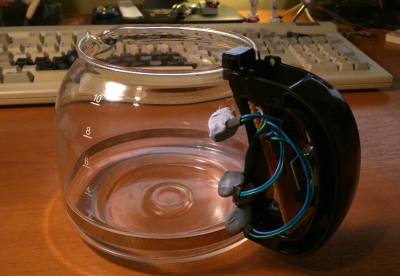
We start with [opeRaptor] and CoffeeOfThings. [OpeRaptor] has created a wireless, internet connected coffee carafe. The carafe has three CdS cells which enable it to detect how much black gold is left in the pot. A TMP36 sensor reports the current coffee temperature. Data is sent out via a NRF24l01 radio. The brains of the coffee pot is an MSP430 microcontroller. All this runs from a simple CR2032 coin cell. A base station receives the coffee data, displays it on a very nice Vacuum fluorescent Display (VFD). An ESP8266 then passes the data on to the internet.
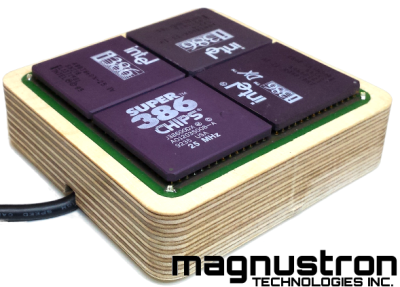
Next up is [magnustron] with quad-386 coffee heater. No one likes a cold cup of coffee. Everyone loves old CPUs. [Magnustron] turned these two shower thoughts into a the world’s first USB powered quad CPU coffee warmer with data logging capabilities. A simple ATtiny461 micro runs the show. PC connectivity is via USB using the V-USB library. [Magnustron] has gotten the CPUs to warm up, but is having some issues with switching. them on. Turning all four heaters on too quickly causes the rail to droop, leading to dropped USB connections. Those power-hungry 386 chips may be a bit too much for a single USB connection. It might be time to add an external power supply.
Next is [kesh1030] with Using Waste Coffee As A Biodiesel Source. Coffee isn’t just liquid energy. There’s oil in them there grounds. Millions of pounds of used coffee grounds produced every year can be converted to biodiesel fuel. [Kesh1030] experimented with different coffee grounds, and different ways to prepare them. The oil was extracted from the coffee using hexane, which is a bit of a nasty solvent. [Kesh1030] used a fume hood to stay safe. He found that homogenized coffee grounds had an 11.87% oil yield. Used homogenized coffee grounds weren’t far behind, with 9.82% yield of oil. Nearly 10% per weight yield isn’t too shabby, considering this is all going into the trash.
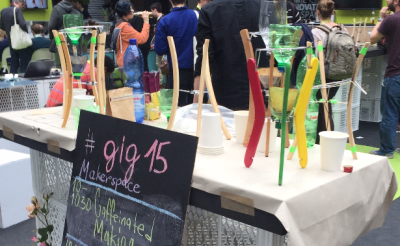
Finally, we have [saadcaffeine] with Caffeinator: gravity powered geek fuel dripper. This is a project of few words, but the images tell much of the story. [Saadcaffeine] created his own cold drip iced coffee maker using upcycled and found components. Three clothes hangers form an ingenious tripod. The tripod holds two soda bottles – the water reservoir and the brew pot. Water is restricted by small holes in the soda bottle caps. This allows it to drop slowly though the machine, giving it time to soak up all the caffeinated goodness. The result is a fresh cup of cold drip. Just add ice and enjoy a quick power up!
If you want to see more coffee hacks, check out our new coffee projects list. See a project I might have missed? Don’t be shy, just drop me a message on Hackaday.io. That’s it for this week’s Hacklet, As always, see you next week. Same hack time, same hack channel, bringing you the best of Hackaday.io!
In part one, I compared the different Analog to Digital Converters (ADC) and the roles and properties of Delta Sigma ADC’s. I covered a lot of the theory behind these devices, so in this installment, I set out to find a design or two that would help me demonstrate the important points like oversampling, noise shaping and the relationship between the signal-to-noise ratio and resolution.
Modulator Implementation
Check out part one to see the block diagrams of what what got us to here. The schematics shown below are of a couple of implementations that I played with depicting a single-order and a dual-order Delta Sigma modulators.
Basically I used a clock enabled, high speed comparator, with two polarities in case I got it the logic backwards in my current state of burn out to grey matter ratio. The video includes the actual schematic used.
Since I wasn’t designing for production I accepted the need for three voltages since my bench supply was capable of providing them and this widget is destined for the drawer with the other widgets made for just a few minutes of video time anyway. Continue reading “Tearing Into Delta Sigma ADCs Part 2”→
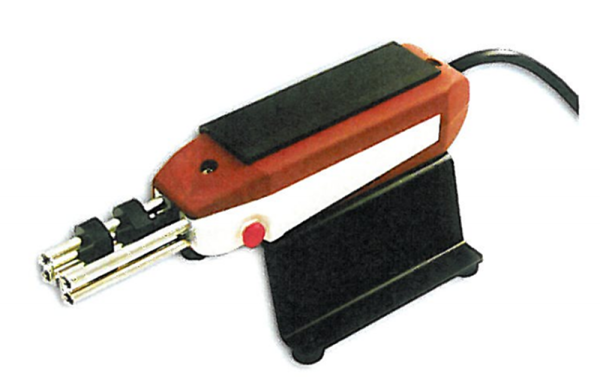
I wanted to point out a tool that I often use, but rarely see on other people’s workbenches: thermal strippers. They aren’t cheap, but once you’ve used them, it is hard to go back to stripping wires with an ordinary tool.
I know, I know. When I first heard of such a thing, I thought what you are probably thinking now: maybe for some exotic coated wire, but for regular wire, I just use a pair of diagonal cutters or a mechanical stripper or a razor blade. You can do that, of course, and for large solid wires, you can even get good results. But for handling any kind of wire, regardless of size, you just can’t beat a thermal stripper.
Rarely on these pages have I read such a fluff piece! Al Williams’ coverage of Emacs versus Vim was an affront to the type of in-depth coverage our Hackaday readers deserve. While attempting to be “impartial” he gave a seven-sentence summary of Vim, the Ultimate Editor. Seven sentences! Steam is pouring out of my ears like Yosemite Sam.
Al, like a lot of you out there, thinks that he “knows how to use vi”. I’m here to tell you that he doesn’t. And unless you’ve spent the last few years alone in a cave high in the Himalayas, with only food, drink, a laptop, and Vim Golf, you probably don’t either. Heck, I don’t consider myself a Vim master, but I’m going to write this overwrought essay praising it (using Vim, naturally).
The reason I’m writing this is not to perpetuate the vi-versus-Emacs war. That idea is silly anyway, and was probably invented by Emacs folks to steal some of vi’s limelight. You see, vi-versus-Emacs is a red herring. Vi and Vim are so strange, so different from any other editor you might use, that it makes Emacs look simply boring in comparison: it’s just a normal editor with decent extensibility (if you can stand Lisp), horrible key combinations that may or may not cause carpal tunnel syndrome, and code bloat that rivals Microsoft Word. If you’re comfortable using Pico or Nano or Joe or Notepad++ or Gedit or Kate, or anything else for that matter, you can be comfortable using Emacs in a month or so. It’s really just another editor. Yawn.
Vi is something else. It’s a programming language for editing text that’s disguised as an editor. If you try to use it like a normal text editor, you will suffer. If you approach your text editing chores like factoring code into functions, you’re starting to understand Vi.
As many of the members of the Brian Benchoff hate/fan club know, the life of a Hackaday writer is nomadic and filled with exciting adventures. Jenny List is actually crime fighting cyborg (think Bond); it’s why she knows so much about electronics. James Hobson is Iron Man. The list goes on. There are lots of unnecessary details, but to summarize: Last month I was living in Washington State, this month I am in Paris, France. It’s really nice here, the buildings are beautiful, the cathedrals stunning, and the food significantly tastier.
However, as a contracting engineer with a project involving a deadline; I found myself in dire need of a significant amount of quick turn-around 3D printing during my working vacation to France. Through a lot of trial and tribulation, I eventually discovered that the most cost-effective way to get the prints done… was to just buy a cheap 3D printer and run it into the ground.
I was spoiled by my hackerspace in Louisville, KY. They had enough 3D printers to go around and the pricing was fixed at 10 cents a gram. For the amount of printing I needed, this would be a perfectly economical arrangement. So, I set out to find a hackerspace in Paris. Whereupon I reached my first and obvious problem; I speak very little French.
Most of the hackerspaces listed in Paris are, as far as I can tell, illegally squatting in a scary part of town, exclusive to a university, exclusive to a business, or closed down.
So, I googled a bit harder. Wow! Apparently a Techshop opened up in Paris. It’s about an hour away from where I live, but having toured a Techshop before, I knew they would have the nice version of the tool I need. So, one morning bright and early I got on the metro and headed over to get a tour of the place.
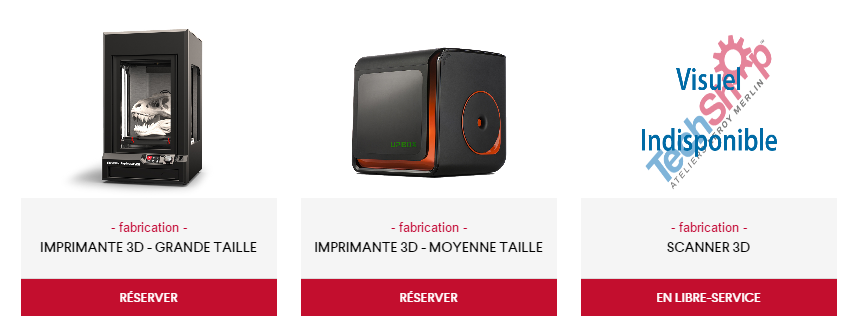
What I’ve discovered is this: If you need things like a water jet cutter, welding station, or a 50 grand CNC machine, Techshop is a really economical way to get access to and play with tools like that. However, if all you want is access to a laser cutter and a 3D printer, it will set you back five-hundred dollars and you’ll have to jump through some incredibly annoying hoops just to get access to them.
Only a small fee of 400 euros to used these bad boys.
See, most pieces of equipment at a Techshop need to be reserved. Only the 150 euro and 300 euro a month membership tiers can reserve equipment. The 150 tier can reserve something for two hours, the 300, four. If you’ve ever 3D printed you can immediately spot the problem with that. For small prints this could be workable, but if you have a lot of large prints four hours is just not enough. However, there is a work around. If you’re willing to take a metro ride late at night, arriving at the Techshop at 10:00pm, you can, of course, run a print overnight.
There were two more glitches in the Techshop plan. To be able to touch the printers required a two-hour course with a 100 euros fee. The filament also ran 65 euro per 500 g. My printing needs would easily cost me tens of hours in travel and had a starting fee of 400 euros to be workable.
The entrance to Usine.io is terrifying. It’s this massive pitch black hallway. I had no idea if I was in the right place until I got to the desk.
Now, I’m not saying Techshop isn’t absolutely wonderful when it comes to more advanced tools. It’s probably the only Hackerspace in the world where you’re entitled to expect that the CNC machine is in working order, properly trammed, and there are actually cutting bits for it. However, if all you need is a 3D printer, don’t bother.
Now, I asked around some more and found that there was a competing space in Paris called Usine.io. It had a flat fee of 180 euros a month and the training was free. I actually did end up getting a membership here for access to a CNC and basic tools, but for 3D printing it was a bust. They only had three printers serving a sizable membership base. This left the printers with a 48 hour line to get your print started and a maximum of 40 hours of printing a month. A die-hard user of 3D printing can easily use 40 hours in 3 days. Because I had to test many iterations for my project, my need the next month was easily triple that number.
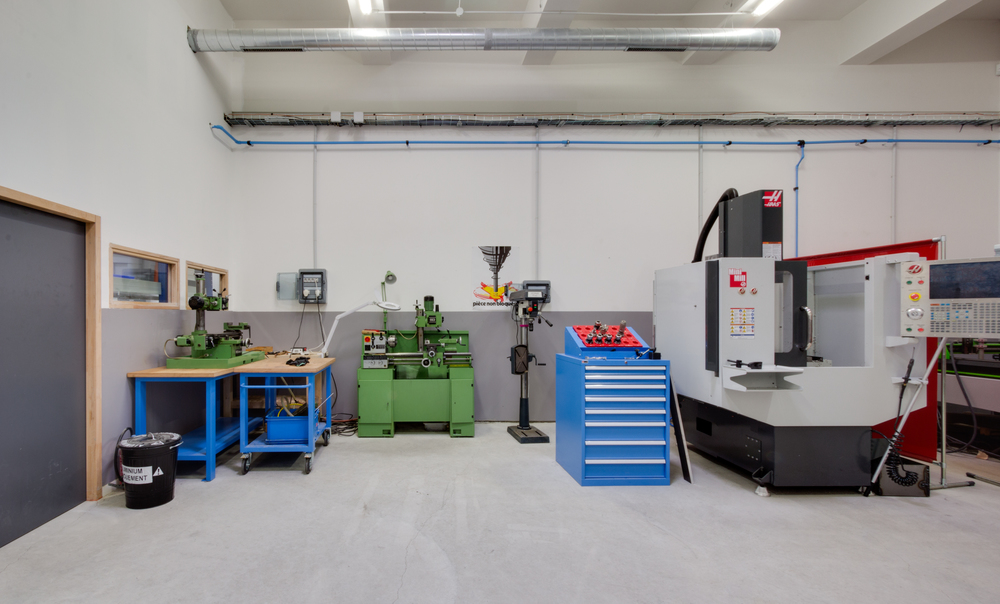
However, the shop itself is really nicely outfitted.
The last avenue available to me aside from 3D printer ownership was contracting someone with a 3D printer to run my prints for me. However, after asking around I found the service to be quite expensive. Rent isn’t cheap in Paris after all. If I just needed a single small print it would be worth it, but if I needed lots of printing it would quickly add up to be more money than I had.
That left me with one option. Which, honestly, sounded absolutely insane for someone visiting a country for a few months. Buy a printer. It’s an indication of the state of 3D printing that the price has come down so far that buying a printer is more economical than having someone do it for you. Even a few years ago this was not possible. However, European Amazon Prime had a workable enough import printer to my doorstep faster than any commercially available service could even process my order. We’ve come a long way since the Darwin. That’s for sure.