Peachy Printer Collapses, Investor Built A House Instead Of A Printer

The Peachy Printer, originally a crowdfunding campaign for a $100 stereolithography 3D printer, is now dead in the water.[Rylan Grayston], the creator of the Peachy Printer, announced that [David Boe] — investor, 50% owner of Peachy Printer, and business partner — had stolen over $300,000 in Kickstarter campaign funds. According to [Rylan], this money was used to build a house.
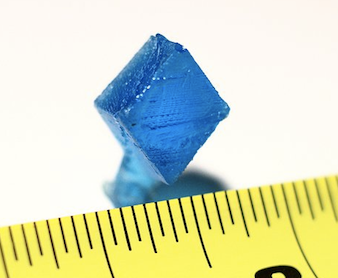
An example print from the Peachy Printer Kickstarter campaign

When the Peachy Printer was announced on Kickstarter, it was, by any measure, a game changing product. Unlike other stereolithographic printers like the Form 1 and DLP projector kit printers, the Peachy was cheap. It was also absurdly clever. Instead of using a stepper motor to raise a print out of a vat of resin, the Peachy Printer floated the resin on a vat of salt water. By slowly dripping salt water into this vat, the level of the resin rose up, allowing the galvanometers and laser diode to print the next layer of a 3D object. In our first coverage of the Peachy Printer, everyone was agog at how simple this printer was. It wasn’t a high-resolution printer, but it was a 3D resin printer that only cost $100. Even today, nearly three years after the launch of the Kickstarter campaign, there’s nothing like it on the market.

For the last two years, [Rylan] appeared to have the Peachy Printer in a pseudo-stealth mode. Whispers of the Peachy Printer circled around 3D printer forums, with very little information coming from [Rylan]. For the last year, the Peachy Printer appeared to be just another failed crowdfunded 3D printer. Either [Rylan] didn’t have the engineering chops to take a novel device to market, there were problems with suppliers, or [Rylan] just couldn’t get the product out the door.

In the update published to the Kickstarter campaign, the reason for the failure of Peachy Printer to deliver becomes apparent. The Kickstarter campaign was set up to deliver the funds received – $587,435.73 – directly into [David Boe]’s account. Thirty days after the funds were received, [David] had spent over $165,000. In just over three months, all the Kickstarter funds, save for $200,000 transferred into the Peachy Printer corporate account, were spent by [David].

With no funds to complete the development of the Peachy Printer, [Rylan] looked into alternative means of keeping the company afloat until Kickstarter rewards had shipped. Peachy Printer received two government grants totalling $90,000 and $135,000. In March of 2015, one of [Rylan]’s family members loaned $50,000 to Peachy Printer. A plan to finance the delivery of Kickstarter rewards with new sales – a plan that is usually looked down upon by Kickstarter backers – was impossible, as cost and time required of certifying the laser in the Peachy Printer would have put the company in the red.

Right now, [Rylan] and the Peachy Printer are pursuing repayment from [David Boe], on the basis that Kickstarter reward money is still tied up in the construction of a house. Once the house is complete, the bank will disburse funds from the construction mortgage, and funds can then be transferred from [David] to Peachy Printer.

In all, the Peachy Printer is a mess, and has been since the Kickstarter funds were disbursed to [David]. There is – potentially – a way out of this situation that gets Peachy Printers into the hands of all the Kickstarter backers if the mortgage construction funds come through and production resumes, but that’s a lot of ‘ifs’. Failed Kickstarter projects for 3D printers are nothing new, but [Rylan]’s experience with the Peachy Printer is by far the most well-documented failure of a crowdfunding project we’ve ever seen.
Tools Of The Trade – Component Placing

Recently we started a series on the components used to assemble a circuit board. The first issue was on dispensing solder paste. Moving down the assembly line, with the paste already on the board, the next step is getting the components onto the PCB. We’re just going to address SMT components in this issue, because the through hole assembly doesn’t take place until after the SMT components have gone through the process to affix them to the board.

Reels!
Reels!

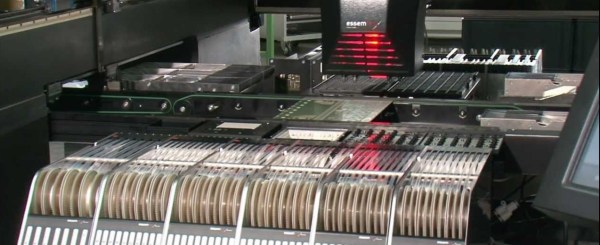
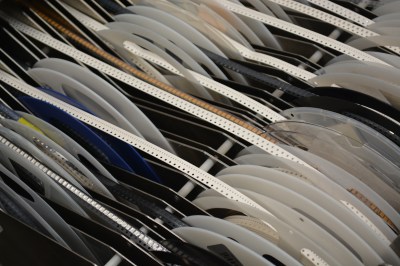
SMT components will come in reels. These reels are paper or plastic with a clear plastic strip on top, and a reel typically has a few thousand components on it. Economies of scale really kick in with reels, especially passives. If you order SMT resistors in quantities of 1-10, they’re usually $.10 each. If you order a reel of 5000, it’s usually about $5 for the reel. It is cheaper to purchase a reel of 10 kOhm 0603 resistors and never have to order them again in your life than it is to order a few at a time. Plus the reel can be used on many pick-and-place machines, but the cut tape is often too short to use in automated processes.

Continue reading “Tools Of The Trade – Component Placing”

New Part Day: A BeagleBone On A Chip

The current crop of ARM single board computers have a lot in common. Everything from the Odroid to the Raspberry Pi are built around Systems on a Chip, a piece of silicon that has just about everything you need to build a bare minimum board. You won’t find many hardware hackers playing around with these chips, though. That would require putting some RAM on the board, and some other high-speed connectors. Until now, the only people building these ARM boards were Real Engineers™, with a salary commensurate of their skills.

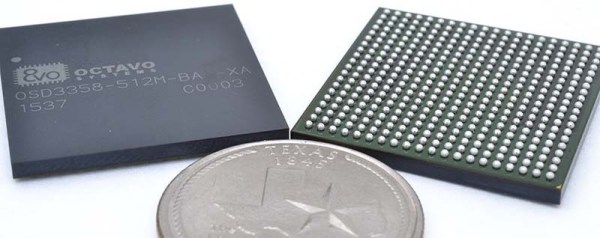
This is now about to change. Octavo Systems has launched a new product that’s more or less a BeagleBone on a chip. If you can handle putting a PCB with a BGA package in a toaster oven, you too can build your own ARM single board computer running Linux.

Octavo’s new System in Package is the OSD335x family, featuring a Texas Instruments AM335x ARM Cortex A8 CPU, up to 1GB of DDR3, and peripherals that include 114 GPIOs, 6 UARTs, 2 SPIs, 2 I2Cs, 2x Gigabit Ethernet, and USB.

The chips used in commercially available single board computers like the Pi and BeagleBone have hundreds of passive components sprinkled around the board. This makes designing one of these single board computers challenging, to say nothing about actually assembling the thing. Octavo is baking a bunch of these resistors, capacitors, and inductors right into this chip, allowing for extremely minimal boards running Linux. [Jason Kridner] – the BeagleBone guy – is working on a PocketBone, a full-fledged Linux computer that will fit inside an Altoids tin.

Of course, with this degree of integration, a BeagleBone on a chip won’t be cheap. The first part number of this family to be released, with the AM3358 CPU and 1GB of RAM, sells for $50 in quantity one.

Still, this is something we haven’t seen before. It’s a Linux computer on a chip that anyone can use. There is an Eagle symbol for this module. This is a chip designed for hardware hackers, and we can’t wait to see what people using this chip will come up with.

Designing A High Performance Parallel Personal Cluster

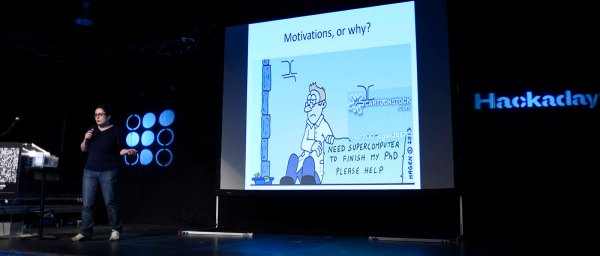
Kristina Kapanova is a PhD student at the Bulgarian Academy of Sciences. Her research is taking her to simulations of quantum effects in semiconductor devices, but this field of study requires a supercomputer for billions of calculations. The college had a proper supercomputer, and was getting a new one, but for a while, Kristina and her fellow ramen-eating colleagues were without a big box of computing. To solve this problem, Kristina built her own supercomputer from off-the-shelf ARM boards.

Continue reading “Designing A High Performance Parallel Personal Cluster”

Minimal MQTT: Building A Broker

In this short series, we’re going to get you set up with a completely DIY home automation system using MQTT. Why? Because it’s just about the easiest thing under the sun, and it’s something that many of you out there will be able to do with material on-hand: a Raspberry Pi as a server and an ESP8266 node as a sensor client. Expanding out to something more complicated is left as an exercise to the motivated reader, or can be simply left to mission creep.

We’ll do this in four baby steps. Each one should take you only fifteen minutes and is completely self-contained. There’s a bunch more that you can learn and explore, but we’re going to get you a taste of the power with the absolute minimal hassle.

In this installment, we’re going to build a broker on a Raspberry Pi, which is the hub of your MQTT network. Next time, we’ll get an ESP8266 up and running and start logging some data. After that, we’ll do some back-end scripting in Python to make the data speak, and in the last installment, we’ll explore some of the useful frills and fancy bits. Let’s get started!

Continue reading “Minimal MQTT: Building A Broker”

Hackaday Links: It’s Mother’s Day And You Forgot

[AvE] noticed someone was having trouble with their Nepeploid Shilden Inversker, and after a sinusoidal lambda deplanarization test, noticed the dinglebop wouldn’t pass through the grumbo. [AvE] is probably just some guy who wears overalls to bed, but he does know a polyfractal magnetorestrictor when he sees one. To wit, he has a novel application of Eularian magnetronics resulting in a friction factor over unityGame changing stuff here, from the guy who brought you the beer stein made out of an oil filter.

It was soft launched at the Midwest RepRap Festival this year, and now Lulzbot’s TAZ 6 is finally out. The biggest new feature? The electronics ‘brain box’ holds everything, including the power supply. This tower of brain box makes the Taz 6 harder to build from source, but there are unconfirmed reports that Lulzbot may sell this brainbox separately.

Boldport, and founder [Saar Drimer] are the cream of the crop when it comes to artistic PCBs. Boldport’s catalog and [Saar]’s portfolio include a tribute to [Bob Pease], a beautiful board with multicolor solder masks, and an emergency business card. Now Boldport is doing a beautiful PCB of the month club. It’s called Boldport Club, and each three-month membership gets you three months of pretty PCBs. The shop will also stop taking orders for the Boldport club 25 hours after this post goes live. If you missed the boat on the club, you can still get in on the pretty PCB action – we have the Boldport cordwood puzzle available in the Hackaday store.

The Apple IIgs was the last gasp of the Apple II before that platform was phased out for the Macintosh. Despite being mostly forgotten, except for thousands of units in middle school computer labs until the 2000s, it was a very interesting machine, with a wavetable synth, real multitasking, a GUI, and very high resolution graphics. After 30-odd years the IIgs now has quadraphonic sound. The 4soniq card was introduced at the WOzFest III conference last month, and it will give an Apple IIgs with four channels of audio output.

There’s a lot of stuff happening next weekend, and Hackaday is going to be there. If you’re at the Maker Faire Bay Area, Hackaday is taking over a pub. It’s on Saturday night, so it doesn’t conflict with the bring-a-hack at an undisclosed location on Sunday night. Me? I’m going to hamvention, mostly for the purposes of documenting the two parking lots full of swap meet. Find me and I’ll get you some Hackaday swag.

Running A Hackerspace Is Hard: Egypt Edition

It’s no secret that it’s difficult to run a hackerspace. Different personalities, different material requirements, and often constrained spaces can require continual negotiation. But if you think that having the metalworking types getting their shavings on your electronics bench is a problem, try having your entire hackerspace demolished on short notice.

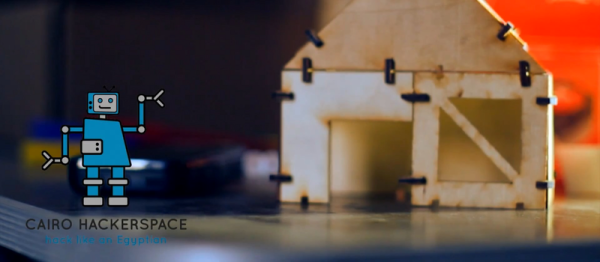
The situation in Cairo is far from normal at the moment. The building that Cairo Hackerspace had recently moved to was raided, closed for two months, and then re-opened under strict surveillance in February.

All was well until a part of the building unexpectedly collapsed. Then they got a demolition order, followed by postponement, followed by armed police entering anyway and breaking stuff, followed by a further declaration of the building as safe, and now a heritage site. And all of this over a week’s time. While some of the art studios in the Townhouse were saved, the Cairo Hackerspace’s space is gone.

tumblr_inline_o5virriTeD1t3bbl6_500

The good news? Nobody got hurt in all of this, and the Cairo Hackerspace crew were able to get their gear out after the initial demolition notice. They’ve been working on a mobile hackerspace-in-a-van approach lately, so hopefully they’ll be able to keep on hacking.

So when you’re bickering over who didn’t clean up the hackspace’s coffee machine, or the proper location of your favorite soldering iron, think kindly about the Cairo crew and get back to doing what you do best — projects.

How about you? What hackerspace tales do you have? Contact us through the tips line — we’d love to hear.