Overunity, Free Energy And Perpetual Motion: The Strange Side Of YouTube

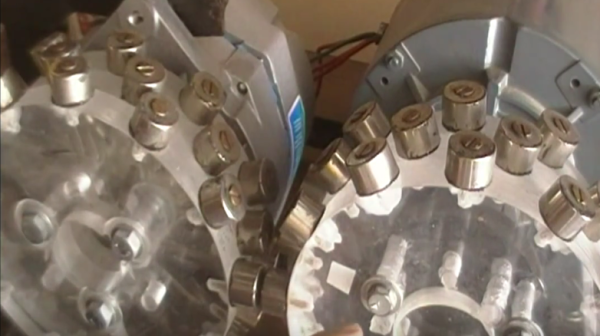
Spend enough time on YouTube, and you’ll eventually find yourself in one of the many dark corners hiding within it. No, I’m not talking about the comments. In this case, I mean the many videos dedicated to free energy, overunity devices, perpetual motion machines, or anything else that violates the laws of thermodynamics by trying to get out more energy than is put in. The human race has been reaching for impossible dreams of perpetual motion and free energy for just about all of recorded history. Now it’s convenient to find them all in one place.

searl_effect_generator-shot0001Browsing the tubes, it’s easy to break free energy videos down into two major groups: enthusiasts and scammers. Catching a scammer is easy – they’re looking for money. Somewhere in the video or description will be a link to a website with more information. Eventually that will lead you to a place where the scammer attempts to part you and your hard-earned money.

Names like John Searl, Muammer Yildiz, and M. T. Keshe go here. Searl especially deserves note because he’s been at it for decades.  Supposedly, his “Searl Effect Generator” SEG has been built several times, but the prototypes generate so much power they create their own anti-gravity field and fly off into space. Obviously this man and his staff need your money to continue their work. Scammers deserve disdain and public shaming. These are the folks who know their “discoveries” are nothing more than snake oil.

On the other side of the coin lie the enthusiasts. These are the backyard tinkerers, the ones who put down their computers, pick up their tools, and try to build something. Sounds a lot like the average Hackaday reader, doesn’t it? I have to admit I went into this article with the same disdain for the enthusiasts that I have for the scammers, possibly even more. In some cases, these are the folks who truly believe they can have a chance to violate the laws of thermodynamics. Inevitably these folks fail to build free energy generators, overunity devices, or whatever their pursuit is, but they all do seem to learn something in the process. A lot can be said about the builds themselves. Some of these are awesome devices. Even if they don’t work for their intended purpose, they are great demonstrations of magnetism or chemistry. This is where I had a change of heart. If someone wants to spend their time working on an impossible hack, then more power to them. I may not think they have any chance of success, but at the very least, they’ll learn how to build.

Continue reading “Overunity, Free Energy And Perpetual Motion: The Strange Side Of YouTube”

Hackaday Links: January 24, 2016

The RepRap wiki was spammed this week. Everything is fine now, but I feel I should call attention to the fact that the RepRap wiki needs some people to contribute, organize, and maintain everything. The wikis for obscure anime shows are better than the RepRap wiki, so if you’re looking to contribute to an important open source project, there ‘ya go.

The 200cc, 5.5HP, 4-stroke OHV Honda GX200 engine is found in a whole lot of tools, and is a fantastic power plant to build a go-kart around. It also costs about $350. There are clones of this engine available direct from China for about $100. Here’s how you add a turbo to one of these clone engines.

Freescale makes some pretty cool sensors and [Juan Ignacio Cerrudo] figured they needed breakout boards. He has some boards for a low-power three-axis accelerometer, an accelerometer and magnetometer, and a pressure sensor.

The Tektronix TDS744A is an older but still extremely capable 500MHz, 2Gsps, 4-channel scope. You can upgrade it to the 1GHz TDS784A by desoldering a few resistors. Very cool if you’re looking for a cheap-ish 1GHz scope.

[TheBackyardScientist] hung out with some cub scouts a few weekends ago and launched a high altitude balloon over Florida. The payload included a game camera, APRS tracker, GoPro, and a few other bits and bobs. The balloon reached 106,000 feet and landed only a few miles from Cape Canaveral.

Big RC planes – UAVs especially – are a pain to launch. Flying wings above a certain size are just dangerous to launch by hand, and landing gear is heavy and for the most part unnecessary. What’s the next best solution? A trebuchet, of course. It mounts on a car and is able to give a UAV a little bit of altitude and some speed. A pretty good idea that could be easily implemented with some load-bearing PVC pipe.

Everybody likes the Game of Life, so here’s one built with a 6502. It’s built around a Western Design Center 65c816 board we’ve seen before, nine MAX7219 LED controllers mapped to the VIA, and nine 8×8 LED matrix displays. Here’s a video of it in action.

About a month ago, a search of AliExpress turned up Apple’s A8 CPU. I bought one. Here’s what I got. It’s a stupidly small pitch BGA, and I don’t have a datasheet. What am I going to do with it? Make a non-functioning board with a few ports, resistors, no traces, and the A8 chip planted square in the middle.

Hacklet 92 – Workbenches And Toolboxes

Everyone needs a place to work. While some of us have well equipped labs with soldering stations, oscilloscopes, and a myriad of other tools, others perform their hacks on the kitchen table. Still, some hackers have to be on the go – taking their tools and work space along with them on the road. This week’s Hacklet is all about the best toolbox and workbench projects on Hackaday.io!

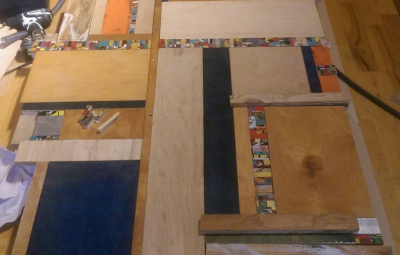
worktableWe start at the top – in this case, a bench top. [KickSucker] created Mondrian Inspired Work Table as a multi-use tabletop for all kinds of projects. Rather than slap down a piece of plywood, [KickSucker] took a more artistic route. Piet Mondrian was a dutch artist known for painting irregular grids of black and white lines. He’d fill a few of the rectangles up with primary colors, but leave most of them white. Between different off-cuts of wood, and colorful bits of skateboard deck [KickSucker] had the makings of an awesome work surface. The frame of the bench is an IKEA expedite shelf unit. The frame is made from MDF, with the offcuts laid on top of it. The fun part was arranging all the pieces to make lines and colors. The result is a great custom work table, and a heck of a lot less wood scraps lying around the shop. That’s a double win in our book!

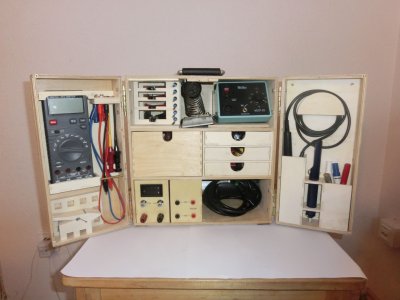
toolboxNext up is [M.Hehr] with Portable Workbench & mini Lab. [M.Hehr] has wanted a portable electronic workstation for years. We’re betting he’s seen a few of them here on the blog. While cleaning up the lab before Christmas, [M.Hehr] found a couple of wooden IKEA boxes. Each box held some drawers. An idea formed in [M.Hehr’s] head. It was time to put the plan in motion! The boxes were attached and hinged. Custom brackets were cut on a Shapeoko 2 router. Everything – even the screws were recycled. [M.Hehr] created a perfect space for each tool, ensuring that things won’t end up in a tangled mess when the box is carried around. We really love the retractable power point and custom-made power supply!

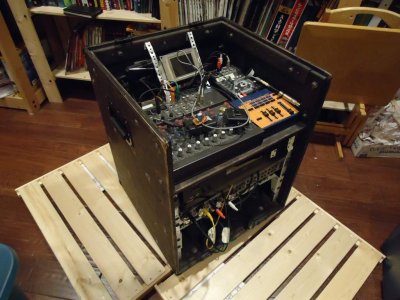
roadcaseNext we’ve got [Tim Trzepacz] with Musician’s Road Box with 9 space rack. [Tim’s] sister [Tina] was playing a lot of music on the road, and needed a way to organize her gear. There are plenty of commercial solutions for this, but [Tim] decided to roll the perfect solution. He designed a plywood box with a 9U rack. [Tina’s] mixer and backing sound sources were located on the top, while effects and other modules were located in the rack. [Tim] spent a good amount of time designing the box. He was able to get the cut list down to a single piece of plywood, with room to spare. This is perfect for a 4′ x 8′ router like the ShopBot. When it comes time to hit the road, the case seals up to a rugged package. Standard roadcase corners and twist-latches finish this awesome piece.

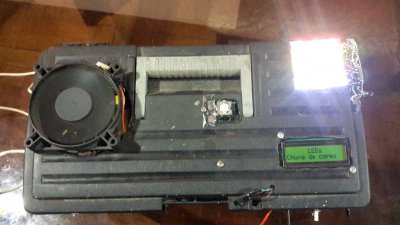
boxtopFinally we have [Géllo] with protoBox. [Géllo] is into induction heating, which requires a Zero Voltage Switching (ZVS) flyback driver. ProtoBox started life as a place for [Géllo] to store his ZVS. It has evolved to become a small portable electronics lab. [Géllo] powers the box with a set of lithium-ion batteries sourced from old laptops. This particular ZVS design is plenty powerful enough to heat metal red hot, or create some nice arcs. [Géllo] added an Arduino Mega, a Bluetooth radio, and a 2×16 character LCD. The system is controlled with relays. A bluetooth enabled smartphone can be used to enable or disable any feature. [Géllo’s] assembly techniques are a bit scary, especially considering the fact that this is a high power design. However, this is a great proof of concept!

If you want to see more workbench and toolbox projects, check out our new workbench and toolbox list! If I missed your project, don’t be shy! Just drop me a message on Hackaday.io. That’s it for this week’s Hacklet. As always, see you next week. Same hack time, same hack channel, bringing you the best of Hackaday.io!

How To Use Lidar With The Raspberry Pi

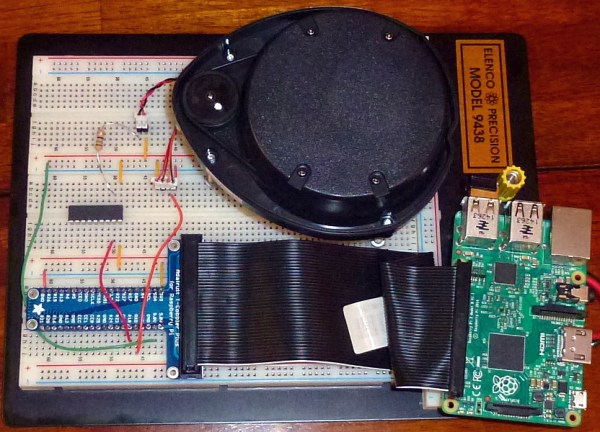
The ability to inexpensively but accurately measure distance between an autonomous vehicle or robot and nearby objects is a challenging problem for hackers. Knowing the distance is key to obstacle avoidance. Running into something with a small robot may be a trivial problem but could be deadly with a big one like an autonomous vehicle.

My interest in distance measurement for obstacle avoidance stems from my entry in the 2013 NASA Sample Return Robot (SRR) Competition. I used a web camera for vision processing and attempted various visual techniques for making measurements, without a lot of success. At the competition, two entrants used scanning lidars which piqued my interest in them.

Continue reading “How To Use Lidar With The Raspberry Pi”

Fail Of The Week : Watt A Loss

This one is a bit dated, but the lessons are still relevant. [Zach Hoeken] posted about the challenges he faced building a CNC stepper driver. He was experimenting with Toshiba motor drivers back in 2012.

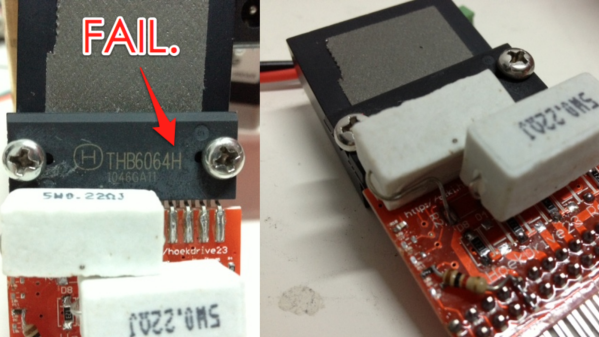
The modular motor driver boards he built were based on the THB6064AH – capable of 1/64th step, and 4.5 Amps at up to 50V. [Zach] built a test jig to run the boards through their paces. A couple of messed tracks was the least of his problems – easily fixed by cutting traces and using jumper wires to correct the errors. But the header footprints for the motor drive boards got reversed. The only way out was to solder the headers on the back side.

LESSON : Always check footprint orientation and pin numbering before sending boards to fab.

The surprising part was when someone as experienced as [Zach] messed up on Ohms Law. Based on the current he wanted the motors to run at, his sense resistors needed to be 3.2W, but he’d used SMD footprints (0805 likely) instead. Those tiny resistors couldn’t be used at all, and the 5W resistors plonked on looked like an ugly hack.

Continue reading “Fail Of The Week : Watt A Loss”

Hackaday Europe: Call For Proposals

Hackaday is coming to Europe in April. The world’s most superb conference on hardware creation starts with you. Please submit your proposal to present a talk or workshop at 2016 Hackaday | Belgrade, Hackaday’s first-ever European conference.

Put it on your calendar: Saturday, April 9th in Belgrade, Serbia. We have a lineup spanning from 10am to 2am, and we’re building on the best of the inaugural SuperConference we held last November: a single track of hardware talks which will run concurrently with a set of hands-on workshops. The surprise hit from that conference was badge hacking, which will be expanded and extended into the wee hours of the morning. While that is in progress, a party with two stages will spin up with performances by Infinite Jest, Grupa TI, and DJ sets.

Tickets go on sale the first week of February. Voja Antonic, who does amazing work with PCBs and badge designs, is building the conference badge. The cost of the admission will be just enough to cover the cost of the badge. We’re keeping the admission cost so low to help offset your travel costs. Belgrade is gorgeous in April, and getting there from other parts of Europe is very affordable. This event will sell out so get organized and make sure you and your fellow hardware hackers get tickets early.

Many of the Hackaday crew will be on hand. We’re likely to have a less-formal meetup (hangover brunch?) on Sunday. Check out the Hackaday | Belgrade planning page to discuss this and learn more about the conference as it comes together. See you in Belgrade!

Kids And Hacking: Electromagnetic Eggs

One of my favorite things to do is visit with school kids who are interested in engineering or science. However, realistically, there is a limit to what you can do in a single class that might last 30 to 90 minutes. I recently had the chance to work with a former colleague, a schoolteacher, and The Teaching Channel to create an engineering unit for classroom use that lasts two weeks.

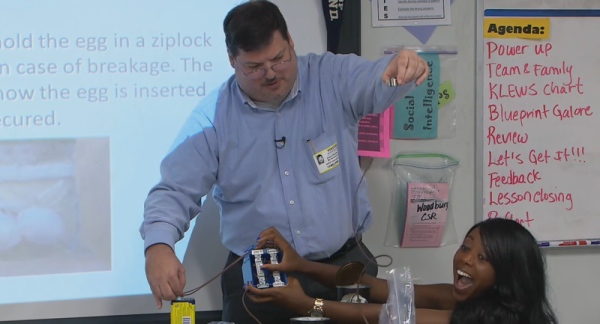
This new unit focuses on an egg drop. That’s not an original idea, but we did add an interesting twist: the project develops a “space capsule” to protect the egg, but also an electromagnetic drop system to test the capsules. The drop system allows for a consistent test with the egg capsule releasing cleanly from a fixed height. So in addition to the classic egg drop capsule, the kids have to build an electromagnet, a safe switching circuit, and a test structure. Better still, teams of kids can do different parts and integrate them into a final product, closely mimicking how real engineering projects work.

There are a few reasons for the complexity. First, given ten class sessions, you can do a lot more than you can in a single day. Second, I always think it is good if you can find exercises that will appeal to lots of different interests. In the past, I’ve used robots and 3D printers for that reason. Some students will be interested in the electronics, others in the mechanics, and still others will be interested in the programming. Some kids will engage in 3D modeling (robot simulation or 3D objects). The point is there is something for everyone.

Continue reading “Kids And Hacking: Electromagnetic Eggs”