A Singing Arc Lighter

We’ve all been guilty of buying things we want, but don’t need. And that’s how [PodeCoet] found himself in possession of a couple of double-arc electric lighters, thanks to those far-eastern websites purveying cheap goods. ‘Tis the season of giving after all, justified [PodeCoet]. Being a hacker, the obvious thing to do was to make them belt out tinny tunes. If you’re still holding on to your gas lighters, don’t — because these electric ones are ‘oh so hackable’. Dual-arcs are the same, but twice the fun.

[PodeCoet] starts off with a tear down of the lighter, to figure out the schematic and understand how it works. There’s a charger IC for the LiPo, an unidentifiable micro-controller, a pair of FET’s driving a pair of power transistors, which in turn drive the HF output transformer at around 15.6kHz. He guesses that the “original micro-controller is probably an OTP part like a 12C508” but in the absence of a chipID he couldn’t be sure.

Instead of trying to break his head over it, he just swapped in a pin-compatible PIC12F1840. All that’s left to do is to write some quick-n-dirty code and sprinkle it with funny comments in order to modulate the output signal at audio frequencies. His first choice of tune was “We are Number One” by Lazy Town, the Icelandic educational musical comedy children’s television series (phew). But redditors are awesome, and someone asked him to add the “Imperial March” and [PodeCoet] obliged.

Since he was going to gift these lighters, the sneaky hacker added a prank in the code. Every time the button is pressed for more than two seconds, it works as normally expected and a counter is incremented. On the 20th count, and for one time only, the tune is played. No amount of pressing the button will play the tune again, confounding the user to wonder if he was hallucinating. This also helps ensure the lighter does not self-destruct prematurely, since the output transformer is likely designed for low duty cycles. His blog post contains all of the information needed to do this hack along with handy tips to avoid the problems he faced. A “Happy Birthday” tune would be great when lighting some birthday candles, we think.

[PodeCoet] has a fancy for high voltage stuff – check out “Home built Stun Baton turns you into a cop from Demolition Man“. This man surely loves his pranks, as evidenced by “Hacking your Co-Workers Label Makers“. And the farce is strong in this one — “Student trolls anti-Arduino Prof with parasite MCU“.

Continue reading “A Singing Arc Lighter” →

SKiDL: Script Your Circuits In Python

SKiDL is very, very cool. It’s a bit of Python code that outputs a circuit netlist for KiCAD.

Why is this cool? If you design a PCB in KiCAD, you go through three steps: draw the schematic, assign footprints to the symbolic parts, and then place them. The netlist ties all of these phases together: it’s a list of which parts are connected to which, the output of schematic capture and the input for layout. The ability to generate this programmatically should be useful.

For instance, you could write a filter circuit generator that would take the order, cutoff, and type of filter as inputs, and give you a spec’ed netlist as output. Bam! In your next design, when you need a different filter, you just change a couple of variables. Writing your circuits as code would make arranging the little sub-circuits modular and flexible, like functions in code.

At the very least, it’s an interesting alternative to the mouse, click, drag, click paradigm that currently dominates the schematic capture phase. Just as some of you like OpenSCAD for 3D modelling, some of you will like SKiDL for circuit design.

We’ve become so accustomed to the circuit diagram as the means of thinking about circuits that we’re not sure that we can ever give up the visual representation entirely. Maybe designing with SKiDL will be like sketching out block diagrams, where each block is a bit of Python code that generates a circuit module? Who knows? All we know is that it sounds potentially interesting, and that it’ll certainly be mind-expanding to give it a try.

Give it a shot and leave feedback down in the comments!

Bluetooth Speaker With Neopixel Visual Display!

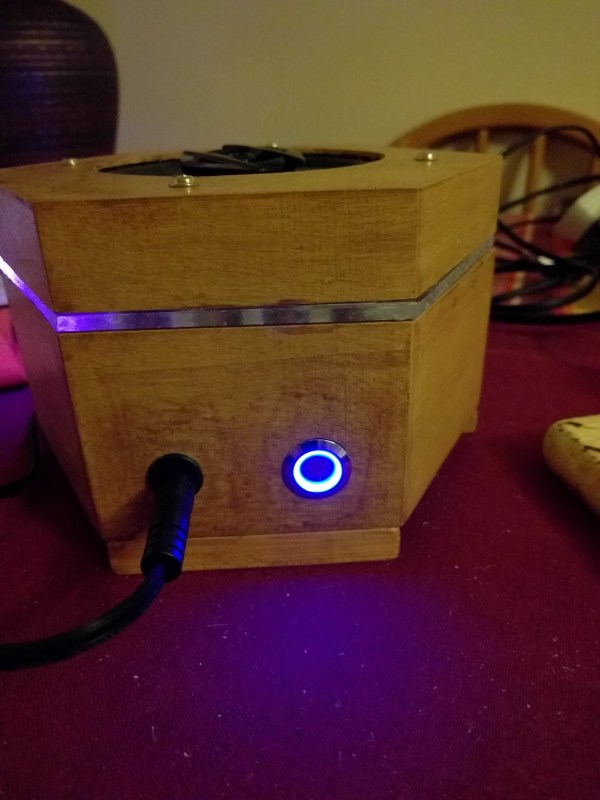
Finding a product that is everything you want isn’t always possible. Making your own that checks off all those boxes can be. [Peter Clough] took the latter route and built a small Bluetooth speaker with an LED visualization display that he calls Magic Box.

A beefy 20W, 4Ohm speaker was screwed to the lid of a wooden box converted to the purpose. [Clough] cut a clear plastic sheet to the dimensions of the box, notching it 2cm from the edge to glue what would become the sound reactive neopixel strip into place — made possible by an electret microphone amplifier. There ended up being plenty of room inside the speaker box to cram an Arduino Pro Mini 3.3V, the RN-52 Bluetooth receiver, and the rest of the components, with an aux cable running out the base of the speaker. As a neat touch, neodymium magnets hold the lid closed.

Continue reading “Bluetooth Speaker With Neopixel Visual Display!” →

Solving IoT Problems With Node.js For Hardware

Tod Kurt knows a thing or two about IoT devices. As the creator of blink(1), he’s shipped over 30,000 units that are now out in the wild and in use for custom signaling on everything from compile status to those emotionally important social media indicators. His talk at the 2016 Hackaday SuperConference covers the last mile that bridges your Internet of Things devices with its intended use. This is where IoT actually happens, and of course where it usually goes astray.

Continue reading “Solving IoT Problems With Node.js For Hardware” →

A Beacon Suitable For Tracking Santa’s Sleigh?

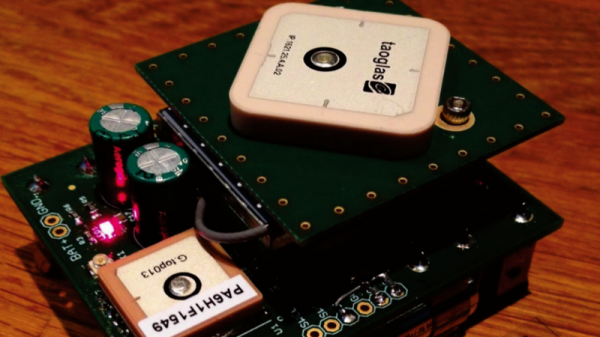
High-altitude ballooning is becoming a popular activity for many universities, schools and hacker spaces. The balloons, which can climb up to 40 km in the stratosphere, usually have recovery parachutes to help get the payload, with its precious data, back to solid ground safely. But when you live in areas where the balloon is likely to be flying over the sea most of the time, recovery of the payload becomes tricky business. [Paul Clark] and his team from Durham University’s Centre for Advanced Instrumentation are working on building a small, autonomous glider – essentially a flying hard drive – to navigate from 30 km up in the stratosphere to a drop zone somewhere near a major road. An important element of such a system is the locator beacon to help find it. They have now shared their design for an “Iridium 9603 Beacon” — a small Arduino-compatible unit which can transmit its location and other data from anywhere via the Iridium satellite network.

The beacon uses the Short Burst Data service which sends email to a designated mail box with its date, time, location, altitude, speed, heading, temperature, pressure and battery voltage. To do all of this, it incorporates a SAMD21G18 M0 processor; FGPMMOPA6H GPS module; MPL3115A2 altitude sensor; Iridium 9603 Short Burst Data module + antenna and an LTC3225 supercapacitor charger. Including the batteries and antenna, the whole thing weighs in at 72.6 g, making it perfectly suited for high altitude ballooning. The whole package is powered by three ‘AAA’ Energizer Ultimate Lithium batteries which ought to be able to withstand the -56° C encountered during the flight. The supercapacitors are required to provide the high current needed when the beacon transmits data.

The team have tested individual components up to 35 km on a balloon flight from NASA’s Columbia Scientific Balloon Facility and the first production unit will be flown on a much smaller balloon, launched from the UK around Christmas. The GitHub repository contains detailed information about the project along with the EagleCAD hardware files and the Arduino code. Now, if only Santa carried this on his Sleigh, it would be easy for NORAD to track his progress in real time.

Ask Hackaday: Dude, Where’s My MOSFET?

(Bipolar Junction) Transistors versus MOSFETs: both have their obvious niches. FETs are great for relatively high power applications because they have such a low on-resistance, but transistors are often easier to drive from low voltage microcontrollers because all they require is a current. It’s uncanny, though, how often we find ourselves in the middle between these extremes. What we’d really love is a part that has the virtues of both.

The ask in today’s Ask Hackaday is for your favorite part that fills a particular gap: a MOSFET device that’s able to move a handful of amps of low-voltage current without losing too much to heat, that is still drivable from a 3.3 V microcontroller, with bonus points for PWM ability at a frequency above human hearing. Imagine driving a moderately robust small DC robot motor forwards with a microcontroller, all running on a LiPo — a simple application that doesn’t need a full motor driver IC, but requires a high-efficiency, moderate current, and low-voltage-logic compatible transistor. If you’ve been here and done that, what did you use?

Continue reading “Ask Hackaday: Dude, Where’s My MOSFET?” →

[CNLohr] Reverses Vive, Valve Engineers Play Along

[CNLohr] needs no introduction around these parts. He’s pulled off a few really epic hacks. Recently, he’s set his sights on writing a simple, easy to extend library to work with the HTC Vive VR controller equipment, and in particular the Watchman controller.

There’s been a lot of previous work on the device, so [Charles] wasn’t starting from scratch, and he live-streamed his work, allowing others to play along. In the process, two engineers who actually worked on the hardware in question, [Alan Yates] and [Ben Jackson], stopped by and gave some oblique hints and “warmer-cooler” guidance. A much-condensed version is up on YouTube (and embedded below). In the links, you’ll find code and the live streams in their original glory, if you want to see what went down blow by blow. Code and more docs are in this Gist.

Continue reading “[CNLohr] Reverses Vive, Valve Engineers Play Along” →