With A Big Enough Laser, The World Is Your Sensor

It’s difficult to tell with our dull human senses, but everything around us is vibrating. Sure it takes more energy to get big objects like bridges and houses humming compared to a telephone pole or mailbox, but make no mistake, they’ve all got a little buzz going on. With their new automated laser, the team behind VibroSight++ believes they can exploit this fact to make city-scale sensing far cheaper and easier than ever before.

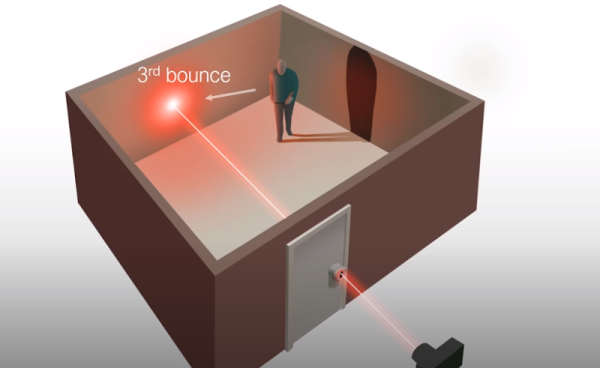
The key to the system is a turret mounted Class 3B infrared laser and photodetector that can systematically scan for and identity reflective surfaces within visual range. Now you might think that such a setup wouldn’t get much of a signal from the urban landscape, but as it so happens, the average city block is packed with retroreflectors. From street signs to road studs and license plates, the team estimates dense urban areas have approximately 7,000 reflectors per square kilometer. On top of those existing data points, additional reflectors could easily be added to particularly interesting devices that city planners might want to monitor.

Once VibroSight++ has identified its targets, the next step is to bounce the laser off of them and detect the minute perturbations in the returned signal caused by vibrations in the reflector. In the video below you can see how this basic concept could be put to practical use in the field, from counting how many cars pass over a certain stretch of road to seeing how popular a specific mailbox is. There’s a whole world of information out there just waiting to be collected, all without having to install anything more exotic than the occasional piece of reflective tape.

If this technology seems oddly familiar, it’s probably because we covered the team’s earlier work that focused (no pun intended) on using reflected laser beams for home automation in 2018. Back then they were aiming a much smaller laser at blenders and refrigerators instead of license plates and street signs, but the concept is otherwise the same. While we’ll admit the technology does give off a distinctive Orwellian vibe, it’s hard not to be intrigued by the “Big Data” possibilities afforded by the team’s upgraded hardware and software.

Continue reading “With A Big Enough Laser, The World Is Your Sensor”

Projecting Moving Images In Air With Lasers

You’ve seen it a million times in science fiction movies and TV shows: a moving holographic display. From Princess Leia asking for help to virtual tennis on Total Recall, it is a common enough idea. [Dan Smalley]’s team at BYU has made progress in projecting moving 3D images in thin air. While they might not be movie quality, they are a start, and, after all, you have to start somewhere.

The display traps a small particle in the air with a laser beam and then moves that particle around, leaving behind an illuminated path in the air. You can see the effect in the video below. The full paper explains how a type of ray tracing allows the relatively small optical trap display to appear larger and more fluid. While it does make images seem to appear behind the display’s actual volume, it also requires eye tracking to work since the illusion only works from a certain perspective.

These are not, of course, technically holograms. That’s actually an advantage in some cases because holograms require a tremendous amount of data that increases rapidly as the size of a display scales up. The optical trap display uses a much more manageable data rate.

We’ve seen optical trap displays before. In fact, volumetric displays seem to be all the rage lately.

Continue reading “Projecting Moving Images In Air With Lasers”

The Laser Power Record Has Been Broken

Lasers do all sorts of interesting things and — as with so many things — more is better. Korean scientists announced recently they’ve created the most powerful laser beam. 1023 watts per square centimeter, to be exact. It turns out that 1022 Watts/cm2 may not be commonplace, but has been done many times already at several facilities, including the CoReLS petawatt (PW) laser used by the researchers.

Just as improving a radio transmitter often involves antenna work instead of actual power increases, this laser setup uses an improved focus mechanism to get more energy in a 1.1 micron spot. As you might expect, doing this requires some pretty sophisticated optics.

Continue reading “The Laser Power Record Has Been Broken”

Air-Assist Analysis Reveals Most Effective — And Quietest — Methods

If there’s one thing that continues to impress us about the Hackaday community as the years roll by, it’s the willingness to share what we’ve learned with each other. Not every discovery will be news to everyone, and everything won’t be helpful or even interesting to everyone, but the mere act of sharing on the off chance that it’ll help someone else is really what sets the hardware hacking world apart.

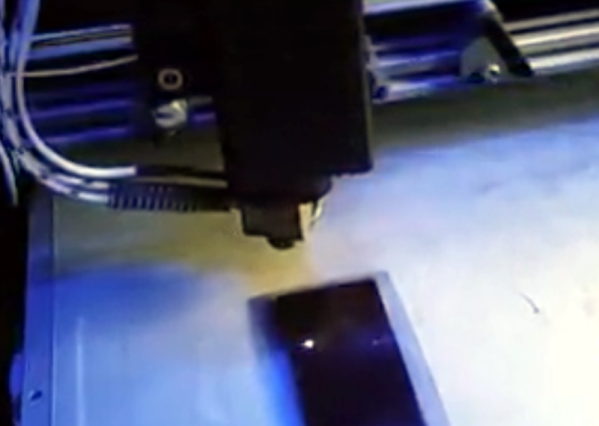
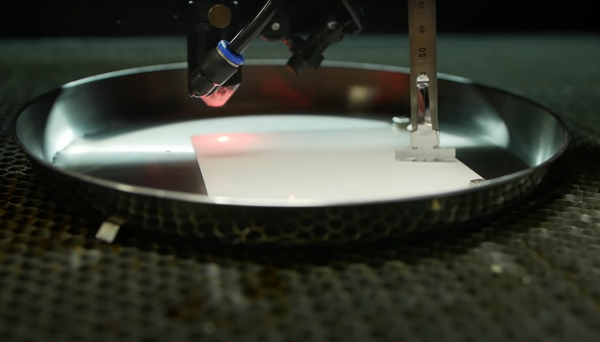
Case in point: this in-depth analysis of laser cutter air-assist methods. Undertaken by [David Tucker], this project reads more like a lab writeup than a build log, because well, that’s pretty much what it is. For those not into laser cutters, an air assist is just a steady flow of air to blow smoke and cutting residue away from the beam path and optics of a laser cutter. It’s simple, but critical; without it, smoke can obscure and reflect the laser beam, foul lenses and mirrors, and severely degrade cut quality.

To see what air-assist methods work best, [David] looked at four different air pumps and compressors, along with a simple fan. Each of these methods was compared to a control of cuts made without air assist. The test was simple: a series of parallel lines cut into particle board with the beam focused on the surface at 80% power, with the cut speed slowly decreasing. It turned out that any air-assist was better than nothing, with the conspicuous exception of using just a fan, which made things worse. Helpfully, [David] included measurements of the noise levels of the compressors he tested, and found there’s no advantage to using an ear-splitting shop compressor over a quieter aquarium air pump. Plus, the aquarium pumps are cheap — always a bonus.

Not sure how to get up to speed with lasers? Laser Cutting 101 might be a great place to start.

Clever Gas Mixer Gets Just The Right Blend For Homebrew Laser Tubes

[Lucas] over at Cranktown City on YouTube has been very busy lately, but despite current appearances, his latest project is not a welder. Rather, he built a very clever gas mixer for filling his homemade CO2 laser tubes, which only looks like a welding machine. (Video, embedded below.)

We’ve been following [Lucas] on his journey to build a laser cutter from scratch — really from scratch, as he built his own laser tube rather than rely on something off-the-shelf. Getting the right mix of gas to fill the tube has been a bit of a pain, though, since he was using a party balloon to collect carbon dioxide, helium, and nitrogen at measuring the diameter of the ballon after each addition to determine the volumetric ratio of each. His attempt at automating the process centers around a so-called AirShim, which is basically a flat inflatable bag made of sturdy material that’s used by contractors to pry, wedge, lift, and shim using air pressure.

[Lucas]’ first idea was to measure the volume of gas in the bag using displacement of water and some photosensors, but that proved both impractical and unnecessary. It turned out to be far easier to sense when the bag is filled with a simple microswitch; each filling yields a fixed volume of gas, making it easy to figure out how much of each gas has been dispensed. An Arduino controls the pump, which is a reclaimed fridge compressor, monitors the limit switch and controls the solenoid valves, and calculates the volume of gas dispensed.

Judging by the video below, the mixer works pretty well, and we’re impressed by its simplicity. We’d never seriously thought about building our own laser tube before, but seeing [Lucas] have at it makes it seem quite approachable. We’re looking forward to watching his laser project come together.

Continue reading “Clever Gas Mixer Gets Just The Right Blend For Homebrew Laser Tubes”

Hacking An Air Assist For The Ortur Laser

Getting great results from a laser cutter takes a bit of effort to make sure all of the settings are just right. But even then, if the air between the material and the laser source is full of smoke and debris it will interfere with the laser beam and throw off the results. The solution is to add air assist which continuously clears that area.

Earlier this year I bought an Ortur laser engraver/cutter and have been hacking on it to improve the stock capabilities. last month I talked about putting a board under the machine and making the laser move up and down easily. But I still didn’t have an air assist. Since then I found a great way to add it that will work for many laser cutter setups.

I didn’t design any of these modifications, but I did alter them to fit my particular circumstances. You can find my very simple modifications to other designs on Thingiverse. You’ll also find links to the original designs and you’ll need them for extra parts and instructions, too. It is great to be able to start with work from talented people and build on each other’s ideas.

Continue reading “Hacking An Air Assist For The Ortur Laser”

Laser-Cut Solder Masks From Business Cards

There are plenty of ways to make printed circuit boards at home but for some features it’s still best to go to a board shop. Those features continue to decrease in number, but not a lot of people can build things such as a four-layer board at home. Adding a solder mask might be one of those features for some, but if you happen to have a laser cutter and a few business cards sitting around then this process is within reach of the home builder too.

[Jeremy Cook] is lucky enough to have a laser cutter around, and he had an idea to use it to help improve his surface mount soldering process. By cutting the solder mask layer into a business card with the laser cutter, it can be held on top of a PCB and then used as a stencil to add the solder paste more easily than could otherwise be done. It dramatically decreases the amount of time spent on this part of the process, especially when multiple boards are involved since the stencil can be used multiple times.

While a laser cutter certainly isn’t a strict requirement, it certainly does help over something like an X-acto knife. [Jeremy] also notes that this process is sometimes done with transparency film or even Kapton, which we have seen a few times before as well.

Continue reading “Laser-Cut Solder Masks From Business Cards”