BeagleBoard Cluster

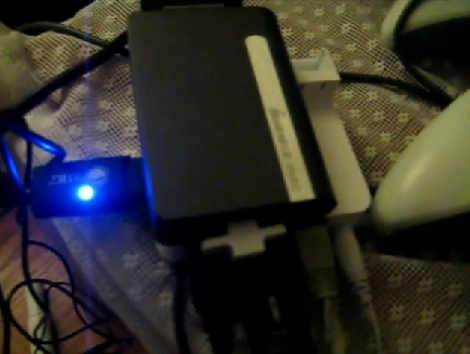
What do you do after you make a BeagleBoard graphing calculator? [Matt] over at Liquidware Antipasto made a BeagleBoard Elastic R Cluster that fits in a briefcase. Ten BeagleBoards, are connected to each other though USB to ethernet adapters and a pair of ethernet switches connected to a wireless router. The cost for this cluster comes in around $2000 and while consuming less than 40 watts of power, out-paces a $4500 laptop. How might you use this cluster? What improvements would you make? Continue reading “BeagleBoard Cluster”

JTAG Programming Over A Network

[Matt Evans] was running up against the common programming gotcha caused by disappearing parallel ports. For years he had used a JTAG parallel cable when working with FPGAs but recently realized he no longer owned any machines with that interface available. Instead of shelling out $50 for a USB programmer he a programming interface from an old router.What he’s doing is bit-banging using Linux. In this case it’s a router running a version of Linux which makes his setup Internet friendly but this could be done in the same basic manner on any Linux device with enough available I/O to connect to the device you are programming.

Command Line Video Processing Using FOSS

[youtube=http://www.youtube.com/watch?v=12fQM7JwwpA]

[Daniel Paluska] is getting away from the point-and-click by editing videos from the command line. Using the free open source software packages FFmpeg, Imagemagick, and Sox he produces new clips from multiple videos with effects like overlaying, slicing, and assigning each video to a different quadrant. The last option would be useful for displaying different angled shots of the same thing all at once but we’re sure you can find a way to use them all. He is using shell scripts to automate some of the process but the commands are still easy enough to understand if this is your first foray into these tools. After all, great video production will go a long way toward becoming an Internet sensation.

Report From ESC Silicon Valley 2010

Ah, the heady aroma of damp engineers! It’s raining in Silicon Valley, where the 2010 Embedded Systems Conference is getting off the ground at San Jose’s McEnery Convention Center.

ESC is primarily an industry event. In the past there’s been some lighter fare such as Parallax, Inc. representing the hobbyist market and giant robot giraffes walking the expo. With the economy now turned sour, the show floor lately is just a bit smaller and the focus more businesslike. Still, nestled between components intended to sell by the millions and oscilloscopes costing more than some cars, one can still find a few nifty technology products well within the budget of most Hack a Day readers, along with a few good classic hacks and tech demos…

Continue reading “Report From ESC Silicon Valley 2010”

Hardware Based Randomness For Linux

True randomness can be hard to come by in the digital world. [Andy Green] is making it easier to get true entropy by using this random USB dongle. The Whirlygig uses a CPDL to gather data from a set of of oscillators. The oscillators have a constantly fluctuating frequency due to temperature changes; if they run faster they generate more heat which in turn slows them down. This, along with the variable latency associated with polling a USB device, gives great depth of randomness. The device is detected and mounted under ‘/dev/hw_random’ and can then be fed into ‘/dev/random’ using the rng-tools package. [Andy’s] done a lot of testing, both on the hardware, and on the quality of randomness. We didn’t see an option to order this but he’s got hardware and firmware repositories so that you can throw one together yourself.

[Thanks Zunk]

Leapfrog Didj: Followup

Yesterday we mentioned the Woot! sale of the Didj, and we had some comments and emails from readers who had purchased one. We couldn’t resist either, and ordered a couple to take apart and modify. We will probably be following the work laid out by [Claude Schwarz], who seems to be one of the leading hackers on the scene. [Claude] has done some work in porting the GP2x libraries to the Didj, which gives a tremendous head start to anyone looking to have a working game system any time soon. There will also be a build log for everyone to follow along at home, and contribute what you want and have, as well as a follow up How-To when a working system is attained. Happy Hacking, everyone.