Infrared Flashlight With Screen Uncovers What’s Hidden

Flashlights are handy around the house, but what if you want a stealthier approach to illuminating the night? Infrared LED flashlights can be acquired at relatively low cost, but where’s the fun in that? To that end [johnaldmilligan] spent a couple hours building an infrared flashlight-gun with an LED display to venture into the night.

[johnaldmilligan] disassembled a handheld spotlight to use as the housing, leaving the trigger assembly and 12V DC charge port in place. A miniature camera was used as the video source after removing its infrared filter. Note: if you do this, don’t forget that you will need to manually readjust the focus! The camera was mounted where LED Array Diagramthe flashlight bulb used to be instead of the LED array since the latter was impractically large for the small space — but attaching it to the top of the flashlight works just as effectively. The infrared LEDs were wired in eight groups of three LEDs in parallel to deliver 1.5V to each bank and preventing burnout. Here is an extremely detailed diagram if that sounds confusing.

Continue reading “Infrared Flashlight With Screen Uncovers What’s Hidden”

From Shop Floor Dust To Carbon Steel

[Chandler Dickinson] did his monthly sweep of the floor in his blacksmith’s shop when it occurred to him that all that metal dust had to go somewhere, didn’t it? So he did the only reasonable thing and made a crude foundry out of cinder blocks, melted his dirt in it, and examined what came out the other end.

His first step was to “pan” for steel. He rinsed all the dirt in a bucket of water and then ran a magnet at the bottom of the bucket. The material that stuck to the magnet, was ripe for reclaimation.

Next he spent a few hours charging a cinderblock foundry with coal and his iron dust. The cinderblocks cracked from the heat, but at the end he had a few very ugly brittle rocks that stuck to a magnet.

Of course there’s a solution to this non-homogenous steel. As every culture with crappy steel eventually discovered, you can get really good steel if you just fold it over and over again.  So he spend some time hammering one of his ugly rocks and folding it a bit. He didn’t get to two hundred folds, but it was enough to show that the resulting slag was indeed usable iron.

He did a deeper examination of the steel last week, going as far as to etch it, after discovering that the metal sparked completely differently when sanded on one side versus the other. It definitely needed work, but all seemed to have worked in the end.

Continue reading “From Shop Floor Dust To Carbon Steel”

The Most Useless Book Scanner

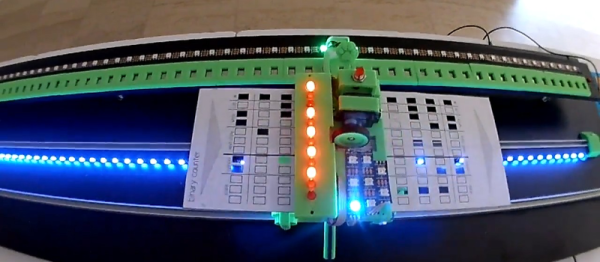
How do artificial intelligences get so intelligent? The same way we do, they get a library card and head on over to read up on their favorite topics. Or at least that’s the joke that [Jakob Werner] is playing with in his automaton art piece, “A Machine Learning” (Google translated here).

Simulating a reading machine, a pair of eyeballs on stalks scan left-right and slowly work their way down the page as another arm swings around and flips to the next one. It’s all done with hand-crafted wooden gears, in contrast to the high-tech subject matter. It’s an art piece, and you can tell that [Jakob] has paid attention to how it looks. (The all-wooden rollers are sweet.) But it’s also a “useless machine” with a punch-line.

Is it a Turing test? How can we tell that the machine isn’t reading? What about “real” AIs? Are they learning or do they just seem to be? OK, Google’s DeepMind is made of silicon and electricity instead of wood, but does that actually change anything? It’s art, so you get license to think crazy thoughts like this.

We’ve covered a few, less conceptual, useless machines here. Here is one of our favorite. Don’t hesitate to peruse them all.

Vending Coins For Your Vending Machine

Anyone who has worked in an office with a vending machine knows this problem well: someone wants a snack or a drink from the vending machine, but doesn’t have any small change. So, they proceed to walk around the office trying to find someone to make some change for them. It’s a hassle, and a surprisingly common one. Sure, a lot of vending machines now accept credit cards, but they’re still in the minority.

This was the problem facing Belgium-based automation company November Five. As automation and IoT specialists, their first thought was to hack the vending machine itself. But, unfortunately, they didn’t own it; as many of you know, vending machines are generally owned by the distributor. So, they needed a solution that allowed their employees access to the vending machine, without actually modifying the vending machine itself.

The solution they came up with was to attach an RFID-activated coin dispenser to the vending machine. Everyone at the company already has an RFID badge for opening doors and such, so the system wouldn’t add any burden to the employees. And keeping track of how many coins each employee used was a simple task of logging requests.

Continue reading “Vending Coins For Your Vending Machine”

NFL To Experiment With Chipped Balls

NFL preseason starts in just a few weeks. This year, it will come with a bit of a technological upgrade. The league plans to experiment with custom microchip-equipped footballs. Unfortunately, this move has nothing to do with policing under-inflation — the idea is to verify through hard data that a narrower set of goal posts would mean fewer successful kicking plays.

Why? Kicking plays across the league have been more accurate than ever in the last couple of seasons, and the NFL would like things to be a bit more competitive. Just last year, extra point kicks were moved back from the 20 to the 33-yard line. Kickers already use brand-new balls that are harder and more slippery than the field balls, so narrowing the goal from the standard 18’6″ width is the natural next step. A corresponding pair of sensors in the uprights will reveal exactly how close the ball is when it passes between them.

The chips will only be in K-balls, and only in those kicked during the 2016 preseason. If all goes well, the league may continue their use in Thursday night games this season. We couldn’t find any detail on these custom-made chips, but assume that it’s some kind of transmitter/receiver pair. Let the speculation begin.

Main image: Field goal attempt during the Fog Bowl via Sports Illustrated

[via Gizmodo]

Droolworthy Animatronic Stargate Horus Helmet

It’s incredibly likely that, unless you own one of the original movie props, your Stargate Horus helmet is not as cool as [jeromekelty]’s. We say this with some confidence because [jerome] got access to the original molds and put in an incredible amount of time on the animatronics. (See his latest video embedded below.)

Surprisingly, a number of the parts for this amazing piece were bought off the shelf. The irises that open and close they eyes, for instance, were bought on eBay. This is not to downplay the amount of custom design, though. The mechanism that moves the feathers is a sight to see, and there’s a lot of hand-machined metal holding it all together. But the payoff is watching the thing move under remote control. The eye dimming and closing, combined with the head movements, make it look almost alive.

Continue reading “Droolworthy Animatronic Stargate Horus Helmet”

20kW Light Is As Bright As You’d Expect

[Photonicinduction] purchased a very very bright light. This 20,000 Watt half meter tall halogen will just about light the back of a person’s skull with their eyes closed. These are typically used to light film sets.

Most people couldn’t even turn such a light on, but [Photonicinduction] is a mad scientist. Making lightning in his attic, it’s easy to mentally picture him as the villain in a Sherlock Holmes novel. Luckily for us, if he has any evil tendencies, they are channeled into YouTube videos.

He gives a good description of the mechanical and electrical properties of the light. The body is as one would expect for an incandescent light. A glass filament envelope with the filaments supported within. The envelope is evacuated and filled with an appropriate gas. This light is dangerous enough that the outside must be thoroughly cleaned of fingerprints to keep a hot-spot from forming, which could cause the lamp to explode.

After some work, he managed to convince himself that the filaments within were not, in fact, garage door springs, and gave a demonstration of their properties. For example, their resistance goes up as they are heated. In order to keep from tripping the power supply, filaments this large must be preheated. Failure to do so passes a very large number of amps.

The next step was to hook the lamp up to his home-made 20 kW power supply. He gives a good demonstration of just how bright it is. Within seconds he’s sweating from the heat and definitely can’t even open his eyes to see with the tiny sun occupying the center of his abode. Video after the break.

Continue reading “20kW Light Is As Bright As You’d Expect”