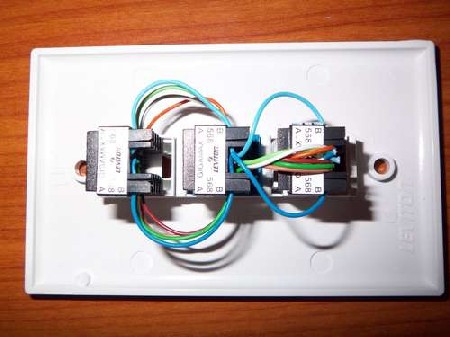
Making a passive network tap can be an easy and inexpensive undertaking as shown in this Instructable. Passive monitoring or port mirroring is needed because most networks use switches which isolate the network traffic and this does not allow for the entire network to be monitored. This example uses a single tap, using multiple taps will provide access to the full-duplex data separately. By using two taps you are able to monitor inbound data that is passed through one tap, and outbound data that is passed through the other tap. Separate taps are desired because most sniffer software handles half-duplex traffic only and requires two network cards for full-duplex.
Misc Hacks4028 Articles
Cheap USB LCD

Part of the pre-Vista hype was the idea of auxiliary displays. Laptop and desktop displays would provide additional information from your computer. The Vista SideShow feature hasn’t really caught on and the surplus hardware has started to drop in price. Take this PicoLCD for example: It’s a 4×20 character LCD with an IR receiver, multiple buttons, and a USB connection. The best part is: it has Linux drivers and an open source SDK. We know a lot of you like wiring up HD44780 based screens, but it’s hard to pass up a $50 prepackaged solution with such nice extras.
[via Engadget]
Reverse Engineering Silicon Logic
![]()
[Karsten Nohl] has recently joined the team on Flylogic’s blog. You may remember him as part of the team that reverse engineered the crypto in MiFare RFID chips. In his first post, he starts out with the basics of identifying logic cells. By studying the specific layout of the transistors you can reproduce the actual logic functions of the chip. The end of post holds a challenge for next week (pictured above). It has 34 transistors, 3 inputs, 2 outputs, and time variant behavior. Also, check out the Silicon Zoo which catalogs individual logic cells for identification.
LED Coffee Table

Spark Fun’s centerpiece at Maker Faire back in May was this LED coffee table. They just recently posted about how it was constructed. The surface is made from 64 8×8 RGB LED matrix boards totaling 4096 LEDs. The eight rows are connected to a custom router board so that one SPI line can control the entire display. The main microcontroller is an Olimex LPC2106 dev board. It runs a four player cooperative pong game where multiple balls are added over time. Each player gets a classic Atari paddle for control. You can see a video of the table running a screensaver after the break. Continue reading “LED Coffee Table”
A Console For Retro Games

Like many nerds, we have our share of retro video games and nonworking consoles lying around. Every so often we feel like dragging one out and hoping it works.. Luckily for us, the Super Genintari is available to fulfill our fantasies of beating Ghosts ‘N Goblins. The Super Genintari is an Atari 2600, NES, SNES and Sega Genesis all rolled into one; you can even put in four cartridges at once and hook it up to your television with a simple AV cable.
[via DVICE]
Large Hadron Collider Roundup
[youtube=http://www.youtube.com/watch?v=qQNpucos9wc]
The Large Hadron Collider was a success and it didn’t destroy the world. We have to admit, we were a little bit worried about the possibility of generating black holes but were soothed by scientists’ reassurances that we would still exist, and this self-explanatory website. We’re also kind of hoping to build our own. PHD Comics visits CERN to learn all about the experiment. Xkcd prepares for the end times with a new friend. The curious can explore some amazing imagery of the LHC, and read about the best-and-worst-case scenarios, and what scientists are hoping for, or monitor progress via webcam. The celebratory will listen to appropriate music, consume inspired science fiction, and drink to the Large Hadron Collider and its success.
Turn Your Playstation 3 Into Linux-based Lab Equipment

In a two-part series called “PS3 Fab-to-lab” on IBM’s awesome developerWorks website, [Lewin] explains how to use the Cell Broadband Engine in a PS3 to create an audio-bandwidth spectrum analyzer and function generator. The set up consists of Yellow Dog Linux, an NTSC television, and an external USB sound card to provide the inputs of the spectrum analyzer and the outputs of the function generator. The sound card driver is written to simply capture or send the info in question (audio range only) and the NTSC television as the graphical interface. This hack involves a lot of coding with hardly any example code provided. The article is more of a guide than anything. If anyone gets this working, let us know!
[via Digg]
[photo: Malcom Tredinnick]