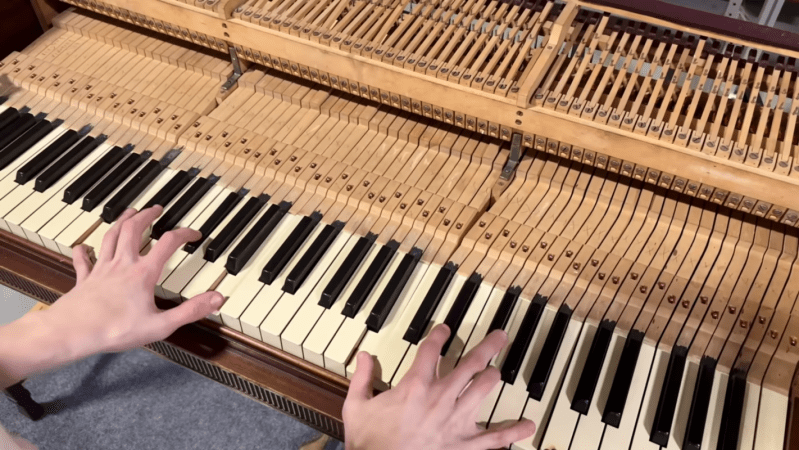
Extremely Rare Electric Piano Restoration

Not only are pianos beautiful musical instruments that have stood the test of many centuries of time, they’re also incredible machines. Unfortunately, all machines wear out over time, which means it’s often not feasible to restore every old piano we might come across. But a few are worth the trouble, and [Emma] had just such a unique machine roll into her shop recently.

What makes this instrument so unique is that it’s among the first electric pianos to be created, and one of only three known of this particular model that survive to the present day. This is a Vivi-Tone Clavier piano which dates to the early 1930s. In an earlier video she discusses more details of its inner workings, but essentially it uses electromagnetic pickups like a guitar to detect vibrations in plucked metal reeds.

To begin the restoration, [Emma] removes the action and then lifts out all of the keys from the key bed. This instrument is almost a century old so it was quite dirty and needed to be cleaned. The key pins are lubricated, then the keys are adjusted so that they all return after being pressed. From there the keys are all adjusted so that they are square and even with each other. With the keys mostly in order, her attention turns to the action where all of the plucking mechanisms can be filed, and other adjustments made. The last step was perhaps the most tedious, which is “tuning” the piano by adjusting the pluckers so that all of the keys produce a similar amount or volume of sound, and then adding some solder to the reeds that were slightly out of tune.

With all of those steps completed, the piano is back in working order, although [Emma] notes that since these machines were so rare and produced so long ago there’s no real way to know if the restoration sounds like what it would have when it was new. This is actually a similar problem we’ve seen before on this build that hoped to model the sound of another electric instrument from this era called the Luminaphone.

Continue reading “Extremely Rare Electric Piano Restoration”
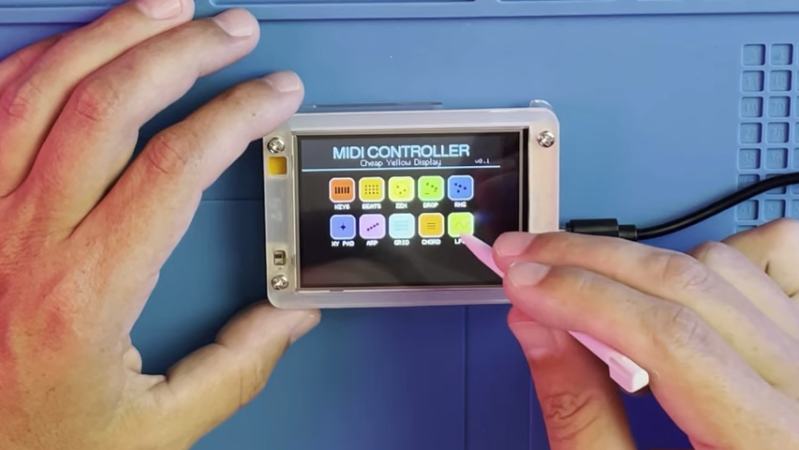
A Touchscreen MIDI Controller For The DIY Set

MIDI controllers are easy to come by these days. Many modern keyboards have USB functionality in this regard, and there are all kinds of pads and gadgets that will spit out MIDI, too. But you might also like to build your own, like this touchscreen design from [Nick Culbertson].

The build takes advantage of a device colloquially called the Cheap Yellow Display. It consists of a 320 x 240 TFT touchscreen combined with a built-in ESP32-WROOM-32, available under the part number ESP32-2432S028R.

Continue reading “A Touchscreen MIDI Controller For The DIY Set”

Quiet Your Drums With An Electronic Setup

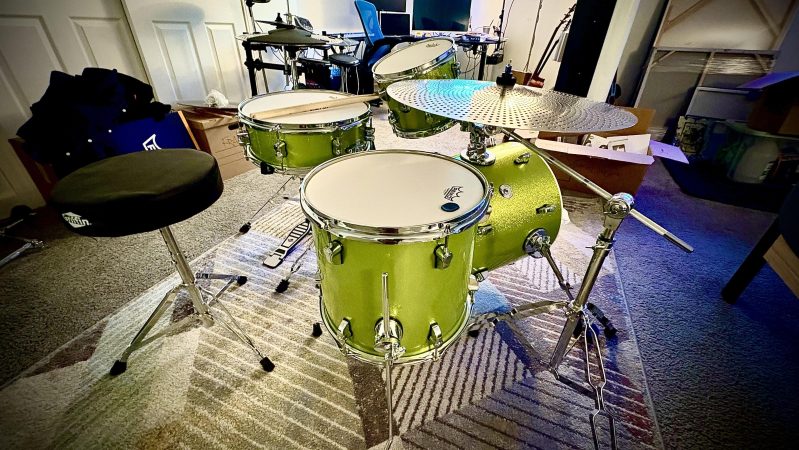
Playing the drums requires a lot of practice, but that practice can be incredibly loud. A nice workaround is presented by [PocketBoy], in converting an acoustic kit to electronic operation so you can play with headphones instead.

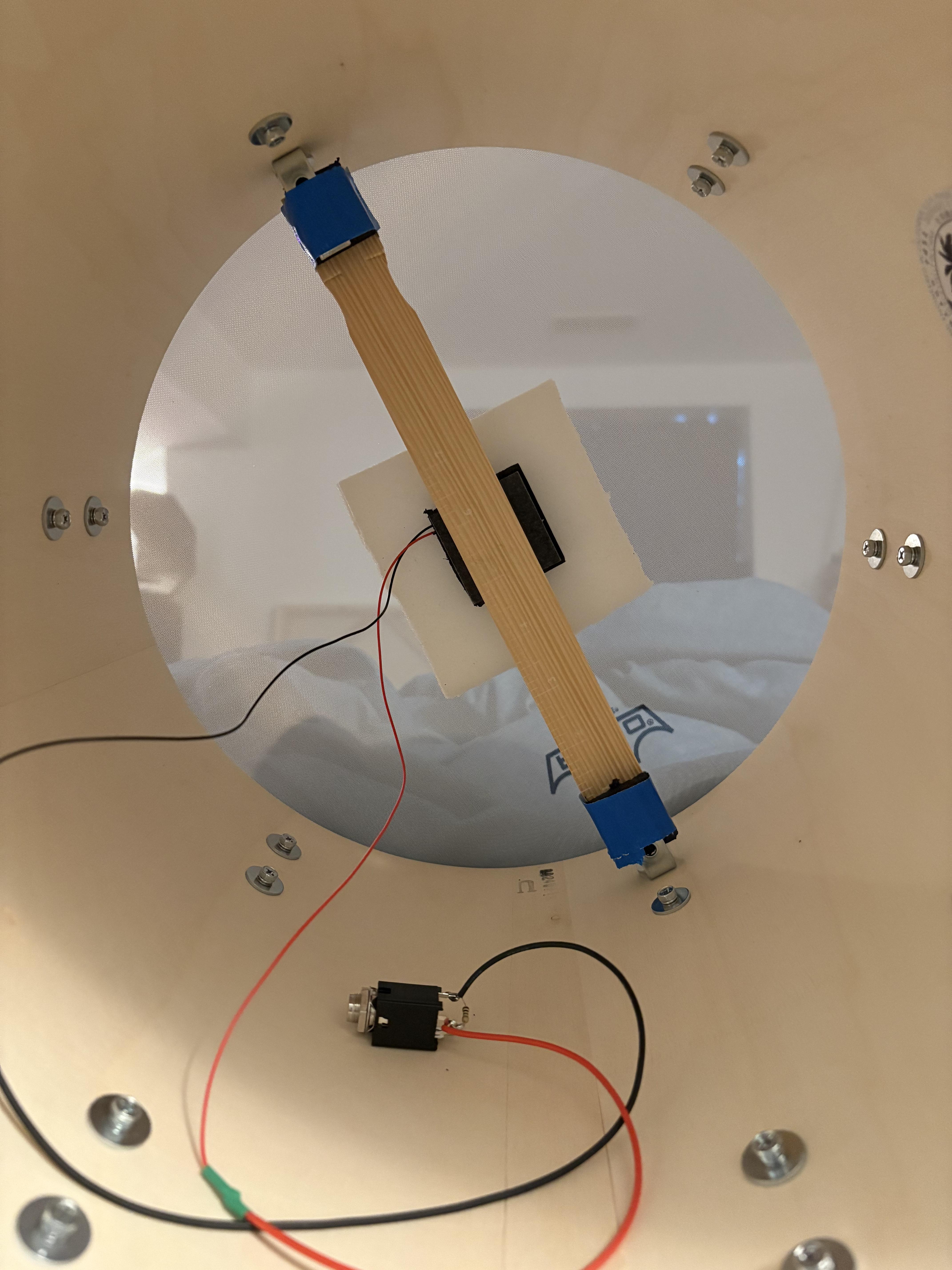
A sensor installed inside a floor tom.

It might sound like a complicated project, but creating a basic set of electronic drums can actually be quite simple if you’ve already got an acoustic kit. You just need to damp all the drums and cymbals to make them quieter, and then fit all the individual elements with their own piezo sensors. These are basically small discs that can pick up vibrations and turn them into electricity—which can be used to trigger an electronic drum module.

[PocketBoy]’s build started with a PDP New Yorker kit, some mesh heads to dull the snares and toms, and some low-volume cymbals sourced off Amazon. Each drum got a small piezo element, which was soldered to a 6.5mm jack for easy hookup. They’re installed inside the drums on foam squares with a simple bracket system [PocketBoy] whipped up from hardware store parts. A DDrum DDti interface picks up the signals from the piezo elements and sends commands to an attached PC. It’s paired with Ableton 12 Lite, which plays the drum sounds as triggered by the drummer.

[PocketBoy] notes it’s a quick and dirty setup, good for quiet practice but not quite gig-ready. You’d want to probably just run it as a regular acoustic kit in that context, but there’s nothing about the conversion that prevents that. Ultimately, it’s a useful project if you find yourself needing to practice the drums quietly and you don’t have space for a second electric-only kit. There’s lots of other fun you can have with those piezos, too. Video after the break.

Continue reading “Quiet Your Drums With An Electronic Setup”

Building A Simple Ribbon Synth

The usual input device for playing a synthesizer is the good old piano keyboard. However, you don’t have to stick to such pedestrian interfaces when making music. [Daisy] has a fun build that shows us how to put together a ribbon synth that makes wonderful little noises.

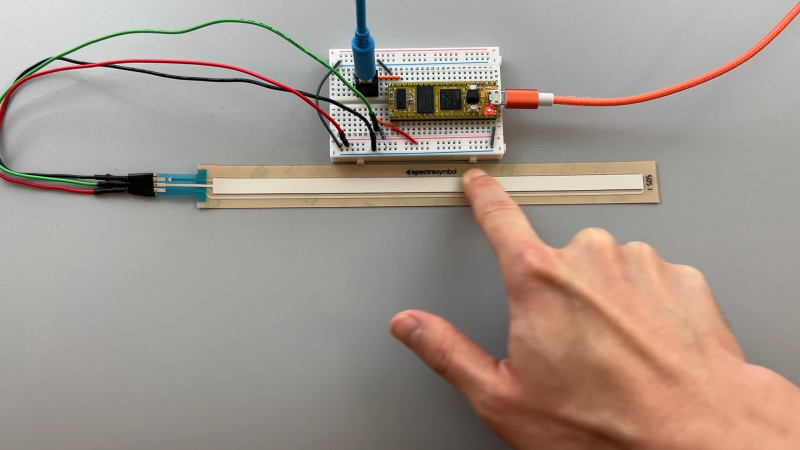
Naturally, the heart of the build is a ribbon potentiometer (also known as soft pots). It’s essentially a touch sensitive strip that changes in resistance depending on where you touch it. You can slide your finger up and down to vary the output continuously; in musical contexts, they can behave rather like a fretless instrument. [Daisy] employs one of these potentiometers in such a role by hooking it up to a Daisy Seed microcontroller board, which reads it with an analog-to-digital converter (ADC). The resistance values are used to vary the pitch of a dual-saw synthesizer programmed in the plugdata framework.

We’ve featured some other great ribbon synths over the years, too, like this tribute to the Eowave Persephone. They’re not the ideal choice for those that prefer their notes on pitch, but they’re beautifully fun to play with when you’re getting a little more experimental.

Continue reading “Building A Simple Ribbon Synth”

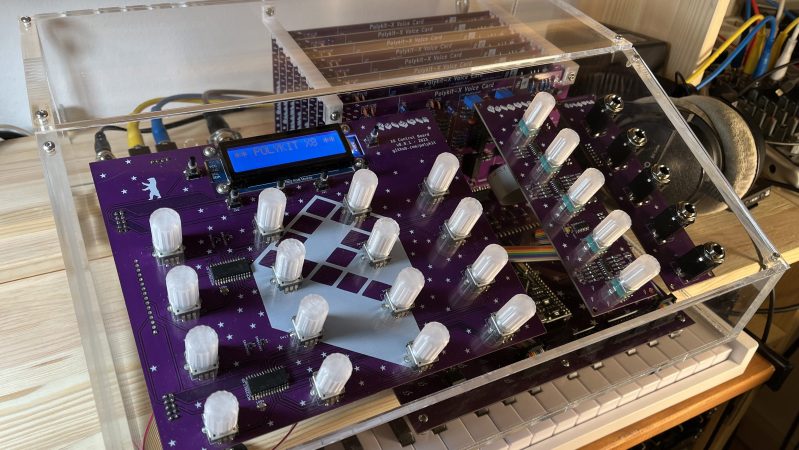
The synth in question in its acrylic case.

DIY Polyphonic Synth Sings In 8-Part Harmony

There’s just something about an analog synthesizer. You’d think that for electronic music, digital sampling would have totally taken over by now, but that’s really not true. The world of analog synths is alive and well, and [Polykit] has a new, open-source polyphonic synthesizer to add to the ever-growing chorus of electronic instruments.

The analog part is thanks to the eight identical voice cards that plug into the machine’s mainboard: each one has a voltage controlled oscillator to generate tones, an envelope generator, multiple voltage-controlled amplifiers, and even a pole mixing filter which is also, yes, voltage controlled. Each voice card outputs stereo, and yes, there are controllable mixing circuits for left and right output.

All that voltage control means a lot of lines from digital-to-analog converters (DACs), because while this is an analog synth, it does have a MIDI interface, and that means that a microcontroller needs to be able to speak voltage. In this case, the brains are an ATmega2560. Instead of stacking the board with enough expensive DACs to interpret the MCU’s digital signals, [Polykit] is instead is using some clever tricks to get more work out of the one DAC he has. Some things get tied together on all eight voices, like the envelope parameters; other values are run through a demultiplexer to make the most possible use of the analog lines available. Of course that necessitates some latching circuitry to hold the demuxed values on those lines, but it’s still cheaper than multiple high-quality DACs.

It’s a well-thought out bit of kit, down to the control panel and acrylic case, and the writeup is worth reading to get the full picture. The voice cards, main board and control board all have their own GitHub repositories you can find at the bottom of the main page. If you’re into video, [Polykit] has a whole series on this project you might want to check out on Makertube; we’ve embedded the first one below.

If you want to get your toes wet in the wonderful world of synthesizers, this library of seventy synths is an amazing place to start, because it has great simple projects.

Thanks to [Polykit] for the tip!

Continue reading “DIY Polyphonic Synth Sings In 8-Part Harmony”

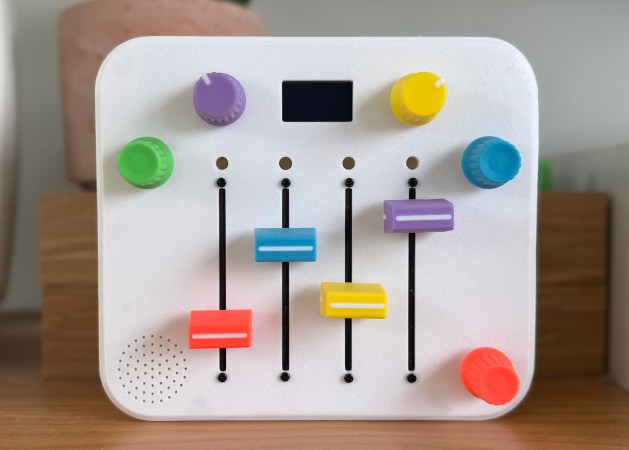
A small, colorful synth built for a 3-year-old. It has five pots, four sliders, and a tiny screen.

Baby’s First Synth Was Daddy’s First Project

We absolutely adore inspired labor-of-love tales such as this one. [Alastair] wanted to build a synth for his daughter’s third birthday in spite of having no prior hardware knowledge. It became the perfect excuse to learn about CAD, microcontrollers, PCB design, and of course, 3D printing.

So, why a synth for a toddler? Aside from plain old ‘why not?’, the story goes that she received a Montessori busy-type board which she seemed to enjoy, and it reminded [Alastair] of the control surface of a synth. He wondered how hard it could be to build something similar that made sound and didn’t require constant button presses.

[Alastair] began his journey by dusting off a 15-year-old Arduino Inventors Kit. The initial goal was to get potentiometer readings and map them to 12 discrete values, and then emit MIDI messages. This was easy enough, and it was time to move to a synth module and an Elegoo Nano.

The full adventure is definitely worth the read. Be sure to check out the pink version in action after the break. You really don’t wanna miss the lil’ panda bear. Trust us.

Continue reading “Baby’s First Synth Was Daddy’s First Project”

3D Printing A Piano Action

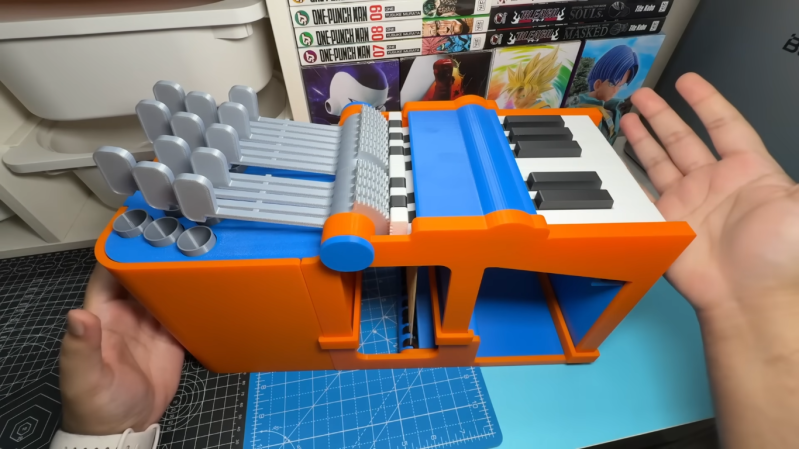
Part of the reason there are always free pianos on your digital classifieds listing of choice is that, at least economically speaking, a piano is less of a musical instrument and more of a complicated machine that can and will wear out (not to mention the physical difficulty of actually moving one). Once a piano reaches that point, whether through age, use, or neglect, at that point it’s to intents and purposes worthless. But still, they’re essentially just machines. [Toast] figured that, since 3D printers not only can print all kinds of other machines and musical instruments alike, he would take a stab at combining these two and made his own 3D printed piano.

A piano’s action is the mechanical linkage between the keys and the strings of the piano themselves. Over many hundreds of years this has developed into a complicated series of levers which not only rapidly strike strings when a key is pressed, but also mute the strings while the key is not being pressed and strike the strings in a way that the hammer won’t be pressed into the strings if the player leaves their finger on a key. Rather than try to recreate all of this in meticulous detail, [Toast] has swapped out the strings for a series of tubes which, unlike strings, do not much change their musical behavior if the hammer remains on the tube after being struck. This greatly simplifies the action (and cost) of his miniature piano.

The piano works by positioning hammers above these tubes, which strike downwards when a musician depresses the keys. Rubber bands return the hammers to their upright positions after the key is lifted. The instrument went through a few stages of design as well where [Toast] refined the size and shape of the tubes as well as improved the way by which the hammers are attached to the keys.

Is it still a piano if it has pipes instead of strings? Perhaps, but at the very least we can all agree that he’s built a working keyboard action capable of producing music, if not an outright definitionally-accurate piano. It’s an interesting build that we hope to see more iterations of in the future, if not to build a more functionally accurate 3D printed piano action then to see what is possible from a 3D printer in the piano space. Despite their complexity and weight, pianos are a fundamental and popular instrument in the Western music tradition and we’ve seen many interesting builds around them like this modern player piano built with a series of solenoids. Continue reading “3D Printing A Piano Action”