Plucky Kalimba Plays Itself

[Gurpreet] fell in love with the peaceful, floaty theme from the Avatar series and bought a kalimba so he could hear it resonate through his fingertips. He soon realized that although it’s nice to play the kalimba, it would be a lot cooler if it played itself. Then he could relax and enjoy the music without wearing out his thumbs.

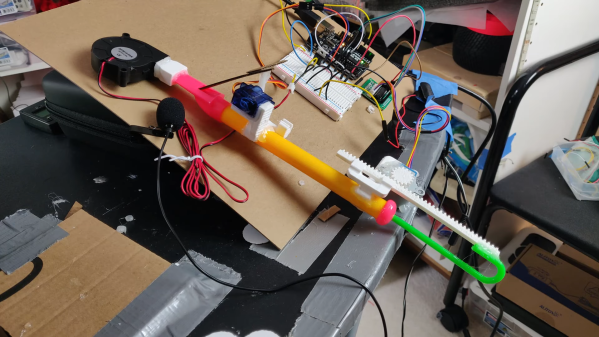
After doing a bit of experimentation with printing tine-plucking extensions for the servo horns, [Gurpreet] decided to start the design process by mounting the servos on a printed base. The servos are slotted into place by their mounting tabs and secured with hot glue. We think this was a good choice — it’s functional and it looks cool, like a heat sink.

[Gurpreet]’s future plans include more servos to pluck the rest of the tines, and figuring out how feed it MIDI and play it real time. For the demo after the break, [Gurpreet] says he lapel mic’d the kalimba from the back and cut out the servo noise with Audacity, but ultimately wants to figure out how to quiet them directly. He’s going to try lubing the gears and making a sound-dampening enclosure with foam, but if you have any other ideas, let him know down below.

We don’t see too many kalimba projects around here, but here’s one connected to a Teensy-based looper.

Continue reading “Plucky Kalimba Plays Itself”

An Arduino-Based Flute Playing Machine

It’s one thing to be able to transcribe music from a flute, and it’s another to be able to make a flute play pre-written music. The latter is what [Abhilash Patel] decided to pursue in the flute player machine, an Arduino-based project that uses an air flow mechanism and PVC pipes to control the notes produced by a makeshift flute. It’s currently able to play 17 notes, just over two octaves starting from the lowest frequency of E.

In order to play songs, the tones have to either be directly coded and uploaded to the Arduino, composed with a random note generator, or detected from a microphone. While a real flute can be used for the machine, [Patel] uses a PVC flute, constructed with some knowledge of flute playing.

The resonant frequency is based on the effective length, hole sizes, and pipe diameter, so it is fairly difficult to correctly tune a homemade flute. Nevertheless, calculating the length as c/2f where c is the speed of sound (~345 m/s) and f is the frequency of the note can help with identifying the location of the holes. [Patel] cut the PVC pipe and sealed off one end, drilling a blowing hole at 1.5 x the pipe diameter. After playing the flute, the end of the pipe was filled until the frequency exactly matched the desired note.

The hole covering uses cuttings of pipe attached to a cable connecting to a servo. The motors are isolated inside a box to keep the wires clear and area all able to be powered with 5 V. As for the software, the code is primarily used to control when the fan is blowing and which holes are covered to produce a note.

Listen to the flute play “My Heart Will Go On” from Titanic in the video below. Now the next step might just be making the flute playing machine automatically play sheet music – imagine the possibilities!

Continue reading “An Arduino-Based Flute Playing Machine”

Fabric(ated) Drum Machine

Some folks bring out an heirloom table runner when they have company, but what if you sewed your own and made it musical? We’d never put it away! [kAi CHENG] has an Instructable about how to recreate his melodic material, and there is a link to his website, which describes his design process, not just the finished product. We have a video below showing a jam session where he exercises a basic function set.

GarageBand is his DAW of choice, which receives translated MIDI from a Lilypad. If you don’t have a Lilypad, any Arduino based on the ATmega328P chip should work seamlessly. Testing shows that conductive threads in the soft circuit results in an occasional short circuit, but copper tape makes a good conductor  at the intersections. Wide metallic strips make for tolerant landing pads beneath modular potentiometers fitted with inviting foam knobs. Each twist controls a loop in GarageBand, and there is a pressure-sensitive pad to change the soundset. Of course, since this is all over MIDI, you can customize to your heart’s content.

MIDI drums come in all shapes and sizes, from a familiar game controller to hand rakes.

Continue reading “Fabric(ated) Drum Machine”

The Hacker History Of Music Technologies

Music throughout history has been inspired and changed by hackers and makers, and never moreso than in the 20th century. Helen Leigh is one such hacker, who brought a talk to Supercon to give us a crash course in the history of recording, electronics and music, and what the maker movement is doing in the music world today.

The tape recorder was an invention that kicked off a golden period of exploration in sound. Beginning in World War II, the Nazi propaganda machine cut and spliced recorded materials and disseminated them across broadcasting stations in Europe. To the astonishment of the Allies, certain German officials appeared to be making broadcasts from different studios at the same time, due to the high quality of the recording hardware. After the war, this technology was discovered by a group of Parisian recording artists who began to experiment with an art that became known as musique concrète, using tape hardware in weird and wonderful ways to create new sounds heretofore unheard in nature.

Continue reading “The Hacker History Of Music Technologies”

AirBass Lets You Jam Wherever

If you play an instrument, you know how rewarding it is to watch and hear yourself reproduce your favorite songs and make new melodies. But you also know how steep the learning curve can be, how difficult it is to learn positions and notes while your body adjusts to the physical side. For stringed instruments, that means gaining muscle memory, growing fingertip calluses, and getting used to awkward arm positions.

For their final project in [Bruce Land]’s class on designing with microcontrollers, [Caitlin, Jackson, and Peter] decided to make a more accessible bass guitar. For starters, it can be placed flat on a table similar to a pedal steel guitar to get around those awkward arm positions. Instead of plucking or slapping the strings, the player wears a glove with a flex resistor on each finger, and plays the string by curling and uncurling their finger.

We think the team’s implementation of the left hand duties and fretboard is pretty clever. Each of the four strings has a break-beam detection circuit, and a single distance sensor decides where the finger is along the fretboard. Another great thing about this backpack-sized bass is that it never needs tuning. If you stay tuned, you can hear [Peter] play “Smoke On the Water” after the break.

There’s more than one way to make an air guitar — this one that does it with LIDAR.

Continue reading “AirBass Lets You Jam Wherever”

Baby’s First Jukebox Is Fun For Parents, Too

Believe it or not, there’s a $400 toy mp3 player out there for kids. It looks pretty nice, with colorful buttons and a wood console and all, but those features don’t really justify the price tag. [DerThes] wanted one for his 2-year-old anyway, so he made his own ruggedized version for a whole lot less.

The simple and kid-friendly interface lets [DerThes Jr.] choose from one of nine albums to play by pushing one of the candy-colored buttons. The bottom row of buttons handle play/pause and moving through the track list. When mom and dad get tired of listening to whatever the kids are into these days, they can enter the special god mode code to access 99 of their favorite albums.

This baby boombox is built with an Arduino Uno and an Adafruit music maker shield. [DerThes] etched his own PCB to hold the buttons and the pair of shift registers needed to interface them with the Uno. If you’ve never etched before, here’s a good chance to dip your toe in the ferric chloride, because [DerThes] has the transparency in his repo and a line on a nice instructional video.

If you don’t think your toddler is ready to respect a field of momentaries, you could make a jukebox with NFC blocks.

[via Arduino blog]

Turning Sounds From A Flute Into Sheet Music

Composing music can be quite difficult – after all, you have to keep in mind all of the elements of musical theory, from time signature and key signature to the correct length for all of the notes. A team of students from Cornell University’s Designing with Microcontrollers class developed a solution for this problem by transcribing sounds from a flute into sheet music.

The project doesn’t simply detect the notes played – it is able to convert the raw audio into a standardized music score complete with accurate note timings and beats per minute. Before transcribing the music, some audio processing was necessary. The team chose to use a Sallen-Key filter to amplify the raw audio input due to its complex conjugate poles. They then used a fast Fourier Transform (FFT) to determine the frequency for the input note, converting the signal from the time domain to the frequency domain.

The algorithm samples the data to generate an input signal, using the ADC on the microcontroller to receive input from the microphone. It takes the real and imaginary components of the sampled signals and outputs a pair of real and imaginary amplitude components corresponding to the sampled frequency, evenly spaced from 0 to the Nyquist rate (half the sampling rate). The spacing of these bins and the bin with the largest amplitude are used to convert the signal back to a real frequency and a MIDI note.

The system uses a PIC32 for the logic. The circuitry for the microphone amplification uses a non-inverting op-amp with a gain of 50 to increase the microphone output signal amplitude from 15 mV to 750 mV to use by the microcontroller’s ADC. The signal is then sent to the anti-aliasing Sallen-Key filter, with a pole at 2.5 kHz and a Q of 1. The frequency was chosen since the FFT samples at 8 kHz and the frequency corresponds to a note out of the range of a flute. As for the filters, only the low pass filter was implemented in hardware.  While a bandpass filter could have been implemented in hardware, the team decided on a cleaner software approach.

The project is well-documented on the team’s project page, and it’s certainly worth checking out for more detailed discussions on the keypad controls and the software side of the audio processing. If you want to learn more about the FFT, check out this 2016 Hackaday Prize entry for an FFT spectrum analyezer.

Continue reading “Turning Sounds From A Flute Into Sheet Music”