How To Restore A Musical Amiga

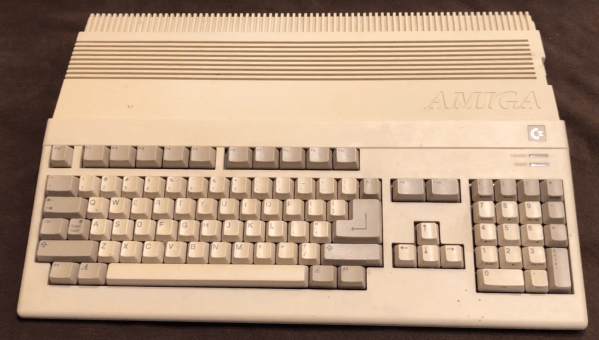
Despite the huge strides in computing power and functionality that have been achieved in the past few decades, there are still some things that older computers can do which are basically impossible on modern machines. This doesn’t just include the ability to use older hardware that’s now obsolete, either, although that is certainly a perk. In this two-part restoration of an Amiga 500, [Jeremy] shows us some of these features like the ability to directly modify the audio capabilities of this retro machine.

The restoration starts by fixing some damage and cleaning up the rest of the machine so it could be powered up for the first time in 30 years. Since it was in fairly good shape he then started on the fun part, which was working with this computer’s audio capabilities. It includes a number of amplifiers and filters in hardware that can be switched on or off, so he rebuilt these with new op-amps and added some new controls so that while he is using his MIDI software he can easily change how it sounds. He also restored the floppy disk drives and cleaned up the yellowing on the plastic parts to improve the overall appearance, as well as some other general improvements.

These old Amigas have a lot going for them, but since [Jeremy] is a musician he mostly focused on bringing back some of the musical functionality of his childhood computer, although he did build up a lot of extra features in this machine as well. These types of audio circuits are not something found in modern computers, though, so to get a similar sound without using original hardware you’ll need to build something like this NES audio processing unit programmed in Verilog.


Continue reading “How To Restore A Musical Amiga”

This Week In Security: GitHub Actions, SHA-1 Retirement, And A Self-Worming Vulnerability

It should be no surprise that running untrusted code in a GitHub Actions workflow can have unintended consequences. It’s a killer feature, to automatically run through a code test suite whenever a pull request is opened. But that pull request is run in some part of the target’s development environment, and there’s been a few clever attacks found over the years that take advantage of that. There’s now another one, what Legit Security calls Github Environment Injection, and there were some big-name organizations vulnerable to it.

The crux of the issue is the $GITHUB_ENV file, which contains environment variables to be set in the Actions environment. Individual variables get added to this file as part of the automated action, and that process needs to include some sanitization of data. Otherwise, an attacker can send an environment variable that includes a newline and completely unintended environment variable. And an unintended, arbitrary environment variable is game over for the security of the workflow. The example uses the NODE_OPTIONS variable to dump the entire environment to an accessible output. Any API keys or other secrets are revealed.

This particular attack was reported to GitHub, but there isn’t a practical way to fix it architecturally. So it’s up to individual projects to be very careful about writing untrusted data into the $GITHUB_ENV file.

Continue reading “This Week In Security: GitHub Actions, SHA-1 Retirement, And A Self-Worming Vulnerability”

Your Own Santa? Thermal Camera Roundup

With Christmas and other end-of-year celebrations, there are gifts. The problem is that your loved ones don’t really know what to get you. Who can blame them? Do you want an Arduino, a Raspberry Pi, or a Blue Pill? Is that 3D printer on sale better than the one you have? Do you even want a second printer? They don’t know. In the best case, they’ll give you gift cards. But sometimes you just have to buy yourself something nice. [Wired] has a suggestion: a phone-based thermal camera. Which one? They have four suggestions ranging from about $150 to $200.

Different people have different reasons for wanting a thermal camera. You can see hot spots in electronics, for example. Or pick out hot water pipes behind walls. The resolution is limited. The highest in the [Wired] review is only 206×136. For the digital camera buffs, that’s 0.028 megapixels! Some cameras have even less resolution. For example, one of the cameras has an 80×60 resolution but uses an optical camera to give the illusion of a higher resolution.

Continue reading “Your Own Santa? Thermal Camera Roundup”

The Physics Behind The Collapse Of A Huge Aquarium

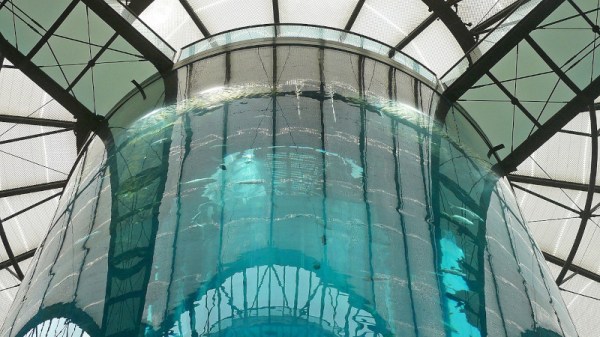
At the end of last week Aquadom, the world’s largest cylindrical aquarium, unexpectedly shattered and caused an emergency as it flooded both the Berlin hotel that housed it and the surrounding streets. From an engineering perspective it’s a fascinating story, because its construction was such that this shouldn’t have happened. We have an analysis of what might have gone wrong from [Luis Batalha] (Nitter), and from it we can learn a little about the properties of the plastic used.

The aquarium was made of an acrylic polymer which has an interesting property — at a certain temperature it transitions between a glass-like state and a rubber-like one. Even at room temperature the acrylic is well below the transition temperature, but as the temperature drops the acrylic becomes exponentially more brittle. When the outside temperature dropped to well below zero the temperature also dropped in the foyer, and the high water pressure became enough to shatter the acrylic.

Sadly few of the fish from the aquarium survived, but fortunately nobody was killed in the incident. News coverage shows how the force of the water destroyed the doors and brought wreckage into the street, and we’re guessing that it will be a while before any other hotel considers such a project as an attraction. Meanwhile we’ve gained a little bit of knowledge about the properties of acrylic, which might come in handy some day.

Header: Chrissie Sternschuppe, CC BY-SA 2.0.

Laser Fusion Ignition: Putting Nuclear Fusion Breakthroughs Into Perspective

This month the media was abuzz with the announcement that the US National Ignition Facility (NIF) had accomplished a significant breakthrough in the quest to achieve commercial nuclear fusion. Specifically, the announcement was that a net fusion energy gain (Q) had been measured of about 1.5: for an input of 2.05 MJ, 3.15 MJ was produced.

What was remarkable about this event compared to last year’s 1.3 MJ production is that it demonstrates an optimized firing routine for the NIF’s lasers, and that changes to how the Hohlraum – containing the deuterium-tritium (D-T) fuel – is targeted result in more effective compression. Within this Hohlraum, X-rays are produced that serve to compress the fuel. With enough pressure, the Coulomb barrier that generally keeps nuclei from getting near each other can be overcome, and that’s fusion.

Based on the preliminary results, it would appear that a few percent of the D-T fuel did undergo fusion. So then the next question: does this really mean that we’re any closer to having commercial fusion reactors churning out plentiful of power?

Continue reading “Laser Fusion Ignition: Putting Nuclear Fusion Breakthroughs Into Perspective”

See What You’re In For When Buying And Moving A Lathe

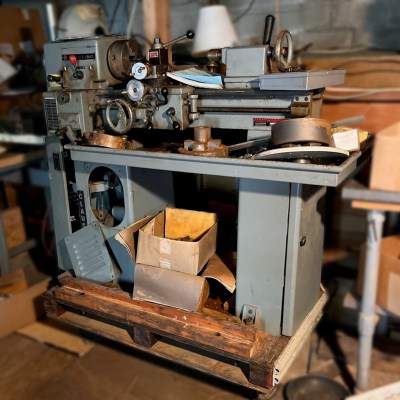
Sometimes, with patience and luck, one can score a sweet deal on machinery. But for tools that weigh many hundreds of pounds? Buying it is only the beginning of the story. [Ben Katz] recently got a lathe and shared a peek at what was involved in moving a small (but still roughly 800 pound) Clausing 4901 lathe into its new home and getting it operational.

The lathe had sat unused in a basement, but was ready for a new home.

Moving such a stout piece of equipment cannot simply be done by recruiting a few friends and remembering to lift with the legs. This kind of machinery cannot be moved and handled except with the help of other machines, so [Ben] and friends used an engine hoist with a heavy-duty dolly to get it out of the basement it was in, and into the bed of a pickup truck. Separating the lathe from its base helped, as did the fact that the basement had a ground-level egress door which meant no stairs needed to be involved.

One also has to consider the machine’s ultimate destination, because not all floors or locations can handle nearly a thousand pounds of lathe sitting on them. In [Ben]’s case, that also meant avoiding a section of floor with a maintenance trapdoor when moving the lathe into the house. Scouting and knowing these things ahead of time can be the difference between celebratory pizza and deep dish disaster. Pre-move preparation also includes ensuring everything can physically fit through the necessary doorways ahead of time; a task that, if ignored, will eventually explain itself.

With that all sorted out, [Ben] dives into cleaning things up, doing function checks, and in general getting the lathe up and running. He provides some fantastic photos and details of this process, including shots of the 70s-era documentation and part diagrams.

Watch the first chips fly in the short video embedded below. And should you be looking at getting a lathe of your own? Check out our very own buyer’s guide to lathe options.

Continue reading “See What You’re In For When Buying And Moving A Lathe”

Ask Hackaday: Will Your 2030 Car Have AM Radio?

Car makers have been phasing out AM radios in their cars for quite some time. Let’s face it, there isn’t much on AM these days, and electric vehicles have been known to cause interference with AM radios. So why have them? For that matter, many aftermarket head units now don’t even have radios at all. They play digital media or stream Bluetooth from your phone. However, a U.S. Senator, Edward J. Markey, has started a letter-writing campaign to the major car makers urging them to retain the AM radio in their future vehicles.

So does that mean AM lives? Or will the car makers kill it off? The letter requests that the companies answer several questions, including if they plan to discontinue AM or FM radios in the near future and if they support digital broadcast radio.

Continue reading “Ask Hackaday: Will Your 2030 Car Have AM Radio?”