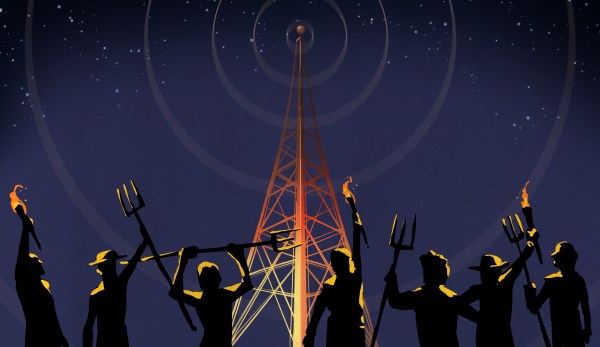
In the surreal world of a pandemic lockdown, we are surrounded by news stories that defy satire. The idea that 5G cellular networks are to blame for the COVID-19 outbreak and a myriad other ills has the more paranoid corners of social media abuzz with concerned citizens leaping upon random pieces of street furniture as potential 5G infrastructure.
The unanimous advice of the world’s scientists, doctors, and engineers that it is inconceivable for a phone technology to cause a viral outbreak. Amusingly, 5G has not yet been rolled out to some of the places where this is happening. But with conspiracy theory, fact denial only serves to reinforce the idea, however misguided. Here at Hackaday we have already ventured into the technical and scientific side of the story, but there is another side to it that leaves the pandemic behind and reaches back over the decades. Fear of new technology and in particular radio is nothing new, it stretches back almost as long as the public has had access to it.
Another DDOS amplification technique has just recently been disclosed, NXNSAttack (technical paper here) that could be used against DNS servers.
We’ve covered amplification attacks before. The short explanation is that some UDP services, like DNS, can be abused to get more mileage out of a DDoS attack. The attacking machined send messages like this: “Hello Google DNS, This is the Hackaday server. Can you send me a really big DNS response packet?” If the DNS response is bigger than the request, then the overall attack is bigger as a result. The measure of effectiveness is the amplification factor. For every byte of DDoS sent by attacking machines, how much many bytes are actually sent to the victim machine? Mirai, for example, had an amplification factor of something around 2.6.
As part of an investigation into opposition to 5G mobile phone networks in the English town of Glastonbury the BBC reporter [Rory Cellan-Jones] shared details of a so-called 5G protection device that was advertised as casting a bubble of 5G-free space around its owner. This set [The Quackometer] writing, because as part of his probing into the world of snake-oil, he’s bought just such a unit and subjected it to a teardown.
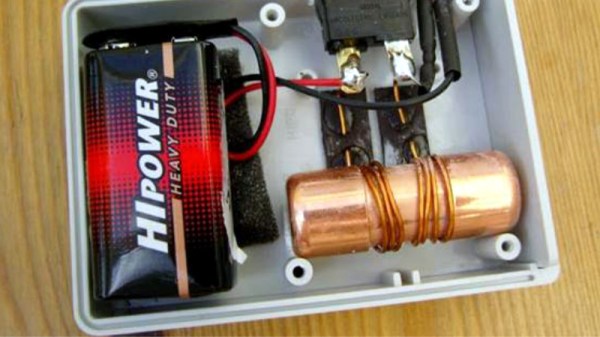
What he has is a plastic project box with a graphic on top, a switch and green LED on the side, and a battery compartment on its rear. Opening the battery compartment reveals a standard 9 V alkaline cell, but the real interest comes when the cover is removed. There is a copper cylinder with a coil of wire round it, though the wires from the coil to the battery have been cut. The active part of the device is simply a battery powering an LED through a switch, as he puts it the device is a £50 ($61) poor quality torch (flashlight). Of more interest is the copper cylinder, which he identifies as a short piece of copper water pipe with two end caps. He doesn’t open it up, leaving us to expect that whatever mystical component deals with the RF must be concealed within it. This is not the usual Hackaday fare, but we know our readers are fascinated by all new technologies and will provide plenty of speculation as to how it might work in the comments.
The BBC story is worth a read to give a little background. If you are a non-Brit and you have heard of Glastonbury it is probably for the famous summer music festival held on a neighbouring farm, but the town is also famous for its connections with Arthurian legend and in recent decades for having become a centre for New Age mysticism. It has also become something of a hotbed of activism against the spread of 5G mobile networks, and has made the news this week because of concerns over the impartiality of a report condemning the technology released by its local government. If you have an interest in the 5G saga then brace yourselves for this document being used to lend a veneer of official credibility.
We’ve spent a while covering 5G issues, and given that some aspects of the story are shaping up to be a gift to technical journalists that keeps on giving, no doubt we’ll bring you more in due course. Devices such as the one featured here could even supplant audiophile products as a source of technical wonderment!
If you haven’t heard from other websites yet, earlier this year a leak of various Nintendo intellectual properties surfaced on the Internet. This included prototype software dating back to the Game Boy, as well as Verilog files for systems up to the Nintendo 64, GameCube and Wii. This leak seems to have originated from a breach in the BroadOn servers, a small hardware company Nintendo had contracted to make, among other things, the China-only iQue Player.
So, that’s the gist of it out of the way, but what does it all mean? What is the iQue Player? Surely now that a company’s goodies are out in the open, enthusiasts can make use of it and improve their projects, right? Well, no. A lot of things prevent that, and there’s more than enough precedent for it that, to the emulation scene, this was just another Tuesday.
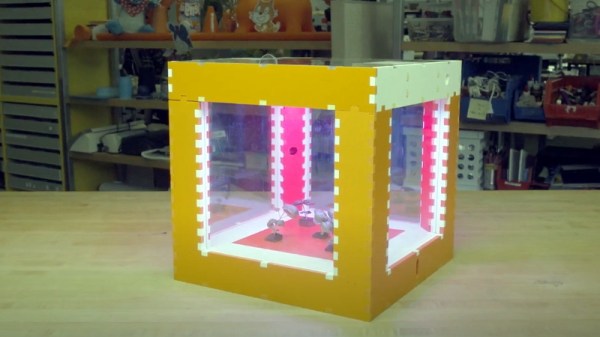
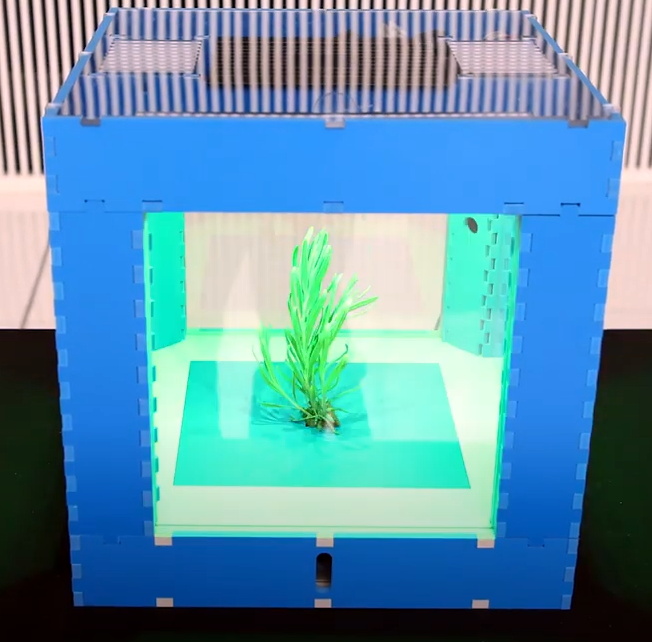
The MIT Media Lab’s Open Agriculture Initiative (OpenAg) promised to revolutionize urban farming with their Food Computers: essentially miniature automated gardens that could be installed in racks to maximize growing space. Each unit would be provided with a “Recipe” that allowed it to maintain the ideal environmental conditions for the species it contained, which meant that even the novice gardener to produce a bumper crop no whether they lived in the Arctic Circle or the Sahara.
With such lofty goals, success certainly wasn’t assured. But we still didn’t expect to hear that the program had to be permanently closed after a string of startling accusations came to light. From engaging in scientific dishonesty to setting off a minor ecological disaster, the story just gets worse and worse. Who could have imagined that one day we’d have to report on an open source project having direct ties to Jeffrey Epstein?
Food Computer v3.0
According to reports, MIT Media Lab Director Joichi Ito and OpenAg principal researcher Caleb Harper attempted to secure $1.5 million in funding for the program during a 2017 meeting with the disgraced financier. Epstein apparently wasn’t impressed by what he saw, and no money ever changed hands. Given the information we now have about the project, this might actually be the least surprising part of the story.
It has since come to light that the Food Computers never worked consistently, and indeed never made it past the prototype stage. This despite the fact that Harper claimed that functional units had already been deployed to refugee camps during presentation to potential investors. A scientist working with the project has even come forward with claims that staff were instructed to place plants brought from local garden centers into the prototype Food Computers prior to tours of the lab so visitors would think they had been grown in the devices.
A former researcher working on the OpenAg program, Babak Babakinejad, also went public with his concerns over the environmental impact of dumping waste water from the Food Computers. The lab had a permit to pump nitrogen-infused water into an underground disposal well, but according to Babakinejad, internal testing showed the nitrogen levels in the water would occasionally top 20 times the stated limit. After his concerns were ignored by Harper and other MIT staff, he eventually took his concerns directly to the Massachusetts Department of Environmental Protection which led to an investigation and ultimately a fine of $25K.
We first covered the Open Agriculture Initiative back in 2016, and readers expressed doubts about the concept even then. While we certainly don’t relish making an update like this about a project we’ve featured, it’s an important reminder that honesty and integrity can’t take a backseat to technical achievement.
Based on a few details from the request for project proposals, it looks like the DoD is targeting mostly companies in this particular solicitation, but have left the door open for academic institutions as well. That makes intuitive sense. Companies can generally operate at a faster pace than most academic research labs. Given the urgency of the matter, faster turnarounds in technological development are imperative. Nonetheless, we have seen quite a bit of important COVID-19 work coming from academic research labs and we imagine that battling this pandemic will take all the brilliant minds we can muster together.
It’s good to see the DoD join the fight in what could be a lengthy battle with the coronavirus.
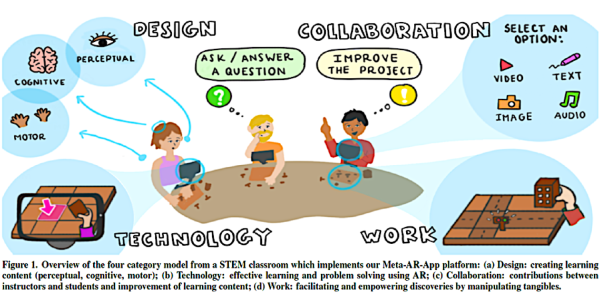
Augmented reality (AR) in the classroom has garnered a bit of interest over the years, but given the increased need for remote and virtual learning these days, it might be worth taking a closer look at what AR can offer. Purdue University’s C Design Lab thinks they’ve found a solution in their Meta-AR platform. The program allows an instructor to monitor each student’s work in real-time without being in the same classroom as the student. Not only that, but the platform allows students to collaborate in real-time with each other giving each other tips and feedback while also being able to interact with each other’s work, no matter where they may be physically located.