Super-Blue CNC Part Fixturing

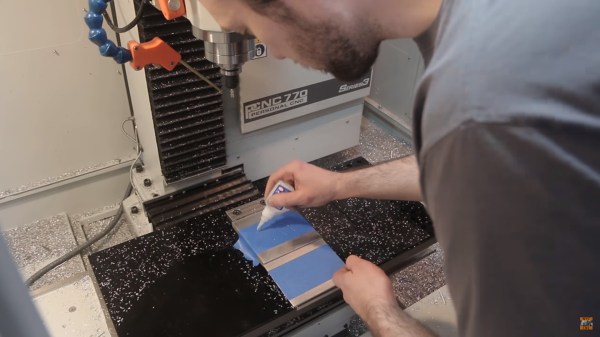
Simple clamps are great if you need to keep the pressure on two parallel surfaces, but if you have an irregular plane, or you need to cut through it, clamps are not the correct tool. The folks at [NYC CNC] feature a video with a clever hack borrowing from other disciplines. Painters tape is applied to the top of a level mounting surface in the machine and then burnished. The same is done to the bottom of the workpiece. Superglue is drizzled between the tape layers and pressed together so now the stock is held firmly below the toolhead.

Some parts are machined in the video, which can be seen below, and the adhesion holds without any trouble. One of the examples they cut would be difficult to hold without damage or stopping the machine. The accepted wisdom is that superglue holds well to a slightly porous surface like tape, but it doesn’t like do as well with smooth surfaces like metal. Removing residue-free tape at the end of a cut is also cleaner and faster than glue any day.

If you have yet to cut your teeth, you can watch our very own Elliot Williams getting introduced to CNC machines or a portable machine even a child can use.
Continue reading “Super-Blue CNC Part Fixturing”

LED Strips Are So Hot Right Now

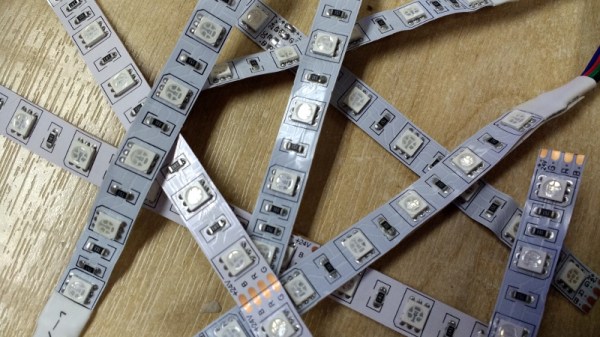
Sometimes there will appear a figure that flies in the face of reason, and challenges everything you think you know about a subject. Just such a moment came from [Chris Taylor] at Milton Keynes Makerspace when he characterised a set of LED strips, and the figure in question was that he found an LED strip creates the same amount of heat as its equivalent incandescent bulb.

We can hear your coffee hitting the monitor and your reaching for the keyboard to place a suitably pithy comment, because yes, that’s a pretty unbelievable statement. But it’s no less true, albeit that the key to it lies in its details. If you have a 100 W incandescent bulb, 88% of the energy is radiated as light and infra-red, leaving 12 W heating the bulb itself. To get the same light output from an LED meanwhile we’d only need 17 W, of which 11.9 W would be left to heat the LED. Which means that an LED strip can get as hot as an incandescent bulb with equivalent light output, and he’s run some tests to prove it.

If you’ve worked with LEDs, you’ll know that they get hot. But to learn that they have the potential to get as hot as their incandescent equivalents is something of a eye-opener, and should demonstrate the need for adequate thermal mitigation. It’s easy to take them for granted, and we’ve taken a look before at some of their safety pitfalls.

Disclosure: [Jenny List] is a member of MK Makerspace.

Uber Has An Autonomous Fatality

You have doubtlessly heard the news. A robotic Uber car in Arizona struck and killed [Elaine Herzberg] as she crossed the street. Details are sketchy, but preliminary reports indicate that the accident was unavoidable as the woman crossed the street suddenly from the shadows at night.

If and when more technical details emerge, we’ll cover them. But you can bet this is going to spark a lot of conversation about autonomous vehicles. Given that Hackaday readers are at the top of the technical ladder, it is likely that your thoughts on the matter will influence your friends, coworkers, and even your politicians. So what do you think?

Continue reading “Uber Has An Autonomous Fatality”

All Your IPhone Are Belong To Us

Apple’s commitment to customer privacy took the acid test after the San Bernadino shooting incident. Law enforcement demanded that Apple unlock the shooter’s phone, and Apple refused. Court cases ensued. Some people think that the need to protect the public outweighs the need for privacy. Some people think that once they can unlock one iPhone, it won’t stop there and that will be bad for everyone. This post isn’t about either of those positions. The FBI dropped their lawsuit against Apple. Why? They found an Israeli firm that would unlock the phone for about $5,000. In addition, Malwarebytes — a company that makes security software — reports that law enforcement can now buy a device that unlocks iPhones from a different company.

Little is known about how the device — from a company called Grayshift — works. However, Malwarebytes has some unverified data from an unnamed source. Of course, the exploit used to break the iPhone security is secret because if Apple knew about it, they’d fix it. That’s happened before with a device called IP-box that was widely used for nefarious purposes.

Continue reading “All Your IPhone Are Belong To Us”

3D Printer Halts And Catches Fire — Analysis Finds A Surprising Culprit

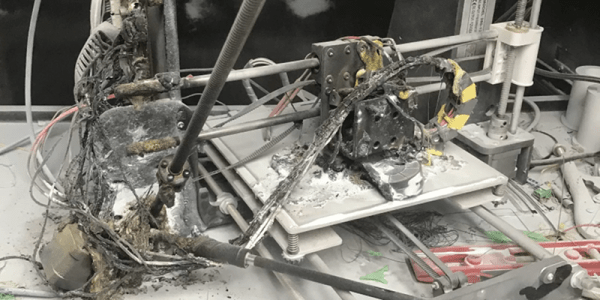
Let’s build a robot that gets hot. Really hot — like three times hotter than McDonald’s coffee. Then make it move around. And let’s get the cost in at around $100. Sounds crazy? Not really, since that describes the cheap 3D printers we all have been buying. [John] found out the hard way that you really need to be careful with hot moving parts.

The short story is that [John’s] Anet A8 caught on fire — significantly caught on fire. Common wisdom says that cheap printers often don’t have connectors for the heated bed that can handle the current. There have been several well-publicized cases of those connectors melting, especially on early production models of several printers. However, this printer had an add-on heater with a relay, so that shouldn’t be the problem. Of course, a cheap power supply could do it, too, but the evidence pointed to it being none of those things.

Continue reading “3D Printer Halts And Catches Fire — Analysis Finds A Surprising Culprit”

Are You Dying To Upload Your Brain?

Cryonics — freezing humans for later revival — has been a staple of science fiction for ages. Maybe you want to be cured of something presently incurable or you just want to see the future. Of course, ignoring the problem of why anyone wants to thaw out a 500-year-old person, no one has a proven technology for thawing out one of these corpsicles. You are essentially betting that science will figure that out sometime before your freezer breaks down. A new startup called Nectome funded by Y Combinator wants to change your thinking about preservation. Instead of freezing they will pump you full of preservatives that preserve your brain including fine structures that scientists currently believe contain your memories.

Nectome’s strategy isn’t to have you revived like in conventional cryonics. They think the technology to do high definition scans of your preserved brain will exist soon. Those scans might allow future scientists to recreate your brain in a simulation. That isn’t really the same as coming back to life, though. At least we don’t imagine it is.

Continue reading “Are You Dying To Upload Your Brain?”

Programming Linux Devices With Arduino And The Cloud

Back in the olden days, when the Wire library still sucked, the Arduino was just a microcontroller. Now, we have single board computers and cheap microcontrollers with WiFi built in. As always, there’s a need to make programming and embedded development more accessible and more widely supported among the hundreds of devices available today.

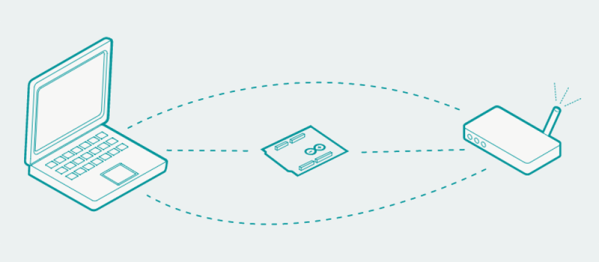
At the Embedded Linux Conference this week, [Massimo Banzi] announced the beginning of what will be Arduino’s answer to the cloud, online IDEs, and a vast ecosystem of connected devices. It’s Arduino Create, an online IDE that allows anyone to develop embedded projects and manage them remotely.

As demonstrated in [Massimo]’s keynote, the core idea of Arduino Create is to put a connected device on the Internet and allow over-the-air updates and development. As this is Arduino, the volumes of libraries available for hundreds of different platforms are leveraged to make this possible. Right now, a wide variety of boards are supported, including the Raspberry Pi, BeagleBone, and several Intel IoT boards.

The focus of this development is platform-agnostic and focuses nearly entirely on ease of use and interoperability. This is a marked change from the Arduino of five years ago; there was a time when the Arduino was an ATmega328p, and that’s about it. A few years later, you could put Arduino sketches on an ATtiny85. A lot has changed since then. We got the Raspberry Pi, we got Intel stepping into the waters of IoT devices, we got a million boards based on smartphone SoCs, and Intel got out of the IoT market.

While others companies and organizations have already made inroads into an online IDE for Raspberry Pis and other single board computers, namely the Adafruit webIDE and Codebender, this is a welcome change that already has the support of the Arduino organization.

You can check out [Massimo]’s keynote below.

Continue reading “Programming Linux Devices With Arduino And The Cloud”