‘LinuxCNC-Features’ Is The Garage-Fab’s Missing CAM Tool

It takes a long toolchain to take the garage-machinist-to-be through all the hoops needed to start cranking out parts. From the choice of CAD software to the CAM tools that turn 3D models into gcode, to the gcode interpretters that chew up this source code and spit out step and direction pulses to turn the cranks of a cnc mill, there’s a multitude of open-and-closed source tools to choose from and even an opportunity to develop some of our own. That’s exactly what [Nick] and the folks over on the cnc-club forums did; they’ve written their own CAM tool that enables the end user to design a procedure of cuts and toolpaths that can export to gcode compatible with LinuxCNC.

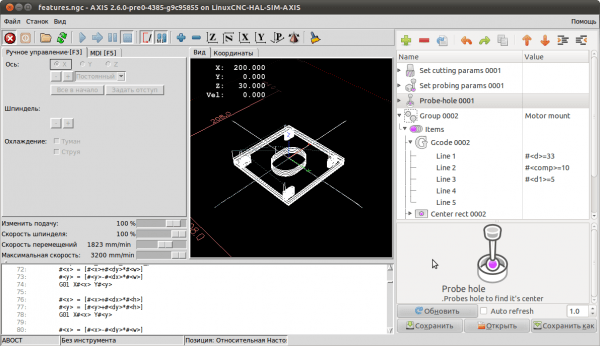
Their tool, dubbed “LinuxCNC-features”, embeds a LinuxCNC-compatible graphical gcode programming interface directly into the LinuxCNC native user interface. Creating a part is a matter of defining a list of sequential cuts along programmable toolpaths. These sequential cuts are treatments like drilled holes, square pockets, bolt holes, and lines. The native embedding enables the machinist to preview each of the 3D toolpaths in LinuxCNC’s live view, giving him-or-her a quick-and-dirty check to make sure that their gcode performs as expected before running it. [Nick] has a couple of videos to get you up-and running on either your mill or lathe.

LinuxCNC-features has been out in the wild for almost two years now, but if you’re looking to get started cranking out parts in the garage, look no further for a CAM tool that can quickly generate gcode for simple projects. In case you’re not familiar with LinuxCNC, it’s one of the most mature open-source gcode interpreters designed to turn your PC into a CNC controller, and it’s the brains behind some outstanding DIY CNC machines like this plasma cutter.

Continue reading “‘LinuxCNC-Features’ Is The Garage-Fab’s Missing CAM Tool”

Camera Quadcopter Almost Hits Slalom Skiier

During the World Cup slalom skiing championship on Wednesday, ski champion [Marcel Hirscher] was nearly hit by an out-of-control camera drone, that crashed just behind him while filming during a run. Watch the (scary) video embedded after the break.

According to this article in Heise.de (Google Translate link), the pilot was accredited and allowed to fly the quad, but only over a corridor where no spectators were present. After the first couple of runs, apparently the pilot went off course and quite obviously lost control of the copter.

Continue reading “Camera Quadcopter Almost Hits Slalom Skiier”

The ESP32 Beta Units Arrive

A little more than a year ago, the ESP8266 WiFi module showed up uneventfully in Seeed Studio’s store. Since then, the documentation has been translated to English, a proper development environment for this chip was created, and everybody is using this cheap but powerful chip for the latest Internet of Things things.

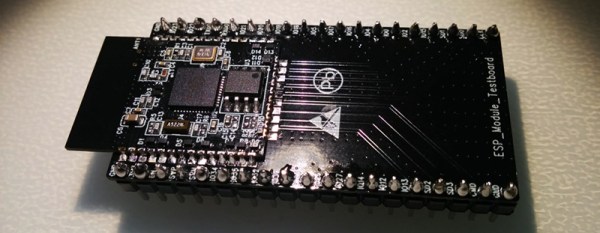
The company behind the ESP8266, Espressif, is not one to rest on their laurels, and for several months they’ve been working on the next generation of powerful WiFi-enabled tiny, cheap systems. They have their silicon, and already 200 lucky people have their hands on the very first test units of the ESP32, the next generation of Espressif’s WiFi chips. The teardowns have begun, and [LadyAda] streamed her initial experiments with the chip to the Intertubes (available below). [Martin] is also one of the guys who received these early beta chips, and he was kind enough to post his thoughts on Espressif’s newest chip.

A little bit of information on the ESP32 has dribbled out, and [LadyAda] and [Martin]’s demo unit confirm all we’ve suspected. There are two Tensilica L108 processors running at up to 160MHz, a lot of peripherals including ADCs, DACs, I2C, SPI, I2S, and PWM, more RAM, AES and SSL for security, and Bluetooth Low Energy. WiFi has also been upgraded, and the ESP32 will support speeds up to 150 Mbps.

Continue reading “The ESP32 Beta Units Arrive”

Guerrilla Grafters Grow Great Gifts For Greater Good

If you’ve been to downtown San Francisco lately, you might have noticed something odd about the decorative trees in the city: they’re now growing fruit. This is thanks to a group of people called the Guerrilla Grafters who are covertly grafting fruit-bearing twigs to city tress which would otherwise be fruitless. Their goal is to create a delicious, free source of food for those living in urban environments.

Biology-related hacks aren’t something we see every day, but they’re out there. For those unfamiliar with grafting, it’s a process that involves taking the flowering, fruiting, or otherwise leafy section of one plant (a “scion”) and attaching them to the vascular structure of another plant that has an already-established root system (the “stock”). The Guerrilla Grafters are performing this process semi-covertly and haven’t had any run-ins with city officials yet, largely due to lack of funding on the city’s part to maintain the trees in the first place.

This hack doesn’t stop at the biological level, though. The Grafters have to keep detailed records of which trees the scions came from, when the grafts were done, and what characteristics the stock trees have. To keep track of everything they’ve started using RFID tags. This is an elegant solution that can be small and inconspicuous, and is a reliable way to keep track of all of one’s “inventory” of trees and grafts.

It’s great to see a grassroots movement like this take off, especially when it seems like city resources are stretched so thin that the trees may have been neglected anyway. Be sure to check out their site if you’re interested in trying a graft yourself. If you’re feeling really adventurous, you can take this process to the extreme.

Thanks to [gotno] for the tip!

The Most Brilliant Use Of Crowdfunding Yet: Medical Research

Since the rise of Kickstarter and Indiegogo, the world has been blessed with $100 resin-based 3D printers, Video game consoles built on Android, quadcopters that follow you around, and thousands of other projects that either haven’t lived up to expectations or simply disappeared into the ether. The idea of crowdfunding is a very powerful one: it’s the ability for thousands of people to chip in a few bucks for something they think is valuable. It’s a direct democracy for scientific funding. It’s the potential for people to pool their money, give it to someone capable, and create something really great. The reality of crowdfunding isn’t producing the best humanity has to offer. Right now, the top five crowdfunding campaigns ever are two video games, a beer cooler, a wristwatch with an e-ink screen, and something to do with Bitcoin. You will never go broke underestimating people.

[Dr. Todd Rider] wants to change this. He might have developed a way to cure nearly all viral diseases in humans, but he can’t find the funding for the research to back up his claims. He’s turned to IndieGoGo with an audacious plan: get normal people, and not NIH grants, to pay for the research.

The research [Dr. Rider] has developed is called the DRACO, the Double-stranded RNA Activated Caspase Oligomerizer. It works by relying on the singular difference between healthy cells and infected cells. Infected cells contain long chains viral double-stranded RNA. The DRACOs attach themselves to these long strands of RNA and cause those cells to commit suicide. The research behind the DRACO was published in 2011, and since then [Dr. Rider] has already received funding from more traditional sources, but right now the project is stuck in the ‘funding valley of death’. It’s easy to get funding for early research, but to get the millions of dollars for clinical trials it takes real results – showing efficacy, and proving to pharmaceutical companies or VCs that the drug will make money.

So far, results are promising, but far from the cure for HIV and the common cold the DRACO promises to be. [Dr. Rider] has performed a few tests on cell cultures and mice, and the DRACOs have been effective in combating everything from the common cold, to the flu to dengue hemorrhagic fever.

The IndieGoGo campaign is flexible funding, meaning all the money raised will go towards research even if the funding goal is not met. Right now, just over $50,000 has been raised of a $100,000 goal. That $100k goal is just the first step; [Dr. Rider] thinks he’ll need about $2 Million to test DRACOs against more viruses and hopefully show enough progress to get additional traditional funding. That $2 Million is a little less than what Solar Roadways raised, meaning no matter what [Dr. Rider] will make one important medical discovery: people are very, very, very dumb.

Continue reading “The Most Brilliant Use Of Crowdfunding Yet: Medical Research”

Heathkit’s Triumphant Return?

Heathkit, the storied purveyor of high-quality DIY electronics kits that inspired a generation of enthusiasts and launched the careers of many engineers, has returned from the dead. We think. At least it seems that way from this build log by [Spritle], an early adopter of the rebooted company’s first offering. But if [Spritle]’s experience is any indication, Heathkit has a long way to go to recreating its glory days. Continue reading “Heathkit’s Triumphant Return?”

TI Releases New Edition Analog Engineer’s Pocket Reference

We aren’t sure that a PDF with 100 pages in it qualifies as a pocket reference, but TI’s Analog Engineer’s Pocket Reference is certainly a good read. You do have to register with TI (use a disposable address if you are too paranoid to do that), but the free download is well worth the effort. The document’s been around for awhile, but TI recently released a new 4th edition.

The first few pages might underwhelm you. You probably know the standard decimal prefixes and are more likely to ask Google to convert circular mils to square millimeters, for example. The second part, though, gets more into electronics. There’s standard values for resistors and quick reminders about the difference between X7R and Y5V ceramic in capacitors, for example.

Things get progressively more interesting, covering measurements and phase shifts, and then amplifiers. The little circuits are pithy but cover the bases including things like frequency response.

Continue reading “TI Releases New Edition Analog Engineer’s Pocket Reference”