Fun With Negative Resistance: Jellybean Transistors

The concept of negative resistance has always fascinated me. Of course, a true negative resistance is not possible, and what is meant is a negative differential resistance (NDR). But of course knowing the correct term doesn’t do anything to demystify the topic. Negative resistance sounds like an unusual effect, but it turns out to be relatively common, showing up in places like neon lamps and a number of semiconductor structures. Now’s as good a time as any to dig in and learn more about this common principle.

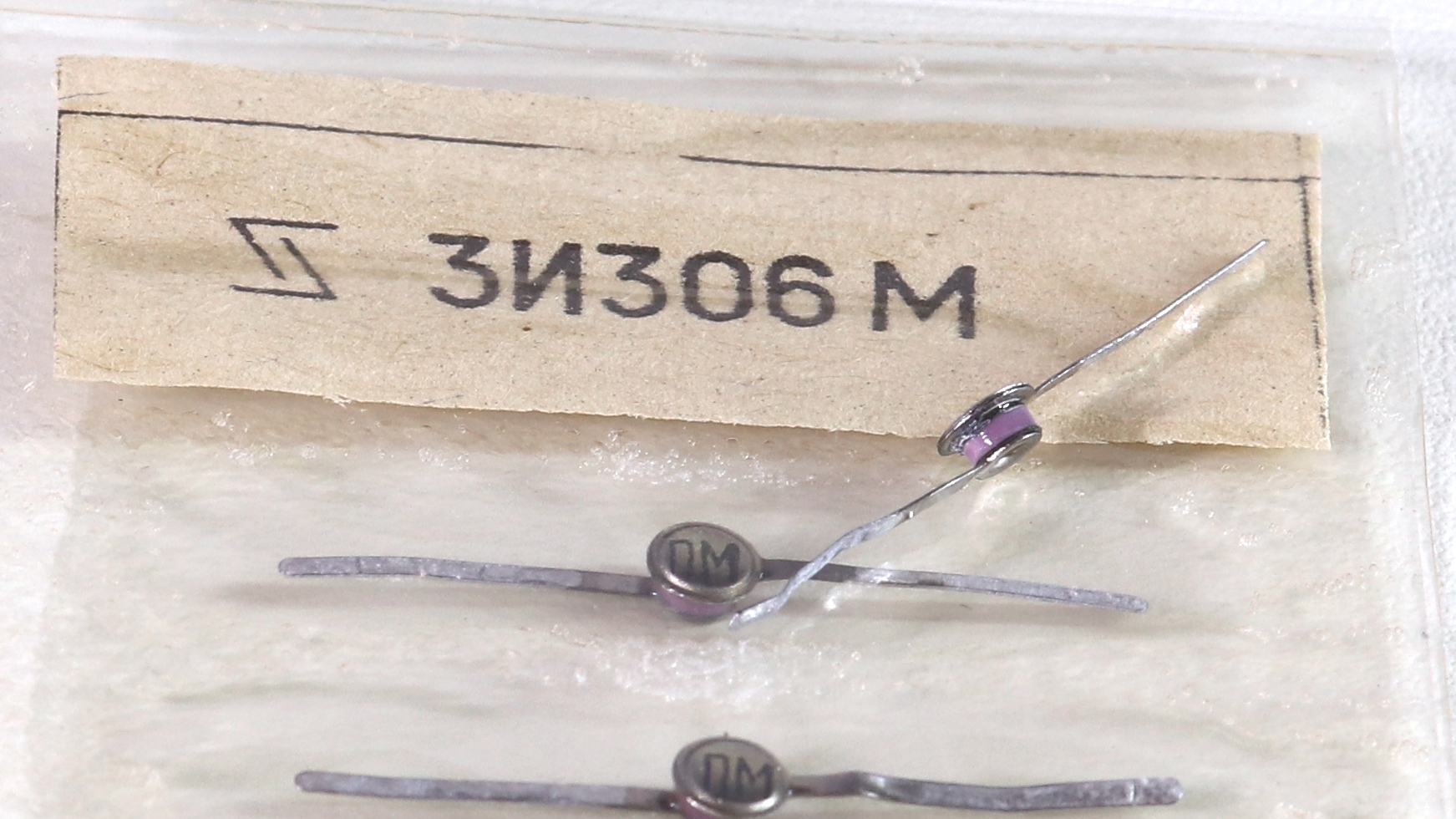
NDR means a portion of a device’s I/V curve where the current falls with increasing applied voltage. The best-known semiconductor device exhibiting negative resistance is the tunnel diode, also known as the Esaki diode after one of the Nobel-Prize-winning discoverers of the quantum tunneling effect responsible for its operation. These diodes can perform at tremendous speeds; the fastest oscilloscope designs relied on them for many years. As the transistor and other technologies improved, however, these diodes were sidelined for many applications, and new-production models aren’t widely available — a sad state for would-be NDR hackers. But, all hope is not lost.

Rummaging through some old notebooks, I rediscovered an NDR design I came up with in 2002 using two common NPN transistors and a handful of resistors; many readers will already have the components necessary to experiment with similar circuits. In this article, we’ll have a look at what you can do with junkbox-class parts, and in a future article we’ll explore the topic with some real tunnel diodes.

So, let’s see what you can do with a couple of jellybean transistors!

Continue reading “Fun With Negative Resistance: Jellybean Transistors”

A Million Zombie Taxis By 2020? It’s Not Going To Happen

The tech world has a love for Messianic figures, usually high-profile CEOs of darling companies whose words are hung upon and combed through for hidden meaning, as though they had arrived from above to our venture-capital-backed prophet on tablets of stone. In the past it has been Steve Jobs or Bill Gates, now it seems to be Elon Musk who has received this treatment. Whether his companies are launching a used car into space, shooting things down tubes in the desert, or synchronised-landing used booster rockets, everybody’s talking about him. He’s a showman whose many pronouncements are always soon eclipsed by bigger ones to keep his public on the edge of their seats, and now we’ve been suckered in too, which puts us on the spot, doesn’t it.

Your Johnny Cab is almost here

The latest pearl of Muskology came in a late April presentation: that by 2020 there would be a million Tesla electric self-driving taxis on the road. It involves a little slight-of-hand in assuming that a fleet of existing Teslas will be software upgraded to be autonomous-capable and that some of them will somehow be abandoned by their current owners and end up as taxis, but it’s still a bold claim by any standard.

Here at Hackaday, we want to believe, but we’re not so sure. It’s time to have a little think about it all. It’s the start of May, so 2020 is about 7 months away. December 2020 is about 18 months away, so let’s give Tesla that timescale. 18 months to put a million self-driving taxis on the road. Can the company do it? Let’s find out.

Continue reading “A Million Zombie Taxis By 2020? It’s Not Going To Happen”

Get To Know The Physics Behind Soldering And The Packaging Of ICs

Often it feels as if soldering is deemed to be more of an art form than something that’s underpinned by the cold, hard reality of physics and chemistry. From organic chemistry with rosin, to the material properties of fragile gold bond wires and silicon dies inside IC packages and the effects of thermal stress on the different parts of an IC package, it’s a complicated topic that deserves a lot more attention than it usually gets.

A casual inquiry around one’s friends, acquaintances, colleagues and perfect strangers on the internet usually reveals the same pattern: people have picked up a soldering iron at some point, and either figured out what seemed to work through trial and error, or learned from someone else who has learned what seemed to work through trial and error. Can we say something scientific about soldering?

Continue reading “Get To Know The Physics Behind Soldering And The Packaging Of ICs”

The Stratolaunch Is Flying, But Can It Do Cargo?

The world’s largest aircraft is flying. Stratolaunch took to the skies in test flights leading up to its main mission to take rockets up to 20,000 feet on the first stage of their flight to space. But the Stratolaunch is a remarkable aircraft, a one-of-a-kind, and unlike anything ever built before. It can lift a massive 250 tons into the air, and it can bring it back down again.

By most measures that matter, the Stratolaunch is the largest aircraft ever flown. It has the largest wingspan of any aircraft, and it has the largest cargo capacity of any aircraft. In an industry that is grasping at interesting and novel approaches to spaceflight like rockoons and a small satellite launcher from a company whose CTO is still a junior in college, the Stratolaunch makes unexpected sense; this is a launch platform above the clouds, that can deliver a rocket to orbit, on time.

But the Stratolaunch is much more than that. This is an aircraft whose simple existence deserves respect. And, like others of its kind, the Antonov AN-225, the Spruce Goose, there is only one. Even if it never launches a rocket, the Stratolaunch will live on by the simple nature of its unique capabilities. But what are those capabilities? Is it possible for the Stratolaunch to serve as a cargo plane? The answer is more interesting than you think.

Continue reading “The Stratolaunch Is Flying, But Can It Do Cargo?”

Ask Hackaday: Is USB Robust Enough?

Earlier this month a single person pleaded guilty to taking down some computer labs at a college in New York. This was not done by hacking into them remotely, but by plugging a USB Killer in one machine at a time. This malicious act caused around $58,000 in damage to 66 machines, using a device designed to overload the data pins on the USB ports with high-voltage. Similar damage could have been done with a ball-peen hammer (albeit much less discreetly), and we’re not here to debate the merits of the USB Killer devices. If you destroy property you don’t own you should be held accountable.

But the event did bring an interesting question to mind. How robust are USB ports? The USB Killer — which we’ve covered off and on through the years —  is billed as a “surge testing” device and operates by injecting -200 volts DC on the data lines of the USB connection. Many USB ports are not protected against this and the result is permanent damage to the computer hardware. Is protection for these levels of abuse necessary or would it needlessly add cost to our machines?

A chip like the TPD4S014 has ESD protection on the data lines that is rated up to +/- 1500 volts, clamping to ground to dissipate the energy. It’s a solution that should protect against repeated spikes on the data lines, as well as short circuits on the power lines and over/undervoltage situations.

ADUM4160 Functional Diagram

The ADuM4160 is an interesting step up from this. It’s designed to provide isolation between a USB host and the device connected to it. Rather than relying on clamping, this chip implements isolation through air core transformers. Certainly this would be overkill to install in every product, but for those of use building and testing USB devices this would save you from “Oops, wrong USB cable” moments at the work bench.

Speaking of accidents at the bench, there is certainly a demand for USB isolation outside of what’s built into our computers. Earlier this year we saw a fantastic take on a properly-designed USB power strip. Among the goals were current limiting, undervoltage protection, and a proper power disconnect switch for each port. The very need to design your own reminds us that consumer manufacturers are often lazy in their USB design. “Use a USB hub” is bad advice for protection at the workbench since quality of design varies so wildly.

We would be interested in hearing from anyone who has insight on standards applying to equipment continuing to survive over current or over voltage events and remain functional. There are standards like UL-60950 that should apply to USB. But that standard includes language about failing safe for the operator, not necessarily remaining functional:

After abnormal operation or a single fault (see 1.4.14), the equipment shall remain safe for an OPERATOR in the meaning of this standard, but it is not required that the equipment should still be in full working order. It is permitted to use fusible links, THERMAL CUT-OUTS, overcurrent  protection devices and the like to provide adequate protection.

So, we’re here to ask you, the readers of Hackaday. Are our USB devices robust enough? Do you have a go-to USB protection chip, part, or other circuit you like to use? Have you ever accidentally killed a USB host device (if so, how)? Do you have special equipment that you depend on when developing projects involving USB? Let us know what you think in the comments below.

The $50 Ham: Dummy Loads

This is an exciting day for me — we finally get to build some ham radio gear! To me, building gear is the big attraction of amateur radio as a hobby. Sure, it’s cool to buy a radio, even a cheap one, and be able to hit a repeater that you think is unreachable. Or on the other end of the money spectrum, using a Yaesu or Kenwood HF rig with a linear amp and big beam antenna to work someone in Antartica must be pretty cool, too. But neither of those feats require much in the way of electronics knowledge or skill, and at the end of the day, that’s why I got into amateur radio in the first place — to learn more about electronics.

To get my homebrewer’s feet wet, I chose perhaps the simplest of ham radio projects: dummy loads. Every ham eventually needs a dummy load, which is basically a circuit that looks like an antenna to a transmitter but dissipates the energy as heat instead of radiating it an appreciable distance. They allow operators to test gear and make adjustments while staying legal on emission. Al Williams covered the basics of dummy loads a few years back in case you need a little more background.

We’ll be building two dummy loads: a lower-power one specifically for my handy talkies (HTs) will be the subject of this article, while a bigger, oil-filled “cantenna” load for use with higher power transmitters will follow. Neither of my designs is original, of course; borrowing circuits from other hams is expected, after all. But I did put my own twist on each, and you should do the same thing. These builds are covered in depth on my Hackaday.io page, but join me below for the gist on a good one: the L’il Dummy.

Continue reading “The $50 Ham: Dummy Loads”