Increasing System Memory With The Flick Of A Switch

There’s an apocryphal quote floating around the internet that “640K ought to be enough memory for anybody” but it does seem unlikely that this was ever actually said by any famous computer moguls of the 1980s. What is true, however, is that in general more computer memory tends to be better than less. In fact, this was the basis for the Macintosh 512k in the 1980s, whose main feature was that it was essentially the same machine as the Macintosh 128k, but with quadruple the memory as its predecessor. If you have yet to upgrade to the 512k, though, it might be best to take a look at this memory upgrade instead.

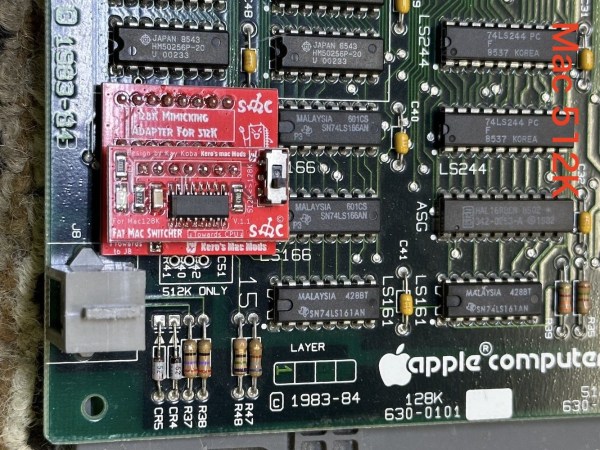
The Fat Mac Switcher, as it is called by its creator [Kay Koba], can upgrade the memory capability of these retro Apple machines with the simple push of a switch. The switch and controller logic sit on a separate PCB that needs to be installed into the computer’s motherboard in place of some of the existing circuitry. The computer itself needs its 16 memory modules replaced with 41256 DRAM modules for this to work properly though, but once its installed it can switch seamlessly between 512k and 128k modes.

Another interesting quirk of the retro Macintosh scene is that the technically inferior 128k models tend to be valued higher than the more capable 512k versions, despite being nearly identical otherwise. There are also some other interesting discussions on one of the forum posts about this build as well. This module can also be used in reverse; by installing it in a Macintosh 512k the computer can be downgraded to the original Macintosh 128k. For this the memory modules won’t need to be upgraded but a different change to the motherboard is required.

A product like this certainly would have been a welcome addition in the mid 80s when these machines were first introduced, since the 512k was released only months after the 128k machines were, but the retrocomputing enthusiasts should still get some use out of this device and be more able to explore the differences between the two computers. If you never were able to experience one of these “original” Macintosh computers in their heyday, check out this fully-functional one-third scale replica.
The Apple Silicon That Never Was

Over Apple’s decades-long history, they have been quick to adapt to new processor technology when they see an opportunity. Their switch from PowerPC to Intel in the early 2000s made Apple machines more accessible to the wider PC world who was already accustomed to using x86 processors, and a decade earlier they moved from Motorola 68000 processors to take advantage of the scalability, power-per-watt, and performance of the PowerPC platform. They’ve recently made the switch to their own in-house silicon, but, as reported by [The Chip Letter], this wasn’t the first time they attempted to design their own chips from the ground up rather than using chips from other companies like Motorola or Intel.

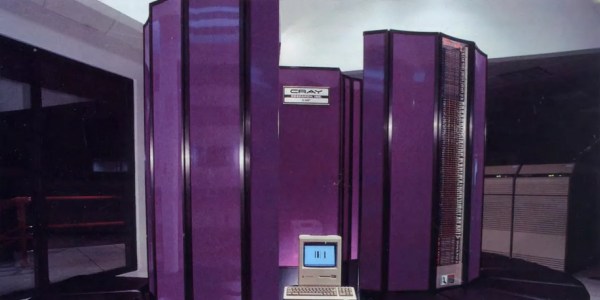
In the mid 1980s, Apple was already looking to move away from the Motorola 68000 for performance reasons, and part of the reason it took so long to make the switch is that in the intervening years they launched Project Aquarius to attempt to design their own silicon. As the article linked above explains, they needed a large amount of computing power to get this done and purchased a Cray X-MP/48 supercomputer to help, as well as assigning a large number of engineers and designers to see the project through to the finish. A critical error was made, though, when they decided to build their design around a stack architecture rather than a RISC. Eventually they switched to a RISC design, though, but the project still had struggled to ever get a prototype working. Eventually the entire project was scrapped and the company eventually moved on to PowerPC, but not without a tremendous loss of time and money.

Interestingly enough, another team were designing their own architecture at about the same time and ended up creating what would eventually become the modern day ARM architecture, which Apple was involved with and currently licenses to build their M1 and M2 chips as well as their mobile processors. It was only by accident that Apple didn’t decide on a RISC design in time for their personal computers. The computing world might look a lot different today if Apple hadn’t languished in the early 00s as the ultimate result of their failure to develop a competitive system in the mid 80s. Apple’s distance from PowerPC now doesn’t mean that architecture has been completely abandoned, though.

Thanks to [Stephen] for the tip!

Commodore 64 Web Server Brings 8-Bit Into The Future

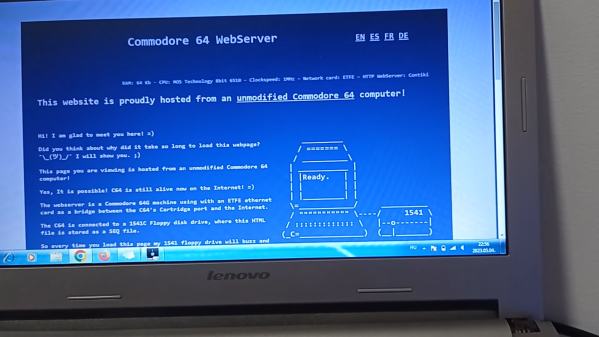
These days, most webservers are big hefty rackmount rigs with roaring fans in giant datacenters. [naDDan]’s webserver is altogether more humble, as it runs on a single Commodore 64. 

The C64 is running Contiki OS, an operating system for 6502-based computers. It’s built with an eye to networking, requiring ethernet hardware for full functionality. In [naDDan]’s case, he’s outfitted his C64 with an ETFE network adapter in the cartridge port to get it online. It serves up the HTML file off a 1541C floppy drive, with the drive buzzing away every time someone loads up the page.

The page itself is simple, showing some basic information on a simple blue background. There is some scrolling text though, as is befitting the 8-bit era. It’s also available in four languages.

[naDDan’s] server can be found here, according to his video, but at the time of writing, it was down for the count. Whether that’s due to a dynamic DNS issue or the simple fact that an 8-bit 6502 isn’t up to heavy traffic is up for debate. Regardless, try for yourself and see how you go. Video after the break.

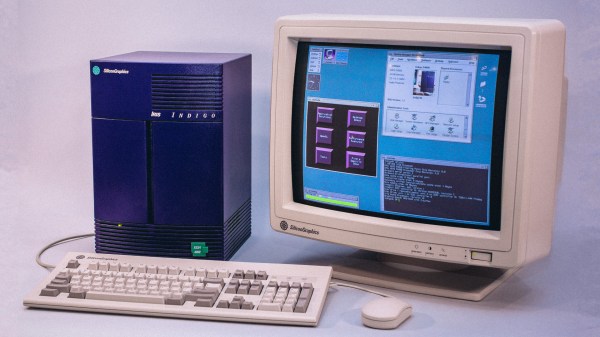
Can Hobbyists Bring SGI’s IRIX OS Back To Life?

Irix was the operating system developed by Silicon Graphics from 1988 to 1998. The OS supported the company’s high-end workstations and served in many serious roles. The company cut off support for the UNIX-based OS in 2006, but now a diehard community is looking to bring the ancient codebase back to life.

SGI workstations used to cost big money before the company collapsed. It failed to make the leap to a new era when x86 architecture began to dominate the wider computing industry. Credit: Bruno Cordioli, CC-BY-2.0

While SGI’s workstations once sold for five or six figures, surviving examples can now often be had for just a few hundred dollars on eBay. The MIPS-based hardware was potent for its time, often used for 3D rendering work for video games, films, or for scientific purposes. IRIX was SGI’s own OS built specifically to support these use cases.

The IRIX Network is a hobbyist community that loves these old machines and their software. The group hopes to raise $6,500 through crowdfunding to reverse-engineer IRIX. The hope is to use those learnings to create an open-source derivative version named IRIX-32, based on IRIX 5.3, the last 32-bit version of the OS.

It’s a monumental task, but admirable nonetheless. Whether we one day see IRIX reborn, akin to what happened to AmigaOS, remains to be seen.

BBC Master 128 Revealed

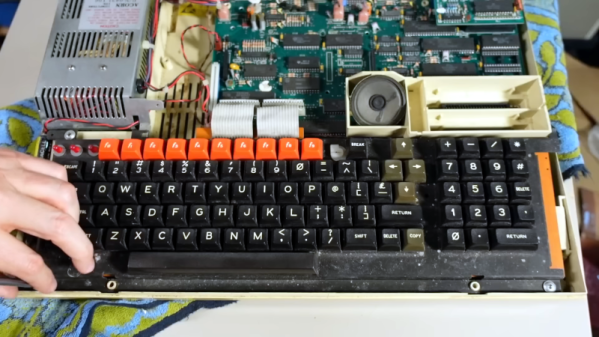
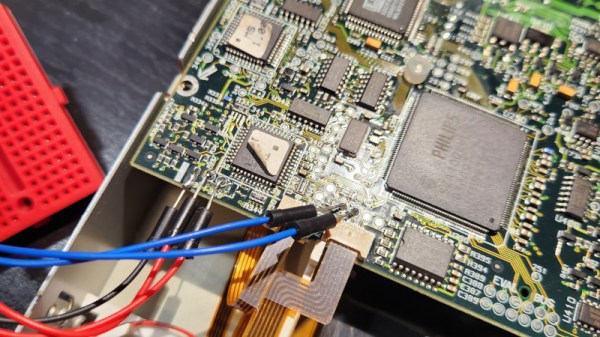
[Adrian] comments that the BBC Master 128 is a rare 8-bit computer, and we agree — we couldn’t remember hearing about that particular machine, although the BBC series is quite familiar. The machine has a whopping 128 K of RAM, quite a bit for those days. It also had a 6502 variant known as the 65C12, which has an extra pin compared to a 6502 and doesn’t use the same clock arrangement. A viewer sent him one of these machines, which apparently was used in the BBC studios. You can see this rare beauty in the video below.

The computer has a very nice-looking keyboard that includes a number pad. There are also expansion ports for printers and floppy disk drives. It has some similarities to a standard BBC computer but has a number of differences externally and internally.

Of course, we were waiting for the teardown about 15 minutes in. There were some corroded batteries but luckily, they didn’t do much damage. The power supply had a burned smell. Cracking it open for inspection was a good time to convert the power supply to run on 120 V, too.

After some power supply repair, it was time to power the machine up. The results were not half bad. It started up with a cryptic error message: “This is not a language.” Better than a dead screen. The keyboard wasn’t totally working, though. A bit of internet searching found that the error happens when the battery dies and the machine loses its configuration.

More walkthroughs will take a bit more work on the keyboard. But we were impressed it came up as far as it did, and we look forward to a future installment where the machine fully starts up.

[Adrian] mentioned the co-processor slot accepting a Raspberry Pi, something we’ve talked about before. Or, add an FPGA and make the plucky computer think it is a PDP/11.

Continue reading “BBC Master 128 Revealed”

Restoring Dot Matrix Printer Cartridges For 2023

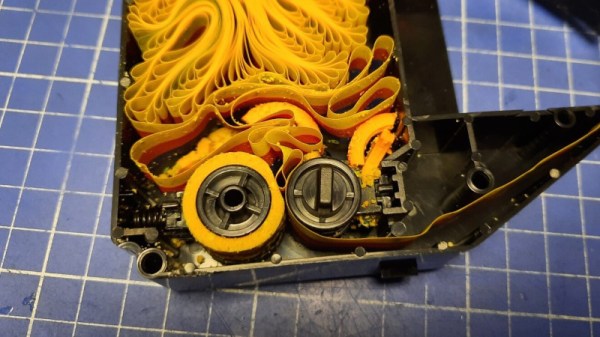
The noise of a dot matrix printer is probably as synonymous with 1980s computing as the modem handshake would become with the desktop experience a decade or more later. But unlike the computers that would have driven it, a dot matrix printer can still be a very useful device here in 2023. And why not? They’re cheap to operate and can produce surprisingly good quality when paired with suitable drivers. There is a snag though; while cartridges for popular models can still be found, there are plenty whose consumables are long gone. [Drygol] had an Apple ImageWriter II with exactly that problem, and after finding all his cartridges were non-functional, took a look at how to bring them back.

Inside a dot matrix cartridge is a fabric ribbon similar to the one that might once have been found on a typewriter. It’s not on a roll but folded into the space, and it’s drawn through by a pair of rollers. Not only had the ink on the fabric dried out, but the foam on the rollers had also disintegrated. Some careful dismantling, and a solution presented itself in the form of O-rings to replace the rollers. Those and a bit of mineral oil to soften the ink had the vintage Apple printing again as though it was the ’80s once more.

It’s a subject we’ve looked at before, as it turns out WD-40 makes a good ink solvent.

When The Professionals Trash Your Data Tape, Can It Still Be Recovered?

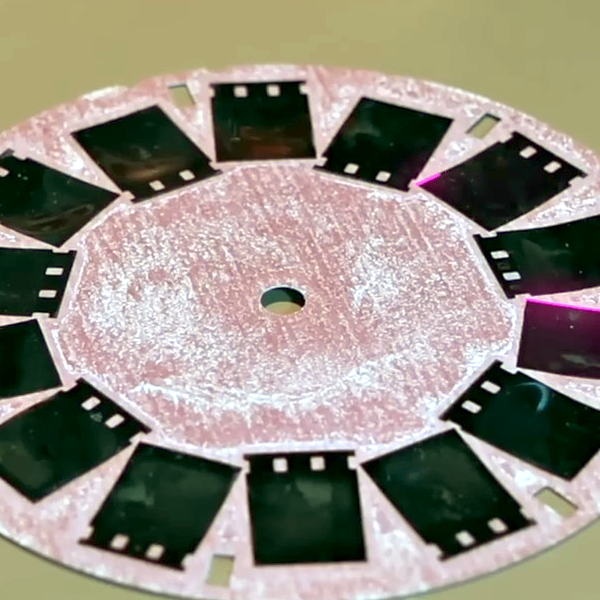
People trying to preserve digital artifacts held on old media often not only have to contend with the media themselves decaying, but also with obscure media formats for which there’s seemingly little chance of finding a working reader. [Kneesnap] had this problem with a tape containing the only known copy of all the assets for the game Frogger 2: Swampy’s Revenge, and the tale of how the data was recovered is a dive into both the shady side of the data recovery industry and some clever old-format hacking.

The tape was an Onstream cartridge, a short-lived format from a company whose first product hit the market at the end of the ’90s and who went bust in 2004. An old drive was found, but it proved to have a pinch roller melted with age, so in desperation the tape was sent to a data recovery company.

We admire the forbearance in not naming and shaming the data recovery company, because far from recovering the data they sent it back with the tape damaged and spliced — something you can do with an analogue tape but not a digital one without compromising the data. Then faced with an unrecoverable tape and a slightly different Onstream cartridge, how could anything be salvaged?

The answer came in overriding the drive’s sensors and initializing it with a known-good tape, then swapping out the tapes so that the drive, unaware anything had changed, could read whatever data it could find. In the event the vast majority of the archive was retrieved, making it a win for the preservation of that game.

This may be more involved than some recovery stories, but it’s not the first we’ve covered.