We never know exactly what to make of university press releases, as we see plenty of them with breathless claims of new batteries or supermaterials, but then we don’t see much else. Sometimes, the claims in the press release don’t hold up in the paper, while other times the claims seem to be impractical for use in real life. We aren’t quite sure what to make of a press release from the University of Arkansas claiming they can draw current from a sheet of freestanding graphene purely from its temperature fluctuations.
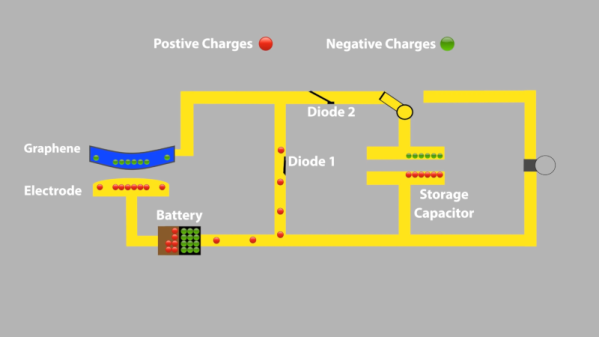
The press release seems to claim that this is a breakthrough leading to “clean, limitless power.” But if you look at the actual paper, normal room temperature is causing tiny displacements in the graphene sheet as in Brownian motion. A scanning tunneling microscope with two diodes can detect current flowing even once the system reaches thermal equilibrium. Keep in mind, though, that this in the presence of a bias voltage and we are talking about nanometer-scale displacements and 20 pA of current. You can see a simple video from the university showing a block diagram of the setup.
The US Nuclear Regulatory Commission (NRC) recently announced that it had approved certification of NuScale’s SMR (small modular reactor) design, completing its Phase 6 review of NuScale’s Design Certification Application (DCA). What this means is that SMRs using NuScale’s reactor design can legally be constructed within the US as soon as the rulemaking process completes. An NRC certification would also mean that certification of the design in other countries should pose no significant hurdles.
A question that remains unanswered at this point for most is how this certification process at the NRC actually works. Are there departments full of engineers at the NRC who have been twiddling their thumbs for the past decades while the US nuclear industry has been languishing? What was in the literally millions of documents that NuScale had to send to the NRC as part of the certification process, and what exactly are these six phases?
Stay tuned for a crash course in nuclear reactor certification, after a bit of SMR history.
Fiber optics are a great way to transfer huge quantity of data at lightning speed. Thanks to the property of total internal reflection, which allows light to flow through a glass fiber like fluid through a pipe, they can be used for communications at long distances and form the backbone of modern communication networks. However, water is also able to pull off the total internal reflection party trick, and [Mike Kohn] decided to see if it could be used as a communication medium, too.
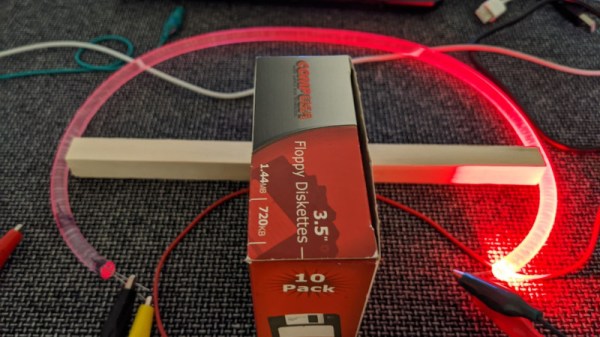
The experimental setup consists of an ATTiny85 that receives signals over its serial port, and outputs the received bits by flashing an LED. This LED is attached to a plastic tube filled with water. On the receiving end, another ATTiny85 reads the voltage level of a photodiode placed in the other end of the tube. When the ADC detects voltage over a certain level, it toggles a pin connected to the serial RX pin.
Hooking the setup to a pair of terminals, [Mike] was able to successfully transmit 9600 baud serial data through a tube full of water with just an LED and a small microcontroller. To verify the success, he ran the test again with an air-filled tube instead, which failed. In doing so, he proved that the water was doing the work.
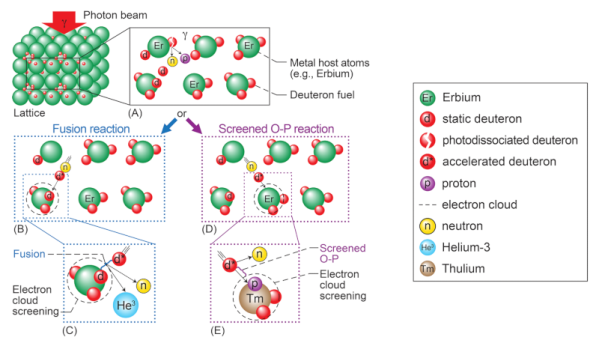
Do you remember in 1989 when two chemists announced they’d created a setup that created nuclear fusion at room temperature? Everyone was excited, but it eventually turned out to be very suspect. It wasn’t clear how they detected that fusion occurred and only a few of the many people who tried to replicate the experiment claimed success and they later retracted their reports. Since then, mentioning cold fusion is right up there with perpetual motion. Work does continue though, and NASA recently published several papers on lattice confinement fusion which is definitely not called cold fusion, although it sounds like it to us.
The idea of trapping atoms inside a metallic crystal lattice isn’t new, dating back to the 1920s. It sounds as though the NASA method uses erbium packed with deuterium. Photons cause some of the deuterium to fuse. Unlike earlier attempts, this method produces detectable neutron emissions characteristic of fusion.
By now, you’ve likely heard that scientists have found a potential sign of biological life on Venus. Through a series of radio telescope observations in 2017 and 2019, they were able to confirm the presence of phosphine gas high in the planet’s thick atmosphere. Here on Earth, the only way this gas is produced outside of the laboratory is through microbial processes. The fact that it’s detectable at such high concentrations in the Venusian atmosphere means we either don’t know as much as we thought we did about phosphine, or more tantalizingly, that the spark of life has been found on our nearest planetary neighbor.
Venus, as seen by Mariner 10 in 1974
To many, the idea that life could survive on Venus is difficult to imagine. While it’s technically the planet most like Earth in terms of size, mass, composition, and proximity to the Sun, the surface of this rocky world is absolutely hellish; with a runaway greenhouse effect producing temperatures in excess of 460 C (840 F). Life, at least as we currently know it, would find no safe haven on the surface of Venus. Even the Soviet Venera landers, sent to the planet in the 1980s, were unable to survive the intense heat and pressure for more than a few hours.
While the surface may largely be outside of our reach, the planet’s exceptionally dense atmosphere is another story entirely. At an altitude of approximately 50 kilometers, conditions inside the Venusian atmosphere are far more forgiving. The atmospheric pressure at this altitude is almost identical to surface-level pressures on Earth, and the average temperature is cool enough that liquid water can form. While the chemical composition of the atmosphere is not breathable by Earthly standards, and the clouds of sulfuric acid aren’t particularly welcoming, it’s certainly not out of the realm of possibility that simple organisms could thrive in this CO2-rich environment. If there really is life on Venus, many speculate it will be found hiding in this relatively benign microcosm high in the clouds.
In short, all the pieces seem to be falling into place. Observations confirm a telltale marker of biological life is in the upper levels of the Venusian atmosphere, and we know from previous studies that this region is arguably one of the most Earth-like environments in the solar system. It’s still far too early to claim we’ve discovered extraterrestrial life, but it’s not hard to see why people are getting so excited.
But this isn’t the first time scientists have turned their gaze towards Earth’s twin. In fact, had things gone differently, NASA might have sent a crew out to Venus after the Apollo program had completed its survey of the Moon. If that mission had launched back in the 1970s, it could have fundamentally reshaped our understanding of the planet; and perhaps even our understanding of humanity’s place in the cosmos.
The Earth’s oceans are a vast frontier that brims with possibilities for the future of medicine, ocean conservation, and food production. They remain largely unexplored because of the physical limits of scuba diving. Humans can only dive for a few hours each day, and every minute spent breathing compressed air at depth must be paid for with a slower ascent to the surface. Otherwise, divers could develop decompression sickness from nitrogen expanding in the bloodstream.
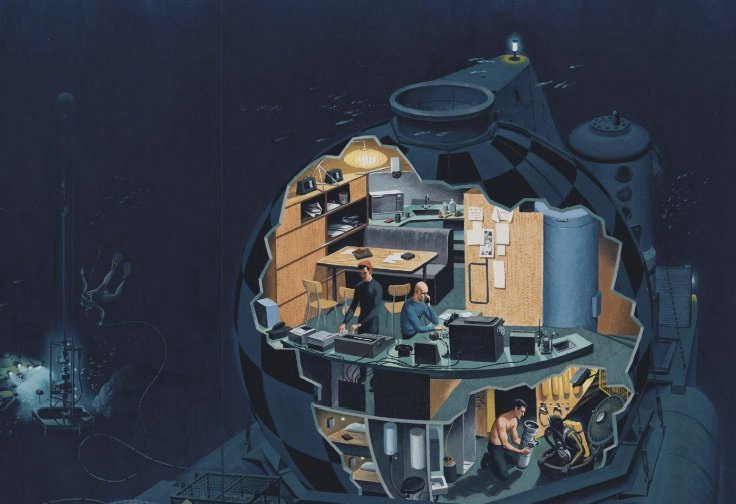
An illustration of the Conshelf 3 habitat. Image via Medium
In the 1960s, world-famous oceanographer Jacques Cousteau built a series of small underwater habitats to extend the time that he and other researchers were able to work. These sea labs were tethered to a support ship with a cable that provided air and power.
Cousteau’s first sea lab, Conshelf 1 (Continental Shelf Station) held two people and was stationed 33 feet deep off the coast of Marseilles, France. Conshelf 2 sheltered six people and spent a total of six weeks under the Red Sea at two different depths.
Conshelf 3 was Cousteau’s most ambitious habitat design, because it was nearly self-sufficient compared to the first two. It accommodated six divers for three weeks at a time and sat 336 feet deep off the coast of France, near Nice. Conshelf 3 was built in partnership with a French petrochemical company to study the viability of stationing humans for underwater oil drilling (before we had robots for that), and included a mock oil rig on the nearby ocean floor for exercises.
Several underwater habitats have come and gone in the years since the Conshelf series, but each has been built for a specific research project or group of tasks. There’s never really been a permanent habitat established for general research into the biochemistry of the ocean.
If you live anywhere near the tropics, air conditioning isn’t a luxury but a necessity. The problem however is that humid climates can cause conventional air conditioners to draw more power to dehumidify the air than it requires to just cool it, which increases the power needed to run the unit. Back in 1963, there was a proposal to create a cooling system that didn’t foster condensation and couple it with different methods of removing humidity. Researchers in Singapore have now created such a system. It uses a membrane that is permeable to infrared radiation but prevents condensation around the cooling unit.
You can see a video of the apparatus in a pavilion in the Singapore heat in the video below. Chilled water runs through tubes behind a membrane that passes thermal radiation. Since the tubes are not exposed to the ambient atmosphere, condensation is minimal. But heat radiates from the warmer area to the much colder area of the tubes.