See You On The Dark Side Of The Moon: China’s Lunar Radio Observatory

For nearly as long as there has been radio, there have been antennas trained on the sky, looking at the universe in a different light than traditional astronomy. Radio astronomers have used their sensitive equipment to study the Sun, the planets, distant galaxies, and strange objects from the very edge of the universe, like pulsars and quasars. Even the earliest moments of the universe have been explored, a portrait in microwave radiation of the remnants of the Big Bang.

And yet with all these observations, there’s a substantial slice of the radio spectrum that remains largely a mystery to radio astronomers. Thanks to our planet’s ionosphere, most of the signals below 30 MHz aren’t observable by ground-based radio telescopes. But now, thanks to an opportunity afforded by China’s ambitious lunar exploration program, humanity is now listening to more of what the universe is saying, and it’s doing so from a new vantage point: the far side of the moon.

Continue reading “See You On The Dark Side Of The Moon: China’s Lunar Radio Observatory”

atom drawing

What’s An Exciton?

If you read the scientific literature, you see the familiar subatomic particles you learned about in school: protons, neutrons, and electrons. If you are young enough, you see others you probably heard about, too, like quarks and gluons. But recently there has been a lot of buzz about excitons and even some transistor circuits demonstrated that use them. But what is an exciton?

It actually sounds like a subatomic particle, but it is a little more complicated than that. An exciton is a bound state of an electron and an electron hole and is technically a boson. You are probably familiar with the idea of an electron hole from semiconductor physics. Technically, it is a quasiparticle. The reason scientists are interested in the beast is that it can transport energy without transporting net electric charge. That is, the state itself is neutral, but also contains energy. Continue reading “What’s An Exciton?”

Weird Substances: Hagfish Slime

In the cold, dark recesses of ocean floors around the world, hagfish slither around like sea snakes, searching for food. When a hagfish finds a suitable carcass, it devours the dead fish in two different ways. As it burrows face-first through the tissue, eating with its jaw-less, tentacled mouth, the hagfish also absorbs nutrients through its skin.

Hagfish are not the unholy result of dumping toxic waste in the ocean. They’re one of the oldest creatures on Earth, having been around for more than 300 million years. How have they lasted this long?

A coiled hagfish reveals its slime ports. Image via Oregon Coast Aquarium

These ancient creatures have no eyes, no backbones, and no scales. They are often misidentified as eel, and often called ‘slime eels’, but they are definitely fish. They just don’t look like conventional fish. In fact, when conventional, gill-faced fish come after hagfish, those guys are in for a surprise, because hagfish have a disgusting but ingenious defense mechanism.

Whenever hagfish are attacked or even just stressed by nearby fish or curious grabby humans, they immediately emit amazing amounts of mucus at an alarming rate. At the same time, the hagfish shoots out silky strands of protein that hold the slime together in a cohesive blob. Any predator that tries to bite down on one of these velvety frankfurters of the deep sea will find its mouth and gills covered in a wad of suffocating slime.

How is it that hagfish haven’t slimed themselves out of existence? Whenever they get get a taste of their own medicine, these boneless noodles quickly twist themselves into a pretzel. In the same motion, they use their paddle-shaped tails to squeegee off the slime.

Continue reading “Weird Substances: Hagfish Slime”

Conductive Tape Current Capacity Comparison

The world of DIY circuits for STEM and wearables has a few options for conductors. Wire with Dupont connectors is a standard, as is adhesive copper tape. There’s also conductive nylon/steel thread or ribbon. Which you choose depends on your application, of course, but as a general rule wire is cheap and ubiquitous while making connections is more challenging; copper tape is cheap and simple to use, but delicate and rips easily, so is best used for flat surfaces that won’t see a lot of stress or temporary applications; and conductive nylon thread or tape is better for weaving into fabrics.

The Brown Dog Gadgets team wanted to respond to a frequent question they are asked, what are the current limits for their Maker Tape (nylon/steel ribbon), so they ran some experiments to find out. In the name of Science you’ll see some flames in the video below, but only under extreme conditions.
Continue reading “Conductive Tape Current Capacity Comparison”

Jonas Salk, Virologist And Vaccination Vanguard

In the early 1950s, the only thing scarier than the threat of nuclear war was the annual return of polio — an easily-spread, incurable disease that causes nerve damage, paralysis, and sometimes death. At the first sign of an outbreak, public hot spots like theaters and swimming pools would close up immediately.

One of the worst polio epidemics in the United States struck in 1952, a few years into the postwar baby boom. Polio is more likely to infect children than adults, so the race to create a vaccine reached a fever pitch.

Most researchers were looking into live-virus vaccines, which had worked nicely for smallpox and rabies and become the standard approach. But Jonas Salk, a medical researcher and budding virologist, was keen on the idea of safer, killed-virus vaccines. He believed the same principle would work for polio, and he was right. Within a few years of developing his vaccine, the number of polio cases in the United States dropped from ~29,000 in 1955 to less than 6,000 in 1957. By 1979, polio had been eradicated in the US.

Jonas Salk is one of science’s folk heroes. The polio vaccine was actually his sophomore effort — he and Thomas Francis developed the first influenza vaccine in the 1940s. And he didn’t stop with polio, either. Toward the end of his life, Salk was working on an AIDS vaccine.

Continue reading “Jonas Salk, Virologist And Vaccination Vanguard”

Building A Mechanical Oscillator, Tesla Style

Before Tesla devised beautifully simple rotary machinery, he explored other methods of generating alternating current. One of those was the mechanical oscillator, and [Integza] had a go at replicating the device himself. (Video, embedded below the break.)

Initial attempts to reproduce the technology using 3D-printed parts were a failure. The round cylinder had issues sealing, and using O-ring seals introduced too much friction to allow the device to oscillate properly. A redesign that used external valving and a square cylinder proved more successful.

Once the oscillator was complete, the output shaft was fitted with magnets and a coil to generate electricity. After generating a disappointing 0.14 volts, [Integza] went back and had a look at the Maxwell-Faraday equations. Using this to guide the design, a new coil was produced with more turns, and the magnetic flux was maximised. With this done, the setup could generate seven volts, enough to light several LEDs.

While it’s not a particularly efficient generator, it’s a great proof-of-concept. Yes, Tesla’s invention worked, but it’s easy to see why he moved on to rotary designs when it came to real-world applications. We’ve seen [Integza] take on other builds too, like the ever-popular Tesla turbine.

Continue reading “Building A Mechanical Oscillator, Tesla Style”

New Silicon Carbide Semiconductors Bring EV Efficiency Gains

After spending much of the 20th century languishing in development hell, electric cars have finally hit the roads in a big way. Automakers are working feverishly to improve range and recharge times to make vehicles more palatable to consumers.

With a strong base of sales and increased uncertainty about the future of fossil fuels, improvements are happening at a rapid pace. Oftentimes, change is gradual, but every so often, a brand new technology promises to bring a step change in performance. Silicon carbide (SiC) semiconductors are just such a technology, and have already begun to revolutionise the industry.

Mind The Bandgap

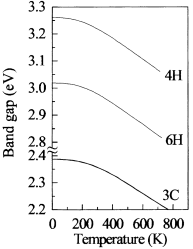
A graph showing the relationship between band gap and temperature for various phases of Silicon Carbide.

Traditionally, electric vehicles have relied on silicon power transistors in their construction. Having long been the most popular semiconductor material, new technological advances have opened it up to competition. Different semiconductor materials have varying properties that make them better suited for various applications, with silicon carbide being particularly attractive for high-power applications. It all comes down to the bandgap.

Electrons in a semiconductor can sit in one of two energy bands – the valence band, or the conducting band. To jump from the valence band to the conducting band, the electron needs to reach the energy level of the conducting band, jumping the band gap where no electrons can exist. In silicon, the bandgap is around 1-1.5 electron volts (eV), while in silicon carbide, the band gap of the material is on the order of 2.3-3.3 eV. This higher band gap makes the breakdown voltage of silicon carbide parts far higher, as a far stronger electric field is required to overcome the gap. Many contemporary electric cars operate with 400 V batteries, with Porsche equipping their Taycan with an 800 V system. The naturally high breakdown voltage of silicon carbide makes it highly suited to work in these applications.

Continue reading “New Silicon Carbide Semiconductors Bring EV Efficiency Gains”