Storm Chasers Score Bullseye On Tornado With Instrument-Packed Rocket

Model rockets are a heck of a lot of fun, and not a few careers in science and engineering were jump-started by the thrilling woosh and rotten-egg stench of an Estes rocket launch. Adding simple instrumentation to the rocket doubles the fun by allowing telemetry to be sent back, or perhaps aiding in recovery of a lost rocket. Sending an instrument-laden rocket into a tornado is quite a few notches past either of those scenarios, and makes them look downright boring by comparison.

A first and hopefully obvious point: just don’t do this. [ChasinSpin] and [ReedTimmer] are experienced storm chasers, and have a small fleet of purpose-built armored vehicles at their disposal. One such vehicle, the Dominator, served as a mobile launch pad for their rocket as they along with [Sean Schofer] and [Aaron Jayjack] chased what developed into an EF4 monster tornado near Lawrence, Kansas on May 28. They managed to score a direct hit on the developing tornado, only 100 feet (30 meters) away at the time, and which took the rocket to 35,000 ft (10.6 km) and dragged it almost 30 miles (42 km) downrange. They lost touch with it but miraculously recovered it from a church parking lot.

They don’t offer a lot of detail on the rocket itself, but honestly it looks pretty much off-the-shelf, albeit launched from an aimable launchpad. [ChasinSpin] does offer a few details on the instrument package, though – a custom PCB with GPS, IMU, a temperature/humidity/barometric pressure sensor, and a LoRa link to send a data packet back every second. The card also supported an SD card for high-resolution measurements at 10 times per second. Check out the launch in the video below, and be sure to mouse around to get a look at the chaotic environment they were working in.

Even if this isn’t as cool as sending a sounding rocket into an aurora, it’s still really cool. We’re looking forward to seeing what kind of data this experiment collected, and what it reveals about the inner workings of these powerful storms.

Continue reading “Storm Chasers Score Bullseye On Tornado With Instrument-Packed Rocket”

The Fascinating World Of Solder Alloys And Metallurgy

Solder is the conductive metal glue that one uses to stick components together. If you get the component and the PCB hot enough, and melt a little solder in the joint, it will stay put and conduct reliably. But it’s far from simple.

There are many different solder alloys, and even the tip of the soldering iron itself is a multi-material masterpiece. In this article, we’ll take a look at the metallurgy behind soldering, and you’ll see why soldering tip maintenance, and regular replacement, is a good idea. Naturally, we’ll also touch upon the role that lead plays in solder alloys, and what the effect is of replacing it with other metals when going lead-free. What are you soldering with? Continue reading “The Fascinating World Of Solder Alloys And Metallurgy”

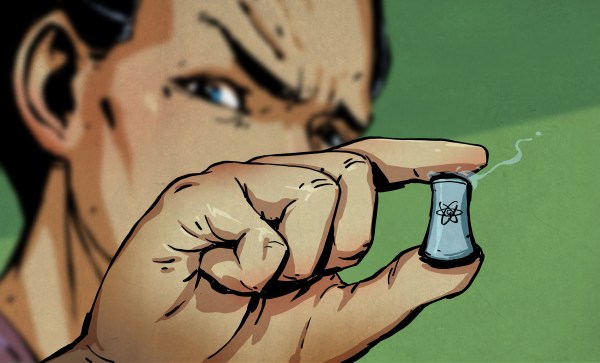
Atomic Power Gets Small

There was a time when nuclear power plants were going to save the world. Barring accidents, the plants are clean and generate a lot of power. However, a few high-profile accidents and increased public awareness of some key issues have made nuclear power a hard sell, at least in the United States. The fastest growing nuclear power-related business in the US — according to sources — is companies decommissioning nuclear power plants. However, there’s a move afoot to make nuclear power a viable solution again. The company behind it says their plants will be cheaper to build, cheaper to operate, and are much safer than conventional plants. Are those claims reasonable?

Continue reading “Atomic Power Gets Small”

Loads Of Testing Yields New, Reliable, And Cheap Leather Hardening Technique

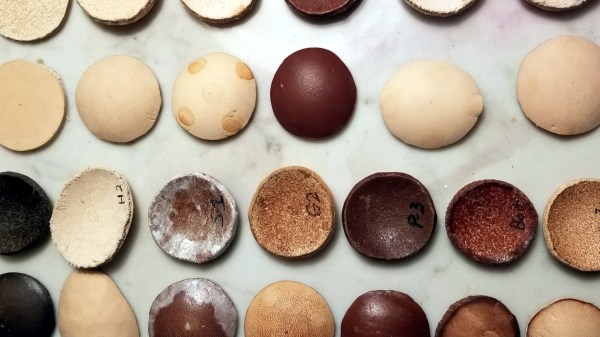
Leather hardening has been around for such a long time that one might think that there was little left to discover, but [Jason F. Timmermans] certainly showed that is not the case. Right around the end of 2018 he set up experiments to compare different techniques for hardening leather, and empirically determine the best options. After considerable effort, he crafted a new method with outstanding results. It’s part of his exhaustive testing of different techniques for hardening leather, including some novel ones. It was a considerable amount of work but [Jason] says that he gathered plenty of really useful information, which we’re delighted that he took the time to share it.

According to [Jason], the various methods of hardening can be separated into four groups:

  1. Thermal: heat-treating at 180 ºF or higher, usually via some kind of boiling or baking process.
  2. Chemical: soaking in a substance that causes changes in the leather. Some examples include ammonia, vinegar, acetone, brine, and alcohol.
  3. Mechanical: hammering the leather.
  4. “Stabilizing” methods: saturating the leather with a substance to add rigidity and strength without otherwise denaturing the leather itself. Examples include beeswax, pine pitch, stearic acid, and epoxy.

We recommend making the time to follow the link in the first paragraph and read the full results, but to summarize: heat-treating generally yields a strong but brittle product, and testing revealed stearic acid  — which resembles a kind of hard, dense wax at room temperature — was an early standout for overall great results. Stearic acid has many modern uses and while it was unclear from [Jason]’s reasearch exactly when in history it became commonplace, at least one source mentioned it as a candidate for hardening leather.

But the story doesn’t stop there. Unsatisfied with simply comparing existing methods, [Jason] put a lot of work into seeing if he could improve things. One idea he had was to combine thermal treatment with a stabilizer, and it had outstanding results. The winning combination (named X1 in his writeup) was to preheat the leather then immerse it in melted stearic acid, followed by bringing the temperature of the combination to 200 ºF for about a minute to heat treat the leather at the same time. [Jason]’s observation was that this method “[B]lew the rest out of the water. Cutting the sample to view the cross section was like carving wood. The leather is very rigid and strong.”

The world may not revolve around leather the way it used to, but there’s still stuff to learn and new things to discover. For example, modern tools can allow for novel takes on old techniques, like using 3D printing to create custom leather embossing jigs.

Piezoelectric Crystals Explained

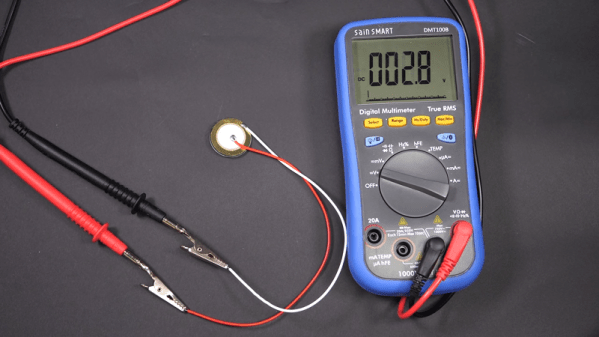
Summer in the Northern hemisphere means outdoor cooking. Matches are old school, and you are more likely to use a piezoelectric lighter to start your grill. [Steve Mould] has one, but he didn’t understand the physics behind why it works, so he decided to do the research and share it in a video.

The first two minutes is a recap of things you already know. But after that [Steve] gets into the crystal lattice structure of quartz. Using some computer animations and some peanut butter lids he shows you exactly why compressing the crystal generates electricity.

Continue reading “Piezoelectric Crystals Explained”

Easy DIY Gecko Tape

Geckos are amazing creatures, with the ability to walk on and stick to all manner of surfaces. If you’ve ever woken up to see lizards on your ceiling, you’re already familiar with their capabilities. The mechanisms behind this have been an area of much research in recent times, and [The Thought Emporium] decided to try and recreate the effect himself (Youtube video, embedded below).

The way geckos stick to surfaces is through the use of nano-scale hairs on their feet. These hairs dramatically increase the surface area of contact between the gecko and the surface in question. This allows the usually-small intermolecular forces to stack up and keep the gecko adhered.

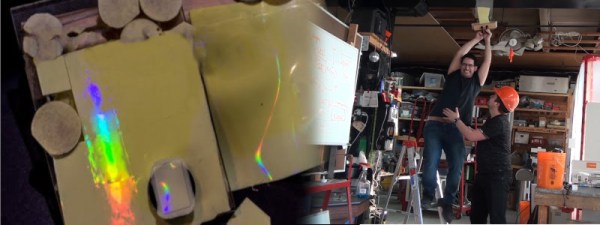
Several teams have managed to create synthetic substances that recreate this ability; indeed we’ve featured some here before. In this case, experimentation started with an attempt to generate the requisite nanostructures by casting RTV silicone on a microporous filter. This was unsuccessful, with the hairs on the surface of the material created being too sparse and at random angles. The next stage involved attempting to use a tattoo gun, needles, and finally sharpened tungsten wires to pattern wax, which could then have silicone cast onto it to pick up the geometry. This too was unsuccessful, as it wasn’t possible to generate tiny enough features to generate the effect.

The final experiment involved casting silicone upon a 1000 line per millimeter diffraction grating. This generated tiny ridges on the surface of the silicone, and greatly improved its sticking ability. While the ridges generated aren’t as capable as gecko feet or professionally-produced films, they do have an impressive weight holding ability. A small section of the silicone was able to hold over 20 pounds for an extended period in testing.

It’s a great example of how to do seemingly complicated science with materials that can be easily acquired for the home workshop. We’d love to see just how strong a gecko tape could be produced with more work done on this method. Video after the break.

Continue reading “Easy DIY Gecko Tape”

By The Numbers: Which Rapper’s Rhymes Are The Freshest?

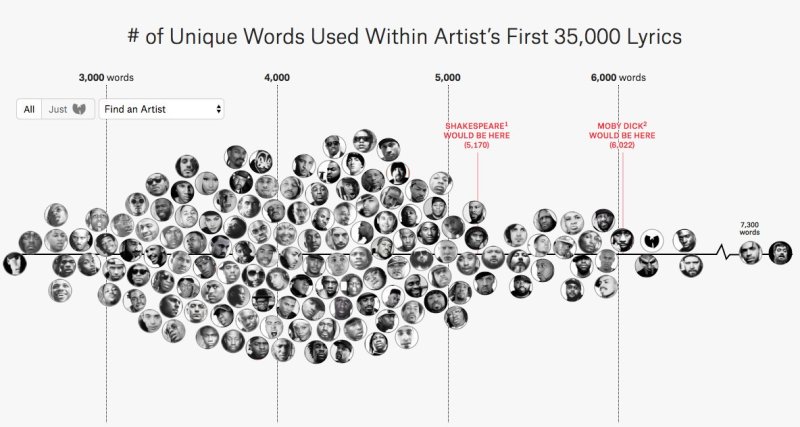
Beats and rhymes are life in the world of hip-hop. A rapper’s ability to seamlessly merge the two is the mark of a master wordsmith. Ranking a rapper’s contributions to hip-hop will forever remain subjective, however [Matt] sought to apply a more quantitative approach to the matter. He created an interactive data set containing all the lyrics from over 150 rappers in order to determine which rapper’s vocabulary was the largest. Now everyone can know definitively which rapper’s rhymes truly are “the freshest”.

The study encompasses hip-hop artists from the last thirty years, pitting recent hit-makers like Lil Uzi Vert against veteran artists like KRS-One. To ensure everything is on even playing field [Matt] limited the study to the first 35,000 lyrics of each artist including any material on a mixtape, EP, or full album release. Rappers’ vocabulary was then plotted according to the total number of unique words found in their lyrics (i.e.: “shorty” and the alternative spelling “shawty” were each considered to be unique words). Oddly enough, there were some notable exclusions from the list as artists like Chance the Rapper, Queen Latifah, and The Notorious B.I.G’s discography did not exceed the 35,000 lyrics mark.

When digging into the data, there was a downward trend in the vocabulary used amongst popular artists of the last decade. [Matt] attributed this trend to the fact that many of these artists have modeled their music to reflect the pop/rock music structure that makes use of simple, repetitive choruses. While others may attribute this downward trend to a general lack of talent when it comes to lyricism, however, it should be noted that the economics of music streaming platforms have had an effect on the average song length. Though whatever era of hip-hop you subscribe to, it is always interesting to see where your favorite emcees rank.