Engineers Develop A Brain On A Chip

Our abilities to multitask, to quickly learn complex maneuvers, and to instantly recognize objects even as infants are just some of the ways that human brains make use of our billions of synapses. Biologically, our brain requires fluid-filled cavities, nerve fibers, and numerous other cells and connections in order to function. This isn’t the case with a new kind of brain recently announced by a team of MIT engineers in Nature Nanotechnology. Compared to the size of a typical human brain, this new “brain-on-a-chip” is able to fit on a piece of confetti.

When you take a look at the chip, it is more similar to tiny metal carving than to any neurological organ. The technology used to design the chip is based on memristors – silicon-based components that mimic the transmissions of synapses. A concatenation of “memory” and “resistor”, they exist as passive circuit elements that retain a relationship between the time integrals of current and voltage across an element. As resistance varies, tiny read charges are able to access a history of applied voltage. This can be accomplished by hysteresis and other non-linear properties of passive circuitry.

These properties can be best observed at nanoscale levels, where they aren’t dwarfed by other electronic and field effects. A tiny positive and negative electrode are separated by a “switching medium”, or space between the two electrodes. Voltage applied to one end causes ions to flow through the medium, forming a conduction channel to the other end. These ions make up the electrical signal transmitted through the circuit.

In order to fabricate these memristors, the researchers used alloys of silver for the positive electrode, and copper alongside silicon for the negative electrode. They sandwiched the two electrodes along an amorphous medium and patterned this on a silicon chip tens of thousands of times to create an array of memristors. To train the memristors, they ran the chips through visual tasks to store images and reproduce them until cleaner versions were produced. These new devices join a new category of research into neuromorphic computing – electronics that function similar to the way the brain’s neural architecture operates.

The opportunity for electronics that are capable of making instantaneous decisions without consulting other devices or the Internet spell the possibility of portable artificial intelligence systems. Though we already have software systems capable of simulating synaptic behavior, developing neuromorphic computing devices could vastly increase the capability of devices to do tasks once thought to belong solely to the human brain.


New Microscope Directly Images Protein Atoms

There’s an old joke that you can’t trust atoms — they make up everything. But until fairly recently, there was no real way to see individual atoms. You could infer things about them using X-ray crystallography or measure their pull on tiny probes using atomic force microscopes, but not take a direct image. Until now. Two laboratories recently used cryo-electron microscopy to directly image atoms in a protein molecule with a resolution of about 1.2 x 10⁻⁷ millimeters or 1.2 ångströms. The previous record was 1.54 ångströms.

Recent improvements in electron beam technology helped, as did a device that ensures electrons that strike the sample travel at nearly the same speeds. The latter technique resulted in images so clear, researchers could identify individual hydrogen atoms in the apoferritin molecule and the water surrounding it.

Continue reading “New Microscope Directly Images Protein Atoms”

How Science Adapted To The Aftermath Of Cold War Nuke Tests

Current global events have demonstrated that we do not live in the most stable of times. Still, most of us 90’s kids are probably glad that we did not have to endure the political shakiness of the Cold War era when people were living in constant fear of nuclear Armageddon. Nuclear weapons tests were common during this period as the United States and the Soviet Union invested heavily to increase the quality and quantity of their warheads in the race for nuclear supremacy.

Even though the political situation stabilized after the fall of the Soviet Union, the consequences of the vast amount of nuclear tests conducted back then are still noticeable today. Besides the devastating effects on human health and the environment, this period also leaves some implications for science which are not always negative.

Continue reading “How Science Adapted To The Aftermath Of Cold War Nuke Tests”

Swap Your Microwave For A High Voltage Stereo

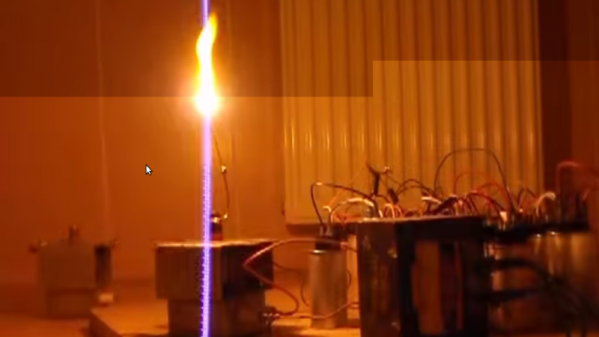
When building a new project, common wisdom suggests to avoid “reinventing the wheel”, or doing something simple from scratch that’s easily available already. However, if you can build a high-voltage wheel, so to speak, it might be fun just to see what happens. [Dan] decided to reinvent not the wheel, but the speaker, and instead of any conventional build he decided to make one with parts from a microwave and over 6,000 volts.

The circuit he constructed works essentially like a Tesla coil with a modulated audio signal as an input. The build uses the high voltage transformer from the microwave too, which steps the 240 V input up to around 6 kV. To modulate that kind of voltage, [Dan] sends the audio signal through a GU81M vacuum tube with the support of a fleet of high voltage capacitors. The antenna connected to the magnetron does tend to catch on fire somewhere in the middle of each song, so it’s not the safest device around even if the high voltage can be handled properly, but it does work better than expected as a speaker.

If you want a high-voltage speaker that (probably) won’t burn your house down, though, it might be best to stick to a typical Tesla coil. No promises though, since working with high voltages typically doesn’t come with safety guarantees.

Continue reading “Swap Your Microwave For A High Voltage Stereo”

Coronavirus Testing: CRISPR Technology Set To Streamline Viral Testing

If we could run back 2020 to its beginning and get a do-over, chances are pretty good that we’d do a lot of things differently. There’s a ton of blame to go around on COVID-19, but it’s safe to say that one of the biggest failures of this whole episode has been the lack of cheap, quick, accurate testing for SARS-CoV-2, the virus behind the current pandemic. It’s not for lack of information; after all, Chinese scientists published the sequence of the viral genome very early in the pandemic, and researchers the world over did the same for all the information they gleaned from the virus as it rampaged around the planet.

But leveraging that information into usable diagnostics has been anything but a smooth process. Initially, the only method of detecting the virus was with reverse transcriptase-polymerase chain reaction (RT-PCR) tests, a fussy process that requires trained technicians and a well-equipped lab, takes days to weeks to return results, and can only tell if the patient has a current infection. Antibody testing has the potential for a quick and easy, no-lab-required test, but can only be used to see if a patient has had an infection at some time in the past.

What’s needed as the COVID-19 crisis continues is a test with the specificity and sensitivity of PCR combined with the rapidity and simplicity of an antibody test. That’s where a new assay, based on the latest in molecular biology methods and dubbed “STOPCovid” comes in, and it could play a major role in diagnostics now and in the future.

Continue reading “Coronavirus Testing: CRISPR Technology Set To Streamline Viral Testing”

Piddler Illustrates Aliasing And The Z-Transform

One of the problems about learning too much control system theory is that you start to realize almost everything is some sort of control system. That’s the case with [Fernando Zigunov]. After observing a Rayleigh-Plateau instability in his kitchen sink, he decided to build a little display piece that shows water apparently defying gravity that he calls The Piddler.

We’ve seen things like this before, of course. A coffee pump, a check valve, and a strobe lamp with a controller is all that it takes. What makes this project interesting is the over hour-long video lecture on the theory behind why this works and how it relates to aliasing and the z-transform. You can check out the video, below.

Continue reading “Piddler Illustrates Aliasing And The Z-Transform”

High Voltage Experiment Pipes Power With Water

The idea of transferring energy with water isn’t exactly new. In fact, it’s downright ancient. Running water has been tapped to power our contrivances since folks were getting excited about that new library they were opening up over in Alexandria. But what if there was a way to deliver power with water that wasn’t kinetic, and instead relied on the electrical properties of the planet’s favorite libation?

That’s exactly what [Jay Bowles] set out to explore with his latest experiment. Since water (we know, not pure water) conducts electricity, it stands to reason that it could be used as a stand-in for traditional copper wiring. Why would you want to do such a thing? Because unlike wires, water can easily morph into whatever shape may be required, and can be moved around and controlled with nothing more complex than ball valves.

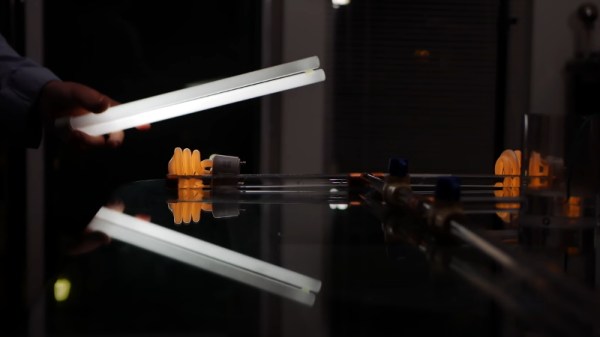
To test this concept, [Jay] put together a water distribution system out of simple acrylic tubing. A reservoir was attached to one of his high voltage generators, and copper caps were placed at the end of the tubes to serve as direct attachment points for devices.

But thanks to capacitive coupling, the fluorescent lights he uses don’t actually need to be physically connected to light up. As demonstrated in the video after the break, the lights surrounding the system can be independently controlled just by turning their respective valves on and off; all without any physical contact being made.

Of course, compared to traditional wiring there are plenty of downsides to this idea. Copper wires don’t tend to freeze in the winter and spring a leak, nor do they build up bubbles of explosive hydrogen gas. So it’s safe to say the wiring in your house probably won’t ever be replaced with a tube of charged water. But [Jay] does have some interesting ideas of how this technique could be used in non-traditional ways. For example, he describes how outdoor lighting could be powered by the energy radiating from a small stream.

Even if the practical applications of this technique are somewhat limited, there’s no question that it’s a fascinating idea. Believing that he’s the first person to ever demonstrate power transmission under these specific circumstances, he’s decided to call the concept “Bowles Transmission”. We’d love to see somebody use this principle in one of their projects, and we’re willing to bet so would [Jay].

As with his recent ozone sterilization experiments, we imagine this idea is going to be met with some debate. But that’s sort of the point. [Jay] doesn’t claim to have all the answers, and hopes these videos get people thinking and talking. As they say, nothing great was ever achieved without enthusiasm.

Continue reading “High Voltage Experiment Pipes Power With Water”