The Universe As We Know It May End Sooner Than Expected

The 'Sombrero Potential' as seen with the Higgs mechanism.
The ‘Sombrero Potential’ as seen with the Higgs mechanism.

One of the exciting aspects of some fields of physics is that they involve calculating the expected time until the Universe ends or experiences fundamental shifts that would render most if not all of the ‘laws of physics’ invalid. Within the Standard Model (SM), the false vacuum state is one such aspect, as it implies that the Universe’s quantum fields that determine macrolevel effects like mass can shift through quantum field decay into a lower, more stable state. One such field is the Higgs field, which according to a team of researchers may decay sooner than we had previously assumed.

As the Higgs field (through the Higgs boson) is responsible for giving particles mass, it’s not hard to imagine the chaos that would ensue if part of the Higgs field were to decay and cause a spherical ripple effect throughout the Universe. Particle masses would change, along with all associated physics, as suddenly the lower Higgs field state means that everything has significantly more mass. To say that it would shake up the Universe would an understatement.

Of course, this expected time-to-decay has only shifted from 10794 years to 10790 years with the corrections to the  previous calculations as provided in the paper by [Pietro Baratella] and colleagues, and they also refer to it as ‘slightly shorter’. A sidenote here is also that the electroweak vacuum’s decay is part of the imperfect SM, which much like the false vacuum hypothesis are part of these models, and not based on clear empirical evidence (yet).

Watch NASA’s Solar Sail Reflect Brightly In The Night Sky

NASA’s ACS3 (Advanced Composite Solar Sail System) is currently fully deployed in low Earth orbit, and stargazers can spot it if they know what to look for. It’s actually one of the brightest things in the night sky. When the conditions are right, anyway.

ACS3’s sail is as thin as it is big.

What conditions are those? Orientation, mostly. ACS3 is currently tumbling across the sky while NASA takes measurements about how it acts and moves. Once that’s done, the spacecraft will be stabilized. For now, it means that visibility depends on the ACS’s orientation relative to someone on the ground. At it’s brightest, it appears as bright as Sirius, the brightest star in the night sky.

ACS3 is part of NASA’s analysis and testing of solar sail technology for use in future missions. Solar sails represent a way of using reflected photons (from sunlight, but also possibly from a giant laser) for propulsion.

This perhaps doesn’t have much in the way of raw energy compared to traditional thrusters, but offers low cost and high efficiency (not to mention considerably lower complexity and weight) compared to propellant-based solutions. That makes it very worth investigating. Solar sail technology aims to send a probe to Alpha Centauri within the next twenty years.

Want to try to spot ACS3 with your own eyes? There’s a NASA app that can alert you to sighting opportunities in your local time and region, and even guide you toward the right region of the sky to look. Check it out!

Pong In A Petri Dish: Teasing Out How Brains Work

Experimental setup for the EAP hydrogel free energy principle test. (Credit: Vincent Strong et al., Cell, 2024)

Of the many big, unanswered questions in this Universe, the ones pertaining to the functioning of biological neural networks are probably among the most intriguing. From the lowliest neurally gifted creatures to us brainy mammals, neural networks allow us to learn, to predict and adapt to our environments, and sometimes even stand still and wonder puzzlingly how all of this even works. Such puzzling has led to a number of theories, with a team of researchers recently investigating one such theory, as published in Cell. The focus here was that of Bayesian approaches to brain function, specifically the free energy principle, which postulates that neural networks as inference engines seek to minimize the difference between inputs (i.e. the model of the world as perceived) and its internal model.

This is where Electro Active Polymer (EAP) hydrogel comes into play, as it features free ions that can migrate through the hydrogel in response to inputs. In the experiment, these inputs are related to the ball position in the game of Pong. Much like experiments involving biological neurons, the hydrogel is stimulated via electrodes (in a 2 x 3 grid, matching the 2 by 3 grid of the game world), with other electrodes serving as outputs. The idea is that over time the hydrogel will ‘learn’ to optimize the outputs through ion migration, so that it ‘plays’ the game better, which should be reflected in the scores (i.e. the rally length).

Based on the results some improvement in rally length can be observed, which the researchers present as statistically significant. This would imply that the hydrogel displays active inference and memory. Additional tests with incorrect inputs resulted in a marked decrease in performance. This raises many questions about whether this truly displays emergent memory, and whether this validates the free energy principle as a Bayesian approach to understanding biological neural networks.

To the average Star Trek enthusiast the concept of hydrogels, plasmas, etc. displaying the inklings of intelligent life would probably seem familiar, and for good reason. At this point, we do not have a complete understanding of the operation of the many billions of neurons in our own brains. Doing a bit of prodding and poking at some hydrogel and similar substances in a dish might be just the kind of thing we need to get some fundamental answers.

How Photomultipliers Detect Single Photons

If you need to measure the presence of photons down to a very small number of them, you are looking at the use of a photomultiplier, as explained in a recent video by [Huygens Optics] on YouTube. The only way to realistically measure at such a sensitivity level is to amplify them with a photomultiplier tube (PMT). Although solid-state alternatives exist, this is still a field where vacuum tube-based technology is highly relevant.

Despite being called ‘photomultipliers’, these PMTs actually amplify an incoming current (electron) in a series of dynode stages, to create an output current that is actually easy to quantify for measurement equipment. They find uses in everything from Raman spectroscopy to medical diagnostics and night vision sensors.

The specific PMT that [Huygens Optics] uses in the video is the Hamamatsu R928. This has a spectral response from 185 nm to 900 nm. The electrode mesh is where photons enter the tube, triggering the photo cathode which then ejects electrons. These initial electrons are then captured and amplified by each dynode stage, until the anode grid captures most of the electrons. The R928 has a gain of 1.0 x 10⁷ (10 million) at -1 kV supply voltage, so each dynode multiplies the amount of electrons by six, with a response time of 22 ns.

PMTs are unsurprisingly not cheap, but [Huygens Optics] was lucky to find surplus R928s on Marktplaats (Dutch online marketplace) for €100 including a cover, optics and a PCB with the socket, high-voltage supply (Hamamatsu C4900) and so on. Without documentation the trick was to reverse-engineer the PCB’s connections to be able to use it. In the video the components and their function are all briefly covered, as well as the use of opamps like the AD817 to handle the output signal of the R928. Afterwards the operation of the PMT is demonstrated, which makes clear just how sensitive the PMT is as it requires an extremely dark space to not get swamped with photons.

An interesting part about the demonstration is that it also shows the presence of thermionic emissions: anode dark current in the datasheet. This phenomenon is countered by cooling the PMT to prevent these emissions if it is an issue. In an upcoming video the R928 will be used for more in-depth experiments, to show much more of what these devices are capable of.

Thanks to [cliff claven] for the tip.

Continue reading “How Photomultipliers Detect Single Photons”

Shedding New Light On The Voynich Manuscript With Multispectral Imaging

The Voynich Manuscript is a medieval codex written in an unknown alphabet and is replete with fantastic illustrations as unusual and bizarre as they are esoteric. It has captured interest for hundreds of years, and expert [Lisa Fagin Davis] shared interesting results from using multispectral imaging on some pages of this highly unusual document.

We should make it clear up front that the imaging results have not yielded a decryption key (nor a secret map or anything of the sort) but the detailed write-up and freely-downloadable imaging results are fascinating reading for anyone interested in either the manuscript itself, or just how exactly multispectral imaging is applied to rare documents. Modern imaging techniques might get leveraged into things like authenticating sealed packs of Pokémon cards, but that’s not all it can do.

Because multispectral imaging involves things outside our normal perception, the results require careful analysis rather than intuitive interpretation. Here is one example: multispectral imaging may yield faded text visible “between the lines” of other text and invite leaping to conclusions about hidden or erased content. But the faded text could be the result of show-through (content from the opposite side of the page is being picked up) or an offset (when a page picks up ink and pigment from its opposing page after being closed for centuries.)

[Lisa] provides a highly detailed analysis of specific pages, and explains the kind of historical context and evidence this approach yields. Make some time to give it a read if you’re at all interested, we promise it’s worth your while.

The Science Of Coating Steel

[Breaking Taps] has a look at “parkerization” — a process to coat steel to prevent rust. While you commonly see this finish in firearms, it is usable anywhere you need some protection for steel parts. The process is relatively easy. It does require heat and a special manganese solution made for the purpose. You scuff up the surface of the steel and degrease and wash it.

Once the part is ready, you insert the part in hot solution which is manganese and phosphoric acid. Rinse and displace the water and you are ready to oil the part.

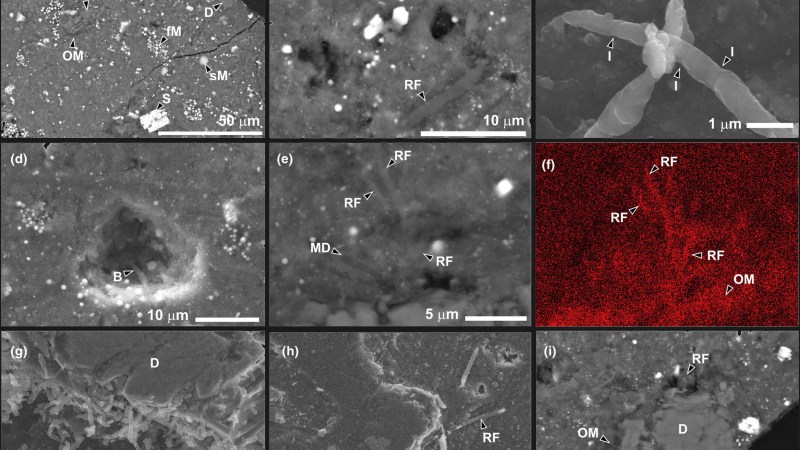
But what we really liked was the electron micrographs of the steel before and after the process. The phosphates formed in the solution cover the iron and hold oil to prevent oxidization. However, the first attempt wasn’t uniform so it wouldn’t work as well. [Breaking Taps] thinks it was a failure to rough up the piece sufficiently before starting. He also raised the temperature of the bath and got a better, but not perfect, result.

We miss having an electron microscope at work and we really want one at home! The last fun coating project we remember used copper in a strange and wonderful way.

Continue reading “The Science Of Coating Steel”

Rendering Skin Transparent Using The Food Dye Tartrazine

Although we generally assume that opacity is the normal look for animals like us humans, this factoid is only correct for as long as you maintain the dissimilar optical refraction indices of skin and the more aqueous underlying structures. What if you could change the refraction index of skin? If you could prevent the normal scattering at the interface, you could reveal the structures underneath, effectively rendering skin transparent. [Zihao Uo] and others demonstrate this in a paper published in Science.

The substance they used was the common food dye known as tartrazine, which also goes by the names of Yellow 5 and E102 when it is used in food (like Doritos), cosmetics, and drugs. By rubbing the tartrazine into the skin of mice, the researchers were able to observe underlying blood vessels and muscles. Simulations predicted that the dye would change the refraction index mismatch between lipids and water which normally causes the light scattering that creates the skin’s opaque appearance. With the dye rubbed into the skin, the effect worked to a depth of about 3 mm, which makes it useful for some research and possible medical applications, but not quite at the ‘jellyfish-transparency’ levels that some seem to have imagined at the news.

Continue reading “Rendering Skin Transparent Using The Food Dye Tartrazine”