Intuitive Explanation Of Arithmetic, Geometric & Harmonic Mean

The simple definition of a mean is that of a numeric quantity which represents the center of a collection of numbers. Here the trick lies in defining the exact type of numeric collection, as beyond the arithmetic mean (AM for short, the sum of all values divided by their number) there are many more, with the other two classical Pythagorean means being the geometric mean (GM) and harmonic mean (HM).

The question that many start off with, is what the GM and AM are and why you’d want to use them, which is why [W.D.] wrote a blog post on that topic that they figure should be somewhat intuitive relative to digging through search results, or consulting the Wikipedia entries.

Compared to the AM, the GM uses the product of the values rather than the sum, which makes it a good fit for e.g. changes in a percentage data set. One thing that [W.D] argues for is to use logarithms to grasp the GM, as this makes it more obvious and closer to taking the AM. Finally, the HM is useful for something like the average speed across multiple trips, and is perhaps the easiest to grasp.

Ultimately, the Pythagorean means and their non-Pythagorean brethren are useful for things like data analysis and statistics, where using the right mean can reveal interesting data, much like how other types using something like the median can make a lot more sense. The latter obviously mostly in the hazy field of statistics.

No matter what approach works for you to make these concepts ‘click’, they’re all very useful things to comprehend, as much of every day life revolves around them, including concepts like ‘mean time to failure’ for parts.


Top image: Cycles of sunspots for the last 400 years as an example data set to apply statistical interpretations to. (Credit: Robert A. Rohde, CC BY-SA 3.0)

Creating Customized Diffraction Lenses For Lasers

[The Thought Emporium] has been fascinated by holograms for a long time, and in all sorts of different ways. His ultimate goal right now is to work up to creating holograms using chocolate, but along the way he’s found another interesting way to manipulate light. Using specialized diffraction gratings, a laser, and a few lines of code, he explores a unique way of projecting hologram-like images on his path to the chocolate hologram.

There’s a lot of background that [The Thought Emporium] has to go through before explaining how this project actually works. Briefly, this is a type of “transmission hologram” that doesn’t use a physical object as a model. Instead, it uses diffraction gratings, which are materials which are shaped to light apart in specific ways. After some discussion he demonstrates creating diffraction gratings using film. Certain diffraction patterns, including blocking all of the light source, can actually be used as a lens as the light bends around the blockage into the center of the shadow where there can be focal points. From there, a special diffraction lens can be built.

The diffraction lens can be shaped into any pattern with a small amount of computer code to compute the diffraction pattern for a given image. Then it’s transferred to film and when a laser is pointed at it, the image appears on the projected surface. Diffraction gratings like these have a number of other uses as well; the video also shows a specific pattern being used to focus a telescope for astrophotography, and a few others in the past have used them to create the illusive holographic chocolate that [The Thought Emporium] is working towards.

Continue reading “Creating Customized Diffraction Lenses For Lasers”

Citizen Scientists Spot Super Fast Moving Object In NASA Data

When you were five, you probably spotted your best friend running at “a million miles an hour” when they beat everybody at the local athletics meet. You probably haven’t seen anything that fast snice. According to NASA, though, a group of citizen scientists spotted a celestial object doing just that!

The group of citizen scientists were involved in a NASA program called Backyard Worlds: Planet 9. They were working on images from NASA’s Wide-field Infrared Explorer mission. Scanning through stored images, Martin Kabatnik, Thomas P. Bickle, and Dan Caselden identified a curiously speedy object termed CWISE J124909.08+362116.0. There are lots of fast-moving objects out in space, but few quite as fast as this one. It’s quite literally zooming through the Milky Way at about 1 million miles per hour.

It’s unclear exactly what the object is. It appears light enough to be a low-mass star, or potentially a brown dwarf—somewhere in between the classification of gas giant and star. It also has suspiciously low iron and metallic content. The leading hypothesis is that CWISE J1249 might have been ejected from a supernova, or that it got flung around a pair of black holes.

For now, it remains a mystery. It’s a grand discovery that really highlights the value of citizen science. If you’ve been doing your own rigorous scientific work—on NASA’s data or your own—do let us know!

WOW! It Wasn’t Aliens After All!

There may not be many radio astronomy printouts that have achieved universal fame, but the one from Ohio State University’s Big Ear telescope upon which astronomer [Jerry R. Ehman] wrote “WOW!” is definitely one of them. It showed an intense one-off burst that defied attempts to find others like it, prompting those who want to believe to speculate that it might have been the product of an extraterrestrial civilization. Sadly for them the Planetary Habitability Laboratory at the University of Puerto Rico at Arecibo has provided an explanation by examining historical data from the Arecibo telescope.

The radio signal in question lay on the hydrogen line frequency at 1420 MHz, and by looking at weaker emissions from cold hydrogen clouds they suggest that the WOW! signal may have come from a very unusual stimulation of one of these clouds. A magnetar is a type of neutron star which can create an intense magnetic field, and their suggestion is that Big Ear was in the lucky position of being in the right place at the right time to see one of these through a hydrogen cloud. The field would excite the hydrogen atoms to maser-like emission of radiation, leading to the unexpected blip on that printout.

There’s a question as to whether speculation about aliens is helpful to the cause of science, but in answer to that we’d like to remind readers that we wouldn’t be talking about magnetars now without it, and that the WOW! signal was in fact part of an early SETI experiment. Better keep on searching then!

Meanwhile readers with long memories will recollect us looking at the WOW! signal before.

Pulling Hydrogen Out Of The Water

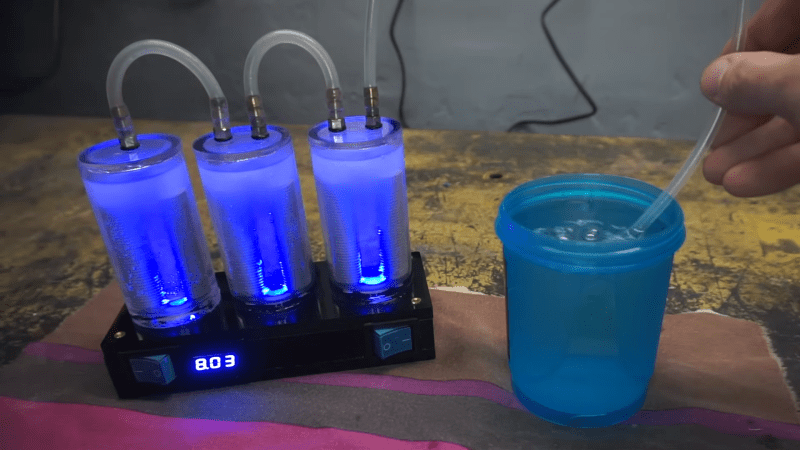
In theory, water and electric current will cause electrolysis and produce oxygen and hydrogen as the water breaks apart. In practice, doing it well can be tricky. [Relic] shows an efficient way to produce an electrolysis cell using a few plastic peanut butter jars and some hardware.

The only tricky point is that you need hardware made of steel and not zinc or other materials. Well, that and the fact that the gasses you produce are relatively dangerous.

Continue reading “Pulling Hydrogen Out Of The Water”

Quantum Sensor Uses Synthetic Diamond

Diamonds are nearly perfect crystals, but not totally perfect. The defects in these crystals give the stones their characteristic colors. But one type of defect, the NV — nitrogen-vacancy — center, can hold a particular spin, and you can change that spin with the correct application of energy. [Asianometry] explains why this is important in the video below.

Interestingly, even at room temperature, an NV center stays stable for a long time. Even more importantly, you can measure the spin nondestructively by detecting light emissions from the center.

Continue reading “Quantum Sensor Uses Synthetic Diamond”

The experimental setup for entanglement-distribution experiments. (Credit: Craddock et al., PRX Quantum, 2024)

Entangled Photons Maintained Using Existing Fiber Under NYC’s Streets

Entangled photons are an ideal choice for large-scale networks employing quantum encryption or similar, as photons can use fiber-optical cables to transmit them. One issue with using existing commercial fiber-optic lines for this purpose is that these have imperfections which can disrupt photon entanglement. This can be worked around by delaying one member of the pair slightly, but this makes using the pairs harder. Instead, a team at New York-based startup Qunnect used polarization entanglement to successfully transmit and maintain thousands of photons over the course of weeks through a section of existing commercial fiber, as detailed in the recently published paper by [Alexander N. Craddock] et al. in PRX Quantum (with accompanying press release).

The entangled photons were created via spontaneous four-wave mixing in a warm rubidium vapor. This creates a photon with a wavelength of 795 nm and one with 1324 nm. The latter of which is compatible with the fiber network and is thus transmitted over the 34 kilometers. To measure the shift in polarization of the transmitted photos, non-entangled photons with a known polarization were transmitted along with the entangled ones. This then allowed for polarization compensation for the entangled photos by measuring the shift on the single photons. Overall, the team reported an uptime of nearly 100% with about 20,000 entangled photons transmitted per second.

As a proof of concept it shows that existing fiber-optical lines could in the future conceivably be used for quantum computing and encryption without upgrades.