The Invisible Battlefields Of The Russia-Ukraine War

Early in the morning of February 24th, Dr. Jeffrey Lewis, a professor at California’s Middlebury Institute of International Studies watched Russia’s invasion of Ukraine unfold in realtime with troop movements overlaid atop high-resolution satellite imagery. This wasn’t privileged information — anybody with an internet connection could access it, if they knew where to look. He was watching a traffic jam on Google Maps slowly inch towards and across the Russia-Ukraine border.

As he watched the invasion begin along with the rest of the world, another, less-visible facet of the emerging war was beginning to unfold on an ill-defined online battlefield. Digital espionage, social media and online surveillance have become indispensable instruments in the tool chest of a modern army, and both sides of the conflict have been putting these tools to use. Combined with civilian access to information unlike the world has ever seen before, this promises to be a war like no other.

Modern Cyberwarfare

The first casualties in the online component of the war have been websites. Two weeks ago, before the invasion began en masse, Russian cyberwarfare agents launched distributed denial of service (DDoS) attacks against Ukrainian government and financial websites. Subsequent attacks have temporarily downed the websites of Ukraine’s Security Service, Ministry of Foreign Affairs, and government. A DDoS attack is a relatively straightforward way to quickly take a server offline. A network of internet-connected devices, either owned by the aggressor or infected with malware, floods a target with request, as if millions of users hit “refresh” on the same website at the same time, repeatedly. The goal is to overwhelm the server such that it isn’t able to keep up and stops replying to legitimate requests, like a user trying to access a website. Russia denied involvement with the attacks, but US and UK intelligence services have evidence they believe implicates Moscow. Continue reading “The Invisible Battlefields Of The Russia-Ukraine War”


Hackaday Links Column Banner

Hackaday Links: March 6, 2022

As if the war in Ukraine weren’t bad enough right here on Earth, it threatens knock-on effects that could be felt as far away as Mars. One victim of the deteriorating relationships between nations is the next phase of the ExoMars project, a joint ESA-Roscosmos mission that includes the Rosalind Franklin rover. The long-delayed mission was most recently set for launch in October 2022, but the ESA says that hitting the narrow launch window is now “very unlikely.” That’s a shame, since the orbital dynamics of Earth and Mars will mean that it’ll be 2024 before another Hohmann Transfer window opens. There are also going to be repercussions throughout the launch industry due to Russia pulling the Soyuz launch team out of the ESA’s spaceport in Guiana. And things have to be mighty tense aboard the ISS right about now, since the station requires periodic orbital boosting with Russian Progress rockets.

Continue reading “Hackaday Links: March 6, 2022”

This Week In Security: Ukraine, Nvidia, And Conti

The geopolitics surrounding the invasion of Ukraine are outside the scope of this column, but the cybersecurity ramifications are certainly fitting fodder. The challenge here is that almost everything of note that has happened in the last week has been initially linked to the conflict, but in several cases, the reported link hasn’t withstood scrutiny. We do know that the Vice Prime Minister of Ukraine put out a call on Twitter for “cyber specialists” to go after a list of Russian businesses and state agencies. Many of the sites on the list did go down for some time, the digital equivalent of tearing down a poster. In response, the largest Russian ISP stopped announcing BGP routes to some of the targeted sites, effectively ending any attacks against them from the outside.

A smattering of similar events have unfolded over the last week, like electric car charging stations in Russia refusing to charge, and displaying a political message, “GLORY TO UKRAINE”. Not all the attacks have been so trivial. Researchers at Eset have identified HermeticWiper, a bit of malware with no other purpose but to destroy data. It has been found on hundreds of high-value targets, likely causing much damage. It is likely the same malware that Microsoft has dubbed FoxBlade, and published details about their response. Continue reading “This Week In Security: Ukraine, Nvidia, And Conti”

Remoticon 2021 // Jay Bowles Dips Into The Plasmaverse

Every hacker out there is familiar with the zaps and sizzles of the Tesla coil, or the crash and thunder of lighting strikes on our hallowed Earth. These phenomena all involve the physics of plasma, a subject near and dear to Jay Bowles’s heart. Thus, he graced Remoticon 2021 with a enlightening talk taking us on a Dip Into the Plasmaverse.

Jay’s passion for the topic is obvious, having fallen in love with high voltage physics as a teenager. He appreciated how tangible the science was, whether it’s the glow of neon lighting or the heating magic of the common microwave. His talk covers the experiments and science that he’s studied over the past 17 years and in the course of running his Plasma Channel YouTube channel. Continue reading “Remoticon 2021 // Jay Bowles Dips Into The Plasmaverse”

Ion Thrusters: Not Just For TIE Fighters Anymore

Spacecraft rocket engines come in a variety of forms and use a variety of fuels, but most rely on chemical reactions to blast propellants out of a nozzle, with the reaction force driving the spacecraft in the opposite direction. These rockets offer high thrust, but they are relatively fuel inefficient and thus, if you want a large change in velocity, you need to carry a lot of heavy fuel. Getting that fuel into orbit is costly, too!

Ion thrusters, in their various forms, offer an alternative solution – miniscule thrust, but high fuel efficiency. This tiny push won’t get you off the ground on Earth. However, when applied over a great deal of time in the vacuum of space, it can lead to a huge change in velocity, or delta V.

This manner of operation means that an ion thruster and a small mass of fuel can theoretically create a much larger delta-V than chemical rockets, perfect for long-range space missions to Mars and other applications, too. Let’s take a look at how ion thrusters work, and some of their interesting applications in the world of spacecraft!

Continue reading “Ion Thrusters: Not Just For TIE Fighters Anymore”

You Can Find Military Radars On Publicly-Available Satellite Data

When it comes to hunting down military radar installations and associated hardware, we typically think of equipment that is firmly in the price bracket of nation states and their military forces. Whether it’s early warning radar, those used for air defence, or for naval purposes, you’d think it was relatively difficult to intercept or track these emissions.

However, a new tool built by geocomputation lecturer Ollie Ballinger shows this isn’t the case. In fact, openly-available data captured via satellite can be used to find all manner of military radar emitters. Let’s explore how!

Continue reading “You Can Find Military Radars On Publicly-Available Satellite Data”

Review: DevTerm Linux Handheld Has Retro-Future Vibe

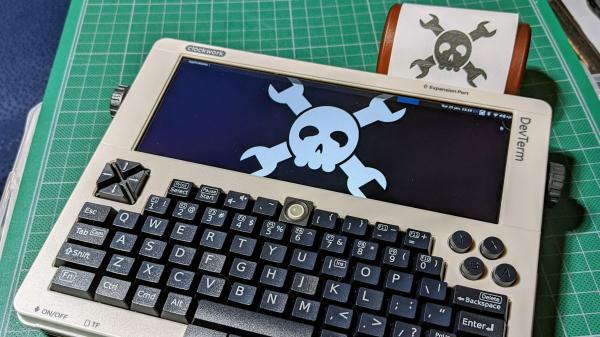
It’s not every day that an open-source, portable Linux handheld computer gets announced, so I couldn’t resist placing an order for the DevTerm by ClockworkPi back when we first learned about the stylish little terminal, which includes a 1280 x 480 screen (double-wide VGA) and a modular little thermal printer.

Of course, the global semiconductor shortage combined with shipping slowdowns led to delays, but things did ultimately come together for the project. I’ve always been a sucker for small-format machines, especially ones that come as a well-designed kit, and that means I can tell you all about what it was like to put it together and turn it on. There’s a lot to look at, so let’s get started.

Continue reading “Review: DevTerm Linux Handheld Has Retro-Future Vibe”