Remoticon 2021 // Voja Antonic Makes You A Digital Designer

[Voja Antonic] has been building digital computers since before many of us were born. He designed with the Z80 when it was new, and has decades of freelance embedded experience, so when he takes the time to present a talk for us, it’s worth paying attention.

For his Remoticon 2022 presentation, he will attempt to teach us how to become a hardware expert in under forty minutes. Well, mostly the digital stuff, but that’s enough for one session if you ask us. [Voja] takes us from the very basics of logic gates, through combinatorial circuits, sequential circuits, finally culminating in the description of a general-purpose microprocessor.
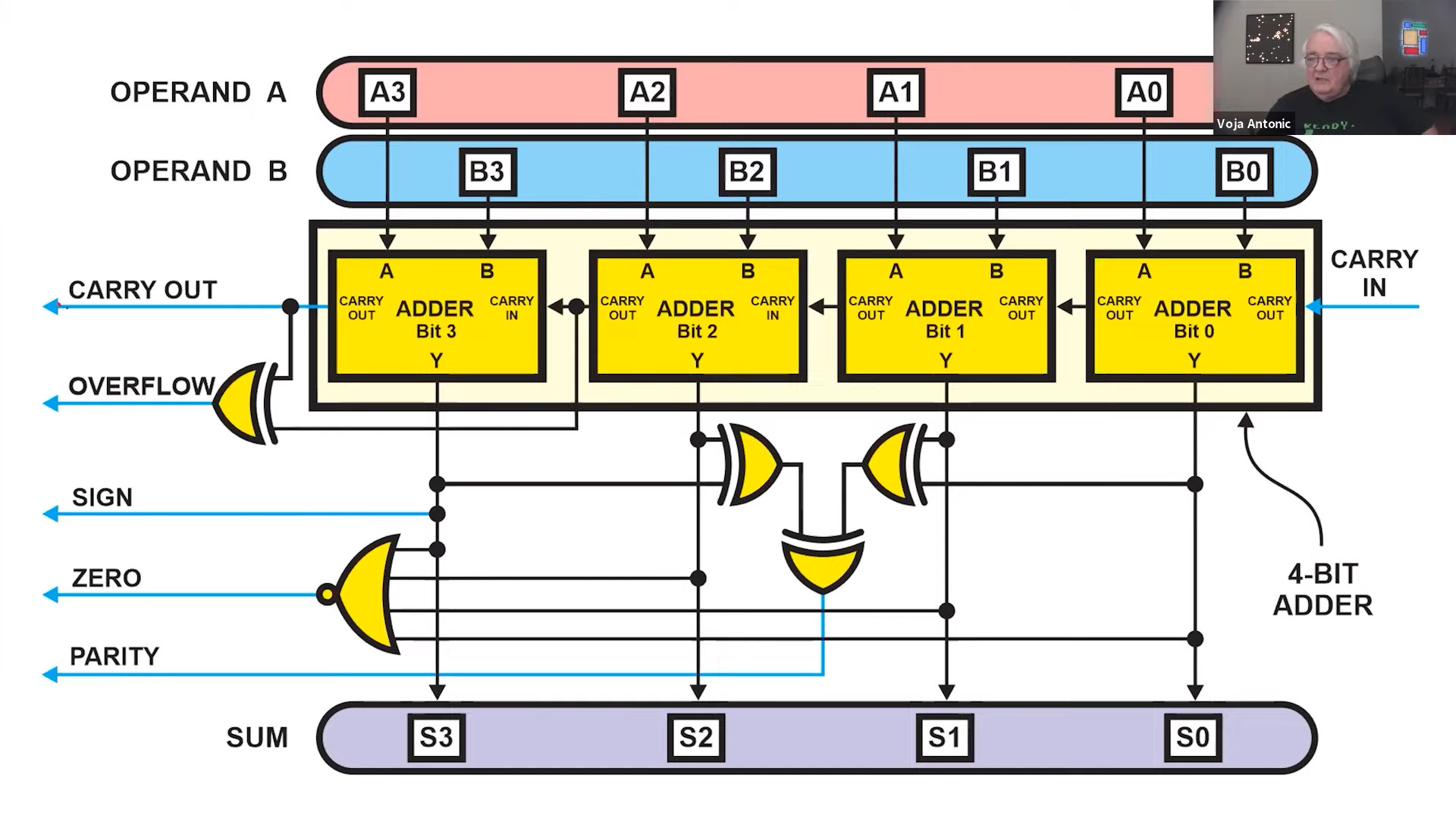
A 4-bit ripple-carry adder with additional CPU flag outputs

As he demonstrates, complex digital electronics systems really are just built up in a series of steps of increasing complexity. starting with individual active elements (transistors operating as switches) forming logic elements capable of performing simple operations.

From there, higher level functions such as adders can be formed, and from those an ALU and so on. Conceptually, memory elements can be formed from logic gates, but it’s not the most efficient way to do it, and those tend to be made with a smaller and faster circuit. But anyway, that model is fine for descriptive purposes.
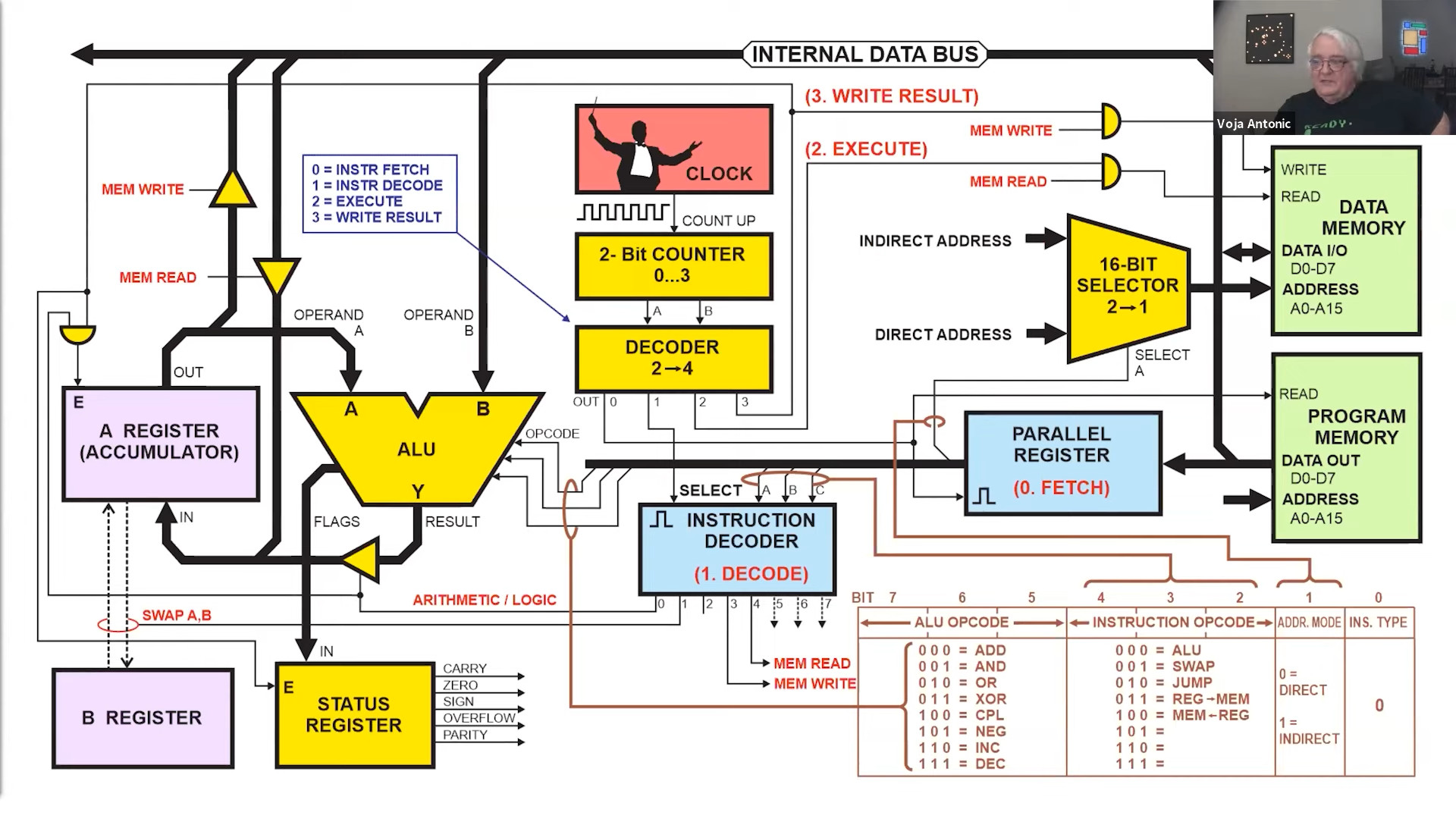
Once you have combinatorial logic circuits and memory elements, you have all you need to make the necessary decoders, sequencers and memory circuits to build processors and other kinds of higher complexity circuits.

Obviously forty minutes isn’t anywhere nearly enough time time to learn all of the intricacies of building a real microprocessor like the pesky details of interfacing with it and programming it, but for getting up the learning curve from just a knowledge of binary numbers to an understanding of how a CPU is built, it’s a pretty good starting point.

Now, If you can only tear your eyes away from his slick game-of-life wall mounted LED display, you might pick up a thing or two.

Continue reading “Remoticon 2021 // Voja Antonic Makes You A Digital Designer”
SHERLOC And The Search For Life On Mars

Humanity has been wondering about whether life exists beyond our little backwater planet for so long that we’ve developed a kind of cultural bias as to how the answer to this central question will be revealed. Most of us probably imagine that NASA or some other space agency will schedule a press conference, an assembled panel of scientific luminaries will announce the findings, and newspapers around the world will blare “WE ARE NOT ALONE!” headlines. We’ve all seen that movie before, so that’s the way it has to be, right?

Probably not. Short of an improbable event like an alien spacecraft landing while a Google Street View car was driving by or receiving an unambiguously intelligent radio message from the stars, the conclusion that life exists now or once did outside our particular gravity well is likely to be reached in a piecewise process, an accretion of evidence built up over a long time until on balance, the only reasonable conclusion is that we are not alone. And that’s exactly what the announcement at the end of last year that the Mars rover Perseverance had discovered evidence of organic molecules in the rocks of Jezero crater was — another piece of the puzzle, and another step toward answering the fundamental question of the uniqueness of life.

Discovering organic molecules on Mars is far from proof that life once existed there. But it’s a step on the way, as well as a great excuse to look into the scientific principles and engineering of the instruments that made this discovery possible — the whimsically named SHERLOC and WATSON.

Continue reading “SHERLOC And The Search For Life On Mars”

Would Nuclear Winter Cancel Out Global Warming?

Nuclear war was very much a front-of-mind issue during the fraught political climate of the Cold War era. Since then, atomic sabre rattling has been less frequent, though has never quite disappeared entirely.

Outside of the direct annihilation caused by nuclear war, however, is the threat of nuclear winter. The basic concept is simple: in the aftermath of a major nuclear war, the resulting atmospheric effects could lead to a rapid cooling in global temperatures.

Some say it couldn’t ever happen, while others – including Futurama – suggest with varying degrees of humor that it could help cancel out the effects of global warming. But what is the truth?

Hard data is isn’t really available, as thus far there have been  no large-scale nuclear wars for scientists to measure. Several studies have explored the concept of nuclear winter, however, and explored its potential effects.

Continue reading “Would Nuclear Winter Cancel Out Global Warming?”

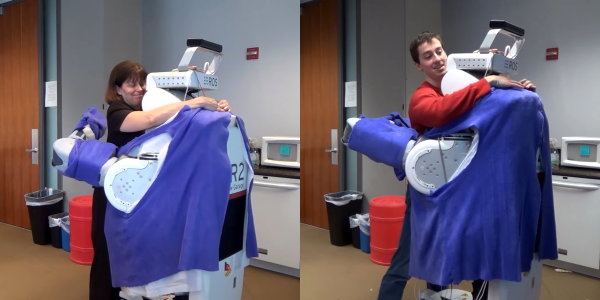
Can Robots Give Good Hugs?

We could all use a hug once in a while. Most people would probably say the shared warmth is nice, and the squishiness of another living, breathing meatbag is pretty comforting. Hugs even have health benefits.

But maybe you’re new in town and don’t know anyone yet, or you’ve outlived all your friends and family. Or maybe you just don’t look like the kind of person who goes for hugs, and therefore you don’t get enough embraces. Nearly everyone needs and want hugs, whether they’re great, good, or just average.

So what makes a good hug, anyway? It’s a bit like a handshake. It should be warm and dry, with a firmness appropriate to the situation. Ideally, you’re both done at the same time and things don’t get awkward. Could a robot possibly check all of these boxes? That’s the idea behind HuggieBot, the haphazardly humanoid invention of Katherine J. Kuchenbecker and team at the Max Planck Institute for Intelligent Systems in Stuttgart, Germany (translated). User feedback helped the team get their arms around the problem.

Continue reading “Can Robots Give Good Hugs?”

Floating Solar Farms Are Taking The World’s Reservoirs By Storm

Photovoltaic solar panels are wonderful things, capable of capturing mere light and turning it into useful electricity. They’re often installed on residential and commercial rooftops for offsetting energy use at the source.

However, for grid-scale generation, they’re usually deployed in huge farms on tracts of land in areas that receive plenty of direct sunlight. These requirements can often put solar farms in conflict with farm-farms — the sunlight that is good for solar panels is also good for growing plants, specifically those we grow for food.

One of the more interesting ideas, however, is to create solar arrays that float on water. Unlike some of the wackier ideas out there, this one comes with some genuinely interesting engineering benefits, too!

Continue reading “Floating Solar Farms Are Taking The World’s Reservoirs By Storm”

Hackaday Links Column Banner

Hackaday Links: January 23, 2022

When Tonga’s Hunga-Tonga Hunga-Ha’apai volcano erupted on January 15, one hacker in the UK knew just what to do. Sandy Macdonald from York quickly cobbled together a Raspberry Pi and a pressure/humidity sensor board and added a little code to create a recording barometer. The idea was to see if the shock wave from the eruption would be detectable over 16,000 km away — and surprise, surprise, it was! It took more than 14 hours to reach Sandy’s impromptu recording station, but the data clearly show a rapid pulse of increasing pressure as the shockwave approached, and a decreased pressure as it passed. What’s more, the shock wave that traveled the “other way” around the planet was detectable too, about seven hours after the first event. In fact, data gathered through the 19th clearly show three full passes of the shockwaves. We just find this fascinating, and applaud Sandy for the presence of mind to throw this together when news of the eruption came out.

Good news for professional astronomers and others with eyes turned skyward — it seems like the ever-expanding Starlink satellite constellation isn’t going to kill ground-based observation. At least that’s the conclusion of a team using the Zwicky Transient Facility (ZTF) at the Palomar Observatory outside San Diego. ZTF is designed to catalog anything that blinks, flashes, or explodes in the night sky, making it perfect to detect the streaks from the 1,800-odd Starlink satellites currently in orbit. They analyzed the number of satellite transients captured in ZTF images, and found that fully 20 percent of images show streaks now, as opposed to 0.5 percent back in 2019 when the constellation was much smaller. They conclude that at the 10,000 satellite full build-out, essentially every ZTF image will have a streak in it, but since the artifacts are tiny and well-characterized, they really won’t hinder the science to any appreciable degree.

Speaking of space, we finally have a bit of insight into the causes of space anemia. The 10% to 12% decrease in red blood cells in astronauts during their first ten days in space has been well known since the dawn of the Space Age, but the causes had never really been clear. It was assumed that the anemia was a result of the shifting of fluids in microgravity, but nobody really knew for sure until doing a six-month study on fourteen ISS astronauts. They used exhaled carbon monoxide as a proxy for the destruction of red blood cells (RBCs) — one molecule of CO is liberated for each hemoglobin molecule that’s destroyed — and found that the destruction of RBCs is a primary effect of being in space. Luckily, there appears to be a limit to how many RBCs are lost in space, so the astronauts didn’t suffer from complications of severe anemia while in space. Once they came back to gravity, the anemia reversed, albeit slowly and with up to a year of measurable changes to their blood.

From the “Better Late Than Never” department, we see that this week that Wired finally featured Hackaday Superfriend Sam Zeloof and his homemade integrated circuits. We’re glad to see Sam get coverage — the story was also picked up by Ars Technica — but it’s clear that nobody at either outfit reads Hackaday, since we’ve been featuring Sam since we first heard about his garage fab in 2017. That was back when Sam was still “just” making transistors; since then, we’ve featured some of his lab upgrades, watched him delve into electron beam lithography, and broke the story on his first legit integrated circuit. Along the way, we managed to coax him out to Supercon in 2019 where he gave both a talk and an interview.

And finally, if you’re in the mood for a contest, why not check out WIZNet’s Ethernet HAT contest? The idea is to explore what a Raspberry Pi Pico with Ethernet attached is good for. WIZNet has two flavors of board: one is an Ethernet HAT for the Pico, while the other is as RP2040 with built-in Ethernet. The good news is, if you submit an idea, they’ll send you a board for free. We love it when someone from the Hackaday community wins a contest, so if you enter, be sure to let us know. And hurry — submissions close January 31.

Hackers, Fingerprints, Laptops, And Stickers

A discussion ensued about our crazy hacker ways the other night. I jokingly suggested that with as many stickers as we each had on our trusty companion machines, they might literally be as unique as a fingerprint. Cut straight to nerds talking too much math.

First off, you could wonder about the chances of two random hackers having the same sticker on their laptop. Say, for argument’s sake, that globally there are 2,000 stickers per year that are cool enough to put on a laptop. (None of us will see them all.) If a laptop lasts five years, that’s a pool of 10,000 stickers to draw from. If you’ve only got one sticker per laptop, that’s pretty slim odds, even when the laptops are of the same vintage.

Real hackers have 20-50 stickers per laptop — at least in our sample of “real hackers”. Here, the Birthday Paradox kicks in and helps us out. Each additional sticker provides another shot at matching, and an extra shot at being matched. So while you and I are unlikely to have the same birthday, in a room full of 42 people, it’s 90% likely that someone will have their birthday matched. With eight of us in the room, that’s 240 stickers that could match each other. (9999 / 10000) ^ (240 * 210 / 2) = about an eight percent chance of no match, so a better than 90% chance that we’d have at least one matching sticker.

But that doesn’t answer the original question: are our be-stickered laptops unique, like fingerprints or snowflakes? There, you have to match each and every sticker on the laptop — a virtually impossible task, and while there were eight of us in the room, that’s just not enough to get any real juice from the Birthday Paradox. (1/10,000) ^ 30 = something with -120 in the exponent. More than all the atoms in the universe, much less hackers in a room, whether you take things to the eighth power or not.

I hear you mumbling “network effects”. We’ve all gone to the same conferences, and we have similar taste in stickers, and maybe we even trade with each other. Think six degrees of separation type stuff. Indeed, this was true in our room. A few of us had the same stickers because we gave them to each other. We had a lot more matches than you’d expect, even though we were all unique.

So while the math for these network effects is over my head, I think it says something deeper about our trusty boxen, their stickers, and their hackers. Each sticker also comes with a memory, and our collected memories make us unique like our laptops. But matching stickers are also more than pure Birthday Paradoxes, they represent the shared history of friends.

Wear your laptop stickers with pride!