This Week In Security: APT Targeting Researchers, And Someone Watching All The Cameras

Microsoft’s Patch Tuesday just passed, and it’s a humdinger. To add the cherry on top, two seperate BSOD inducing issues led to Microsoft temporarily pulling the update.

Among the security vulnerabilities fixed is CVE-2021-26897, another remote code exploit in the Windows DNS server. It’s considered a low-complexity attack, but does require local network access to pull off. CVE-2021-26867 is another of the patched vulnerabilities that sounds very serious, allowing an attacker on a Hyper-V virtual machine to pierce the barrier and run code on the hypervisor. The catch here is that the vulnerability is only present when using the Plan 9 filesystem, which surely limits the scope of the problem to a small handful of machines.

The most interesting fixed flaw was CVE-2021-26411 a vulnerability that allowed remote code execution when loading a malicious web page in either IE or pre-chromium Edge. That flaw was actively being exploited in a unique APT campaign, which we’ll cover right after the break.
Continue reading “This Week In Security: APT Targeting Researchers, And Someone Watching All The Cameras” →

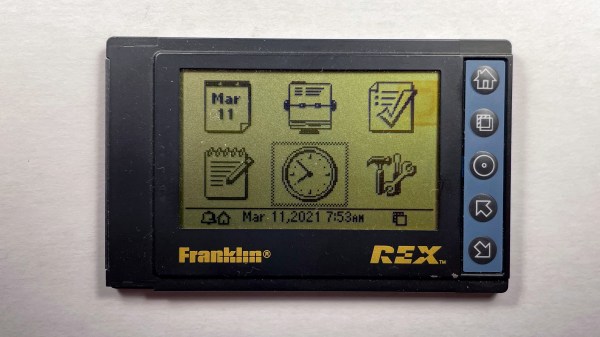
Rex Wasn’t Really A PDA, It Was The First Great Digital Rolodex

Back in the 1990s I was fascinated with small computers. I used the HP200LX palmtop computer for almost ten years, which I wrote about back in December. Naturally, the Franklin Rex 3 PCMCIA-sized organizer caught my attention when it was released in 1997. Here was a Personal Digital Assistant (PDA) the size of a credit card that could fit not just in your pocket, but in your shirt pocket.

Viewed today, it was an interesting paradigm. The screen takes up almost the entire front face of the device with a few buttons for navigation. But isn’t it a deal-breaker that you can’t enter or edit contact info on the device itself? This was long before cellphones were pervasive, and if you had the option to connect to the internet a telephone or Ethernet cable was involved. The ability to have a large data set in your pocket viewable without slapping a brick-like laptop on a table was pretty huge.

I think the killer feature was the PCMCIA interface. I challenged myself to reverse engineer the API so that I could sync data outside of the

Continue reading “Rex Wasn’t Really A PDA, It Was The First Great Digital Rolodex” →

Ask Hackaday: What’s Your Favourite Build Tool? Can Make Ever Be Usurped?

What do you do whilst your code’s compiling? Pull up Hackaday? Check Elon Musk’s net worth? Research the price of a faster PC? Or do you wonder what’s taking so long, and decide to switch out your build system?

Clamber aboard for some musings on Makefiles, monopolies, and the magic of Ninja. I want to hear what you use to build your software. Should we still be using make in 2021? Jump into the fray in the comments.

Continue reading “Ask Hackaday: What’s Your Favourite Build Tool? Can Make Ever Be Usurped?” →

Our Curious Relationship With Caffeine

If you were to paint a few stereotypes surrounding our community, where would you start? Maybe in apparel habits: the t-shirt from a tech conference, or the ubiquitous hoodie. Or how about leisure pursuits: gaming, or even D&D? There’s one thing I can think of that unites most of us, we have a curious affinity for caffeine. Is it a propensity for working into the dark of the night that’s responsible, or perhaps those of us with ADHD find the alertness helpful, but whatever it is we like our coffee and energy drinks. Rare is the hackerspace without a coffee machine and a fridge full of energy drinks, and I have lost count of the times I have been derided by the coffee cognoscenti among my peers for my being satisfied with a mug of mere instant. Deprived of my usual socialisation over the festive period by the pandemic, and contemplating my last bottle of Club-Mate as I drank it, I took a while to ponder on our relationship with this chemical.

Continue reading “Our Curious Relationship With Caffeine” →

Got Oxygen? Future Mars Missions Are Relying On The MOXIE Of Perseverance

The rule of thumb with planetary exploration so far has been, “What goes up, stays up.” With the exception of the Moon and a precious few sample return missions to asteroids and comets, once a spacecraft heads out, it’s never seen again, either permanently plying the void of interplanetary or interstellar space, or living out eternity on the surface of some planet, whether as a monument to the successful mission that got it there or the twisted wreckage of a good attempt.

At the risk of jinxing things, all signs point to us getting the trip to Mars reduced to practice, which makes a crewed mission to Mars something that can start turning from a dream to a plan. But despite what some hardcore Martian-wannabees say, pretty much everyone who goes to Mars is going to want to at least have the option of returning, and the logistical problems with that are legion. Chief among them will be the need for propellants to make the return trip. Lugging them from Earth would be difficult, to say the least, but if an instrument the size of a car battery that hitched a ride to Mars on Perseverance has anything to say about it, future astronauts might just be making their own propellants, literally pulling them out of thin air.

Continue reading “Got Oxygen? Future Mars Missions Are Relying On The MOXIE Of Perseverance” →

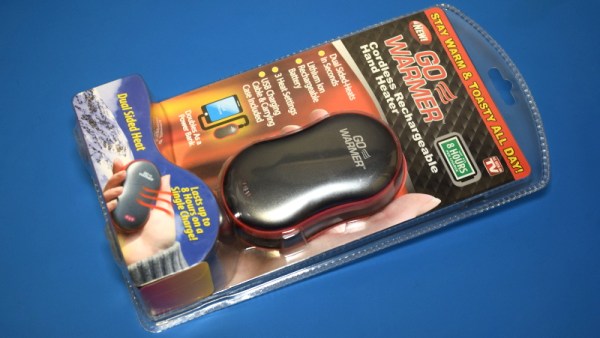
Teardown: Go Warmer USB Rechargeable Hand Heater

Under normal circumstances, if an electronic gadget in your pocket suddenly became hot to the touch, it would be cause for alarm. But not so with the Go Warmer. This lozenge shaped device is not only a USB power bank that can keep your mobile devices topped up, but is also doubles as a miniature heater that the manufacturer claims can bring its surface temperature up to 48 °C (120 °F) for several hours. You can hold in in your hand, put it in your pocket, maybe even sit on it if you’re particularly daring. The possibilities are endless, at least until the 4,000 mAh battery runs down.

For $14.99 USD, the Go Warmer certainly isn’t much of a deal when compared to other battery packs. Even if it does come with a swanky velveteen carrying pouch. But is it a good deal for one that can heat itself up without exploding? Let’s crack this metallic egg and find out.

Continue reading “Teardown: Go Warmer USB Rechargeable Hand Heater” →

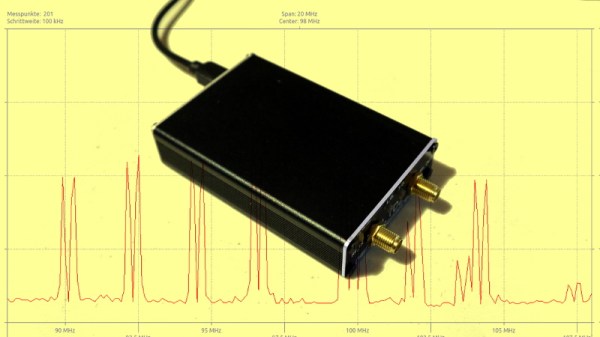
What Can A $30 USB Spectrum Analyser Do For Me?

As mildly exotic silicon has become cheaper and the ingenuity of hardware hackers has been unleashed upon it, it’s inevitable that some once-unattainably expensive instruments will appear as cheap modules from China. The LTDZ spectrum analyser on the bench today covers 35 MHz to 4.4 GHz, and has a USB interface and tracking source. It has been available from all the usual outlets for a while now either as a bare PCB or in a metal box about the size of a pack of cards.

We’ve already taken a look at the $50 VNA, and this time it’s the turn of the $30 spectrum analyser, in the form of a little device that I succumbed to while browsing Banggood.

I ordered one, along with an attenuator and RF bridge for SWR measurements, and after the usual wait for postage my anonymous grey package arrived and it was time to give it a look and consider its usefulness. It’s a design derived from one published in Germany’s Funkamateur (“amateur radio”) magazine early in the last decade, and unscrewing the end plate to slide out the board from its extruded enclosure we can see what makes it tick. Continue reading “What Can A $30 USB Spectrum Analyser Do For Me?” →