The Golden Age Of Ever-Changing Computer Architecture

Given the accuracy of Moore’s Law to the development of integrated circuits over the years, one would think that our present day period is no different from the past decades in terms of computer architecture design. However, during the 2017 ACM Turing Award acceptance speech, John L. Hennessy and David A. Patterson described the present as the “golden age of computer architecture”.

Compared to the early days of MS-DOS, when designing user- and kernel-space interactions was still an experiment in the works, it certainly feels like we’re no longer in the infancy of the field. Yet, as the pressure mounts for companies to acquire more computational resources for running expensive machine learning algorithms on massive swaths of data, smart computer architecture design may be just what the industry needs.

Moore’s law predicts the doubling of transistors in an IC, it doesn’t predict the path that IC design will take. When that observation was made in 1965 it was difficult or even impossible to envision where we are today, with tools and processes so closely linked and widely available that the way we conceive processor design is itself multiplying.

Continue reading “The Golden Age Of Ever-Changing Computer Architecture” →

The Young Engineers Guide To University Capstone Projects

Engineering degrees are as wide and varied as the potential careers on offer out in the real world. There’s plenty of maths to learn, and a cavalcade of tough topics, from thermodynamics to fluid mechanics. However, the real challenge is the capstone project. Generally taking place in the senior year of a four-year degree, it’s a chance for students to apply everything they’ve learned on a real-world engineering project.

Known for endless late nights and the gruelling effort required, it’s an challenge that is revered beforehand, and boasted about after the fact. During the project, everyone is usually far too busy to talk about it. My experience was very much along these lines, when I undertook the Submarine That Can Fly project back in 2012.  The project taught me a lot about engineering, in a way that solving problems out of textbooks never could. What follows are some of the lessons I picked up along the way. Continue reading “The Young Engineers Guide To University Capstone Projects” →

The Strain Of Flu Shot Logistics

Did you get a flu shot this year? How about last year? In a world of next-day delivery and instant downloads, making the yearly pilgrimage to the doctor or the minute clinic feels like an outdated concept. Even if you get your shots free at the office, it’s still a pain to have to get vaccinated every year.

Unfortunately, there’s really no other way to deal with the annual threat of influenza. There’s no single vaccine for the flu because there are multiple strains that are always mutating. Unlike other viruses with one-and-done vaccinations, influenza is a moving target. Developing, producing, and distributing millions of vaccines every year is a massive operation that never stops, or even slows down a little bit. It’s basically Santa Claus territory — if Santa Claus delivered us all from mass epidemics.

The numbers are staggering. For the 2018-19 season, as in last year, there were 169.1 million doses distributed in the United States, up from 155.3 million doses the year before. How do they do it? We’re gonna roll up our sleeves and take a stab at it.

Continue reading “The Strain Of Flu Shot Logistics” →

New Silicon Carbide Semiconductors Bring EV Efficiency Gains

After spending much of the 20th century languishing in development hell, electric cars have finally hit the roads in a big way. Automakers are working feverishly to improve range and recharge times to make vehicles more palatable to consumers.

With a strong base of sales and increased uncertainty about the future of fossil fuels, improvements are happening at a rapid pace. Oftentimes, change is gradual, but every so often, a brand new technology promises to bring a step change in performance. Silicon carbide (SiC) semiconductors are just such a technology, and have already begun to revolutionise the industry.

Mind The Bandgap

A graph showing the relationship between band gap and temperature for various phases of Silicon Carbide.

Traditionally, electric vehicles have relied on silicon power transistors in their construction. Having long been the most popular semiconductor material, new technological advances have opened it up to competition. Different semiconductor materials have varying properties that make them better suited for various applications, with silicon carbide being particularly attractive for high-power applications. It all comes down to the bandgap.

Electrons in a semiconductor can sit in one of two energy bands – the valence band, or the conducting band. To jump from the valence band to the conducting band, the electron needs to reach the energy level of the conducting band, jumping the band gap where no electrons can exist. In silicon, the bandgap is around 1-1.5 electron volts (eV), while in silicon carbide, the band gap of the material is on the order of 2.3-3.3 eV. This higher band gap makes the breakdown voltage of silicon carbide parts far higher, as a far stronger electric field is required to overcome the gap. Many contemporary electric cars operate with 400 V batteries, with Porsche equipping their Taycan with an 800 V system. The naturally high breakdown voltage of silicon carbide makes it highly suited to work in these applications.

Continue reading “New Silicon Carbide Semiconductors Bring EV Efficiency Gains” →

Tales From The Sysadmin: Dumped Into The Grub Command Line

Today I have a tale of mystery, of horror, and of hope. The allure of a newer kernel and packages was too much to resist, so I found myself upgrading to Fedora 30. All the packages had downloaded, all that was left was to let DNF reboot the machine and install all the new packages. I started the process and meandered off to find a cup of coffee: black, and darker than the stain this line of work leaves on the soul. After enough time had elapsed, I returned, expecting the warming light of a newly upgraded desktop. Instead, all that greeted me was the harsh darkness of a grub command line. Something was amiss, and it was bad.

(An aside to the reader, I had this experience on two different machines, stemming from two different root problems. One was a wayward setting, and the other an unusual permissions problem.)

How does the fledgling Linux sysadmin recover from such a problem? The grub command line is an inscrutable mystery to the uninitiated, but once you understand the basics, it’s not terribly difficult to boot your system and try to restore the normal boot process. This depends on what has broken, of course. If the disk containing your root partition has crashed, then sorry, this article won’t help.

In order to get a system booting, what exactly needs to happen? How does booting Linux work, even? Two components need to be loaded into memory: the kernel, and the initramfs. Once these two elements are loaded into memory, grub performs a jump into the kernel code, which takes over and finishes the machine’s boot. There is one more important detail that we care about — the kernel needs to know where to find the root partition. This is typically part of the kernel parameters, specified on the kernel boot line.

When working with an unfamiliar shell, the help command is a good starting point. grub runs in a very limited environment, and running the help command scrolls most of the text off the screen. There is an environment variable that helps out here, enabling output paging:set pager=1.
Continue reading “Tales From The Sysadmin: Dumped Into The Grub Command Line” →

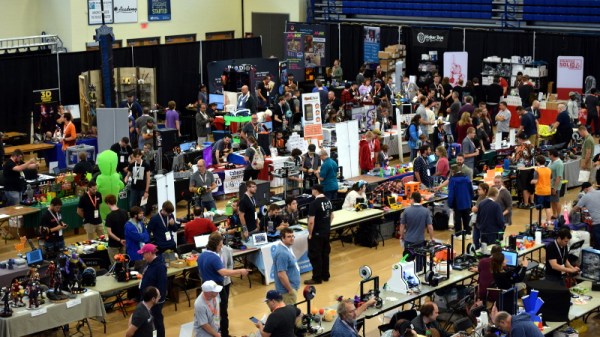
East Coast RepRap Festival Comes Alive In Second Year

By pretty much any metric you care to use, the inaugural East Coast RepRap Festival (ERRF) in 2018 was an incredible success. There was plenty to see, the venue was accommodating, and the ticket prices were exceptionally reasonable. But being a first-time event, there was an understandable amount of trepidation from both exhibitors and the attendees. Convincing people to travel hundreds of miles to an event with no track record can be a difficult thing, and if there was a phrase that would best describe the feel of that first ERRF, it would probably have been “cautious optimism”.

But this year, now that they had some idea of what to expect, the 3D printing community descended on Bel Air, Maryland with a vengeance. In 2019, everything at ERRF was bigger and better. There were more people, more printers, and of course, more incredible prints. Activities like the 3D Printed Derby returned, and were joined by new attractions including full-body 3D scanning and a shooting gallery where attendees could try out the latest in printable NERF weaponry.

The official tally shows that attendance nearly doubled over last year, and with growth like that, we wouldn’t be surprised if the ERRF organizers consider relocating to a larger venue for 2020 or 2021. As far as problems go, growth so explosive that it requires you to rethink where you hold the event isn’t a bad one to have. The Midwest RepRap Festival, which served as the inspiration for ERRF, found they too needed to move into more spacious digs after a few years. Something to keep in mind the next time somebody tells you the bubble has burst on desktop 3D printing.

Trying to distill an event as large and vibrant as ERRF 2019 into a few articles is always difficult. Even after spending hours walking around the show floor, you would still stumble upon something you hadn’t seen previously. As such, this article is merely a taste of what was on hand. The East Coast RepRap Festival 2020 should absolutely be marked on your calendar for next year, but until then let’s take a look at just some of what made this year’s event such a smash.

Continue reading “East Coast RepRap Festival Comes Alive In Second Year” →

This Week In Security: More WhatsApp, Nextcry, Hover To Crash, And Android Permissions Bypass

There is another WhatsApp flaw, but instead of malicious GIFs, this time it’s malicious mp4 files. Facebook announced the vulnerability late last week. An update has been released, so first go make sure WhatsApp is updated. Facebook’s advisory is a bit light on the details, simply saying that a “stack-based buffer overflow” was possible as a result of “parsing the elementary stream metadata of an mp4 file”.

Shortly after the bug was announced, a GitHub repository popped up, with a claimed proof-of-concept mp4 file for CVE-2019-11931. (Thanks to [justtransit] on Reddit for the link.) I can’t easily test the PoC file, but we can take a look at it to see what the vulnerability is. What tools do we need to take a look? A hex editor is a good start. I’m using GHex, simply because it was available and easily installed on Fedora. Continue reading “This Week In Security: More WhatsApp, Nextcry, Hover To Crash, And Android Permissions Bypass” →