Hackaday Editors Tom Nardi and Mike Szczys comb through their favorite hacks from the past week. We loved Donald Papp’s article on considerations before making the leap from FDM 3D Printers to a resin-based process, and we solidify our thoughts on curing cement in low-gravity. Tom’s working on a Cyberdeck build, and he also found an ancient episode of an earlier and much different version of the Hackaday podcast. We’re impressed with a mostly 3D-printed useless machine, a thermal-insert press that’s also 3D-printed, and the Raspberry-Pi based Sidekick clone that popped up this week. A DIY wire-bending robot is an incredible build, as is the gorgeous wire-routing in a mechanical keyboard, and the filigree work on this playing card press. Plus you need to spend some time getting lost in this one hydrogen-line telescope project.
Take a look at the links below if you want to follow along, and as always tell us what you think about this episode in the comments!
Take a look at the links below if you want to follow along, and as always, tell us what you think about this episode in the comments!
Ever wondered what “cyberwar” looks like? Apparently it’s a lot of guessing security questions and changing passwords. It’s an interesting read on its own, but there are some interesting clues if you read between the lines. A General in the know mentioned that Isis:
clicked on something or they did something that then allowed us to gain control and then start to move.
This sounds very similar to stories we’ve covered in the past, where 0-days are used to compromise groups or individuals. Perhaps the NSA supplied such an exploit, and it was sent in a phishing attack. Through various means, the U.S. team quietly compromised systems and collected credentials.
The article mentions something else interesting. Apparently the targets of this digital sting had also been compromising machines around the world, and using those machines to manage their efforts. The decision was made by the U.S. team to also compromise those machines, in order to lock out the Isis team. This might be the most controversial element of the story. Security researchers have wanted permission to do this for years. How should the third parties view these incursions?
The third element that I found particularly interesting was the phase 2 attack. Rather than outright delete, ban, and break Isis devices and accounts, the U.S. team installed persistent malware that emulated innocuous glitches. The internet connection is extremely laggy on certain days, certain websites simply don’t connect, and other problems. These are the sort of gremlins that networking pros spend all day trying to troubleshoot. The idea that it’s intentional gives me one more thing to worry about. Continue reading “This Week In Security: Is RSA Finally Broken? The Push For Cloud Accounts, Encrypted DNS, And More Mobile Mayhem”→
The harsh reality of keeping historical airplanes airworthy and flying is that from time to time one will crash. Thus it was that on October 2nd a Boeing B-17 Flying Fortress crash-landed after technical troubles. Incidentally, this is the very same airplane which we covered only a number of days ago. Painted to look like another B-17 of WWII (Nine-o-Nine, variant B-17G-30-BO), this late-model B-17G-85-DL aircraft wasn’t finished in time to join World War II, but instead spent its 74 years being a flying museum to these amazing airplanes.
Details about the cause of the crash are still scarce, but from radio communication between the crew and tower, it’s understood the B-17 was having having issues with the number 4 engine, which was seen sputtering and smoking by a witness. The airplane’s pilots tried to perform an emergency landing at Bradley International Airport, Connecticut, where it had taken off from only moments ago. Unfortunately the aircraft ran off the runway and struck a building, after which it burst into flames. The NTSB has indicated that they have dispatched a team to investigate the crash, and say that a preliminary report is likely two weeks away.
Of the thirteen people on board, seven died, with the remaining six surviving with injuries. One person on the ground was injured as well. The vintage bomber (civilian registration number N93012) has been all but completely destroyed in the fire, with only a section of the wing and tail remaining recognizable.
We feel terrible about such loss of life and hope the injured make a speedy recovery. The loss of yet another B-17 is also tough to swallow, as this leaves just ten airworthy B-17s. How long until we say farewell to this part of our history, with the final flight of a B-17, or its kin?
There’s an old saying: Tell me and I forget, teach me and I may remember, involve me and I learn. I’m guilty of this in a big way — I was never much on classroom learning. But if I build something or write some code, I’m more likely to understand how it works and why.
Circuit simulation and software workbooks like Matlab and Jupyter are great for being able to build things without a lot of overhead. But these all have some learning curve and often use clever tricks, abstractions, or library calls to obscure what’s really happening. Sometimes it is easier to build something in a spreadsheet. In fact, I often do little circuit design spreadsheets or even digital design because it forces me to create a mathematical model which, in turn, helps me understand what’s really going on.
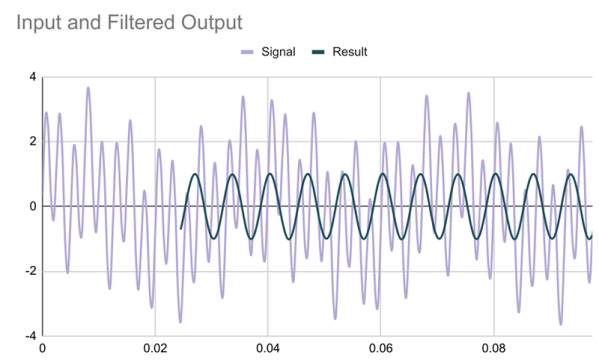
In this article I’m going to use Google Sheets — although you could do the same tricks in just about any spreadsheet — to generate some data and apply a finite impulse response (FIR) filter to it. Of course, if you had a spreadsheet of data from an instrument, this same technique would work, too.
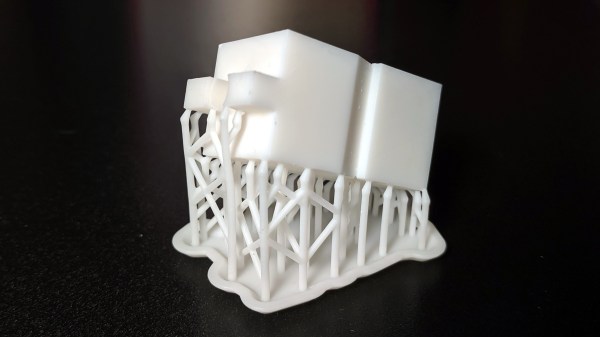
An Elegoo Mars resin 3D printer, straight to my doorstep for a few hundred bucks. What a time to be alive.
Resin-based 3D printers using digital light processing (DLP) and especially stereolithography (SLA) are getting more common and much more affordable. Prosumer-level options like Formlabs and the Prusa SL1 exist, but more economical printers like the Elegoo Mars, Anycubic Photon, and more can be had for a few hundred bucks. Many printers and resin types can even be ordered directly from Amazon, right at this moment.
Resin prints can look fantastic, so when does it make sense to move to one of these cheap resin printers? To know that, consider the following things:
The printing process and output of resin printers is not the same as for filament-based printers. Design considerations, pre-processing, and post-processing are very different.
Resin printing has a different workflow, with consumables and hidden costs beyond the price of resin refills.
Back in the good old days of carburetors and distributors, the game was all about busting door locks and hotwiring the ignition to boost a car. Technology rose up to combat this, you may remember the immobilizer systems that added a chip to the ignition key without which the vehicle could not be started. But alongside antitheft security advances, modern vehicles gained an array of electronic controls covering everything from the entertainment system to steering and brakes. Combine this with Bluetooth, WiFi, and cellular connectivity — it’s unlikely you can purchase a vehicle today without at least one of these built in — and the attack surface has grown far beyond the physical bounds of bumpers and crumple zones surrounding the driver.
Cyberattackers can now compromise vehicles from the comfort of their own homes. This can range from the mundane, like reading location data from the navigation system to more nefarious exploits capable of putting motorists at risk. It raises the question — what can be done to protect these vehicles from unscrupulous types? How can we give the user ultimate control over who has access to the data network that snakes throughout their vehicle? One possible solution I’m looking at today is the addition of internet killswitches.
It’s fair to say that 2019 has not been a good year for the aircraft manufacturer Boeing, as its new 737 MAX aircraft has been revealed to contain a software fault that could cause the aircraft to enter a dive and crash. Now stories are circulating of another issue with the 737, some of the so-called “Pickle forks” in the earlier 737NG aircraft have been found to develop cracks.
It’s a concerning story and there are myriad theories surrounding its origin but it should also have a reassuring angle: the painstaking system of maintenance checks that underpins the aviation industry has worked as intended. This problem has been identified before any catastrophic failures have occurred. It’s not the story Boeing needs at the moment, but they and the regulators will no doubt be working hard to produce a new design and ensure that it is fitted to aircraft.
The Role of the Pickle Fork
For those of us who do not work in aviation though it presents a question: what on earth is a pickle fork? The coverage of the story tells us it’s something to do with attaching the wing to the fuselage, but without a handy 737 to open up and take a look at we’re none the wiser.
Fortunately there’s a comprehensive description of one along with a review of wing attachment technologies from Boeing themselves, and it can be found in one of their patents. US9399508B2 is concerned with an active suspension system for wing-fuselage mounts and is a fascinating read in itself, but the part we are concerned with is a description of existing wing fixtures on page 12 of the patent PDF.
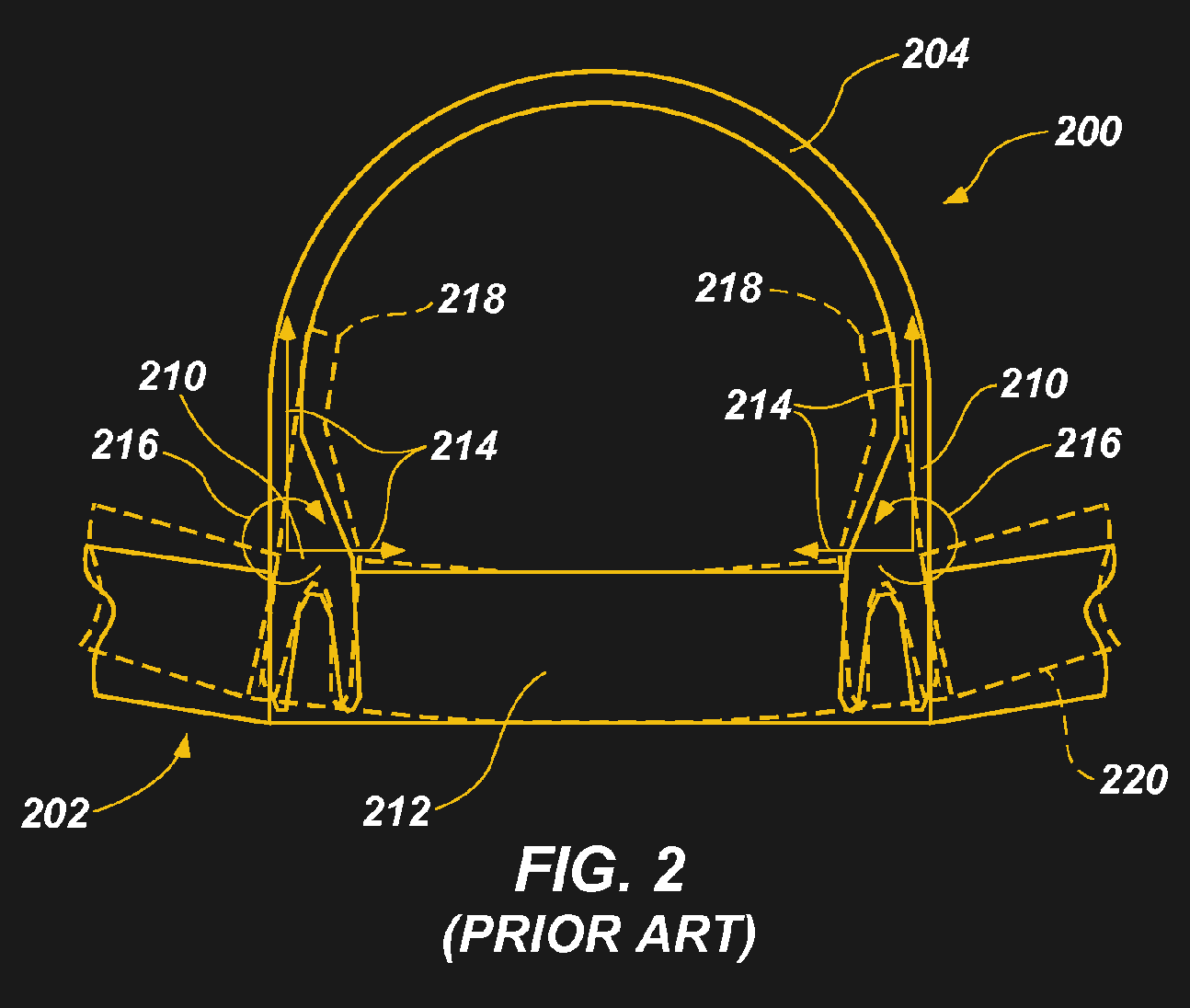
A cross-section of the aircraft wing fixing, in which we’ve highlighted the role of the pickle forks. (Boeing)
The pickle fork is an assembly so named because of its resemblance to the kitchen utensil, which attaches firmly to each side of the fuselage and has two prongs that extend below it where they are attached to the wing spar.
For the curious engineer with no aviation experience the question is further answered by the patent’s figure 2, which provides a handy cross-section. The other wing attachment they discuss involves the use of pins, leading to the point of the patented invention. Conventional wing fixings transmit the forces from the wing to the fuselage as a rigid unit, requiring the fuselage to be substantial enough to handle those forces and presenting a problem for designers of larger aircraft. The active suspension system is designed to mitigate this, and we’d be fascinated to hear from any readers in the comments who might be able to tell us more.
We think it’s empowering that a science-minded general public can look more deeply at a component singled out in a news report by digging into the explanation in the Boeing patent. We don’t envy the Boeing engineers in their task as they work to produce a replacement, and we hope to hear of their solution as it appears.