Doomed Thermostat

It is amazing how the game Doom has been ported to so many things. Enter one more port, where the hardware in question is a Honeywell Prestige thermostat.

In his video, [cz7asm] shows us the game running quite nicely on the 480 x 272 LCD with an NES controller plugged into the USB port originally intended for software updates. The thermostat runs on a STM32F429 which is an ARM9 processor that has the juice to pull it off. The Doom engine being used is based on Chocolate Doom, an open source port of the game, and the binaries can be downloaded for Windows and Mac. The source code is also available as a download for your tinkering pleasure. This project by [cz7asm]  is extended from a code on GitHub by [floppes] that was meant for the STM32F429IDISCOVERY evaluation board.

The author shares his code for the STM32F4 on Dropbox as a zip and in order to compile it, the Atmel BSP for GNU GCC is used. The video below demonstrates the hack in action and, though there is no sound yet, the satisfaction that comes from such modifications is its own reward.

What else can you run Doom on? How about a calculator or maybe the Intel Edison or even an ATM machine! If there is a processor with enough muscle power, hackers will find a way to run Doom on it. So have you seen any alien computers lately that you think can be hacked? Continue reading “Doomed Thermostat”

Gravity Defying Drips Of A Bike Pump Controlled Fountain

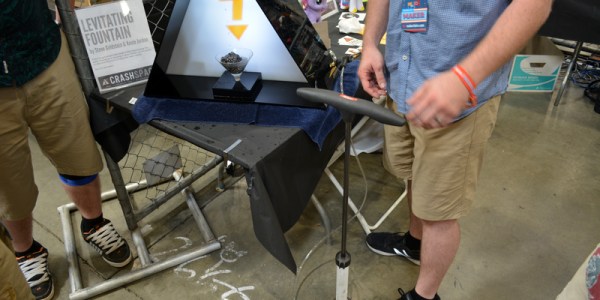
People love to see a trick that fools their senses. This truism was in play at the Crash Space booth this weekend as [Steve Goldstein] and [Kevin Jordan] showed off a drip fountain controlled by a bike pump.

These optical illusion drip fountains use strobing light to seemingly freeze dripping water in mid-air. We’ve seen this before several times (the work of Hackaday alum [Mathieu Stephan] comes to mind) but never with a user input quite as delightful as a bike pump. It’s connected to an air pressure sensor that is monitored by the Arduino that strobes the lights. As someone works the pump, the falling droplets appear to slow, stop, and then begin flowing against gravity.

Continue reading “Gravity Defying Drips Of A Bike Pump Controlled Fountain”

Bitcoin Price Ticker

Are you a Bitcoin miner or trader, but find yourself lacking the compulsive need to check exchange rates like the drug-fuelled daytraders of Wall Street? Fear not – you too can adorn your home or office with a Bitcoin Price Ticker! The post is in Italian but you can read a translated version here.

It’s a straightforward enough build – an Arduino compatible board with an onboard ESP8266 is hooked up with an HD44780-compatible LCD. It’s then a simple matter of scraping the Bitcoin price from the web and displaying it on the LCD. It’s a combination of all the maker staples, tied together with some off-the-shelf libraries – it’s quick, and it works.

[Ed: Oh boo!  The images of the LCD were photoshopped.  Please ignore the next paragraph.]

What makes the build extra nice is the use of custom characters on the LCD. The HD44780 is a character based display, and this project appears to use a screen with two lines of sixteen characters each. However, a custom character set has been implemented in the display which uses several “characters” on the screen to create a single number. It’s a great way to make the display more legible from a distance, as the numbers are much larger, and the Bitcoin logo has been faithfully recreated as well. It’s small touches like this that can really set a project apart. We’d love to see this expanded to display other financial market information and finished off in a nice case.

If you’re wondering what you can actually do with Bitcoin, check out the exploits of this robotic darknet shopper. Oh, and Microsoft will take them, too.

Dis-Integrated 6502 Running Programs; Acting Like Computer

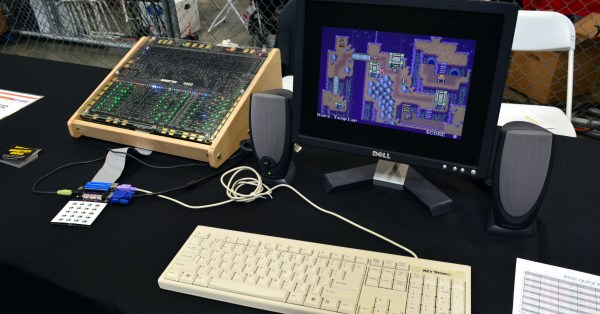
[Eric Schlaepfer] tends to turn up to Maker Faire with projects you simply don’t want to miss. This year is no different. Twelve months ago we delighted in seeing his 6502 processor built from an enormous reel of discrete MOSFETs. At the time it was freshly built and running random code to happily blink the LEDs reflecting activity in the registers. This year he’s given that blinking meaning and is running real programs on his Monster 6502 processor.

Continue reading “Dis-Integrated 6502 Running Programs; Acting Like Computer”

Arduino Cinque – The RISC-V, ESP32, WiFi, Bluetooth Arduino

This weekend at the Bay Area Maker Faire, Arduino in conjunction with SiFive, a fabless provider of the Open Source RISC-V micros, introduced the Arduino Cinque. This is a board running one of the fastest microcontrollers available, and as an added bonus, this board includes Espressif’s ESP32, another wonderchip that features WiFi and Bluetooth alongside a very, very powerful SoC.

Details on the Arduino Cinque are slim at the moment, but from what we’ve seen so far, the Cinque is an impressively powerful board featuring the RISC-V FE310 SoC from SiFive, an ESP32, and an STM32F103. The STM32 appears to be dedicated to providing the board with USB to UART translation, something the first RISC-V compatible Arduino solved with an FTDI chip. Using an FTDI chip is, of course, a questionable design decision when building a capital ‘O’ Open microcontroller platform, and we’re glad SiFive and Arduino found a better solution. It’s unknown if this STM32 can be used alongside the FE310 and ESP32 at this point.

We’ve taken a look at SiFive’s FE310 SoC, and it is an extremely capable chip. It was released first at the HiFive1, and our hands-on testing revealed this is a chip that outperforms the current performance champ of the Arduino world, the Teensy 3.6. Of course, with any new architecture, there will be a few problems porting the vast number of libraries over to the FE310, but SiFive has included an Arduino compatible SDK. It’s promising, and we can’t wait to see SiFive’s work in more boards.

FAA’s Drone Registration System Struck Down For Hobbyists

The US Court of Appeals for the D.C. Circuit has struck down a rule requiring recreational drone users and model aircraft pilots to register their drones with the FAA.

This began when [John Taylor], an RC hobbyist and attorney, filed suit against the FAA questioning the legitimacy of the FAA’s drone registration program. This drone registration began early last year, with the FAA requiring nearly all drones and model aircraft to be registered in a new online system. This registration system caused much consternation; the FAA Modernization And Reform Act of 2012 states, ““…Federal Aviation Administration may not promulgate any rule or regulation regarding a model aircraft…”, defining model aircraft as any unmanned aircraft flown within visual line of sight for hobby or recreational purposes. Despite this mandate from Congress, the FAA saw fit to require registration for every model aircraft weighing between 0.55 and 55 pounds, regardless of the purpose of its flight.

In our coverage of the FAA’s drone registration program, we couldn’t make heads or tails of the reasons behind this regulation. In addition to the questionable legality of this regulation, there are questions over the FAA’s mandate to regulate anything flying under the 400 foot ceiling cited in the FAA’s rules. The question of safety is also open — a 2 kg drone is likely to cause injury to a passenger on a commercial flight only once every 187 million years of operation. In short, the FAA might not have the mandate of managing the air traffic, certification, and safety of the nation’s airspace when it comes to model aircraft.

While the Circuit court struck down the rule for registration concerning model aircraft, this still only applies to small (under 55 pounds) planes and quads flown within line of sight. Commercial drone operators still fall under the purview of the FAA, and for them the drone registration system will stand.

KiCAD Best Practices: Library Management

One common complaint we hear from most new KiCAD users relates to schematic and footprint libraries. The trick is to use just one schematic symbol and footprint library each with your project. This way any changes to the default schematic libraries will not affect your project and it will be easy to share your project with others without breaking it. I’ve spent some time refining this technique and I’ll walk you through the process in this article.

We have covered KiCAD (as well as other) Electronic Design Automation (EDA) tools several times in the past. [Brian Benchoff] did a whole series on building a project from start to finish using all the various EDA packages he could lay his hands on. No CAD or EDA software is perfect, and a user has to learn to get to grips with the idiosyncrasies of whichever program they decide to use. This usually leads to a lot of cussing and hair pulling during the initial stages when one can’t figure out “How the hell do I do that?”, especially from new converts who are used to doing things differently.

Read on to learn the best practices to use when using KiCAD and its library management.

Continue reading “KiCAD Best Practices: Library Management”