$10 Raspberry Pi Zero W Adds WiFi And Bluetooth

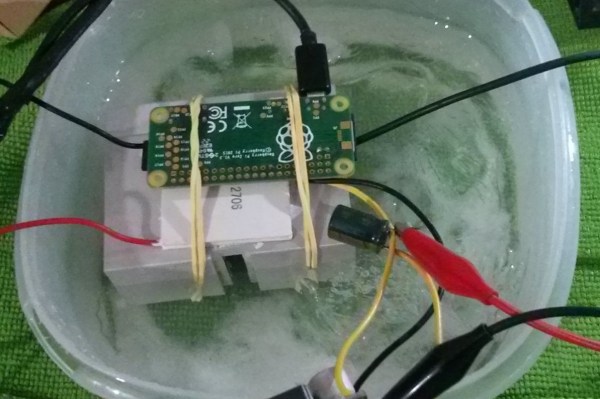
The Raspberry Pi was born on February 29th which means we’re only three years away from its second birthday, and a new hardware release from the Pi Foundation is becoming somewhat of a tradition. This year is no different: a new Raspberry Pi has been announced. The Raspberry Pi Zero W is the latest iteration of the Pi foundation’s tiny and extremely inexpensive single board computer. It’s a Raspberry Pi Zero with WiFi and Bluetooth.

The specs of the new Pi Zero W are nearly identical to the previous incarnation of the non-W Zero. It sports a 1GHz single-core processor, 512 MB of RAM, features Mini HDMI and USB OTG ports, uses a micro USB port for power, features the now-standard 40-pin header with four additional pins for composite video and a reset button. This board, like the second hardware revision of the Pi Zero, also features a CSI camera connector.

Of course, the big feature is the addition of WiFi and Bluetooth. The Pi Zero W adds the wireless functionality from the Raspberry Pi 3B. That’s 802.11n and Bluetooth 4.0.

The Pi Zero’s claim to fame was, of course, the price. The original Pi Zero was at first a bit of hardware glued to the cover of the MagPi magazine, later to sell for just $5 USD. The Raspberry Pi Zero W is priced at just $10.

Continue reading “$10 Raspberry Pi Zero W Adds WiFi And Bluetooth”

Audi Engineer Exposes Cheat Order

In an interesting turn of events last week in a German court, evidence has materialized that engineers were ordered to cheat emissions testing when developing automotive parts.

Last Tuesday, Ulrich Weiß brought forward a document that alleges Audi Board of Director members were involved in ordering a cheat for diesel emissions. Weiß was the head of engine development for Audi, suspended in November of 2015 but continued to draw more than half a million dollars in salary before being fired after prior to last week’s court testimony.

Volkswagen Group is the parent company of Audi and this all seems to have happened while the VW diesel emissions testing scandal we’ve covered since 2015 was beginning to come to light. Weiß testified that he was asked to design a method of getting around strict emissions standards in Hong Kong even though Audi knew their diesel engines weren’t capable of doing so legitimately.

According to Weiß, he asked for a signed order. When he received that order he instructed his team to resist following it. We have not seen a copy of the letter, but the German tabloid newspaper Bild reports that the letter claims approval by four Audi board members and was signed by the head of powertrain development at the company.

Hackaday was unable to locate any other sources reporting on the letter other than the Bild article we have linked to (also the source used in the Forbes article above). Sources such as Die Welt reference only “internal papers”. If you know of other reporting on the topic please leave a comment about it below.


San Francisco Tapped For Hackaday Unconference On March 18th

We want you to make the next Hackaday live event great. This is an Unconference in San Francisco on Saturday, March 18th and it depends completely on you. Get signed up now!

You’re in Control of the Hackaday Unconference

An unconference is a live event where you decide the topic, guide the discussion, and generally make it an epic Saturday. We have a handful of speakers lined up to help get things started. But we also want you to be ready to give a talk. Everyone that shows up should be prepared to stand up and deliver eight minutes on something they find exciting right now.

Kicking off the night we’ll ask each person to tell us the title or topic of their talk and approximate length of the presentation. Once all the titles are written down we’ll hammer out the schedule right then and there. If you haven’t been to an unconference this is the time to sign up, collect your thoughts, and jump into an afternoon of extemporaneous idea-sharing. If you have been to an unconference we’re guessing you signed up as soon as you saw this announcement.

Continue reading “San Francisco Tapped For Hackaday Unconference On March 18th”

The AI Is Always Watching

My phone can now understand me but it’s still an idiot when it comes to understanding what I want. We have both the hardware capacity and the software capacity to solve this right now. What we lack is the social capacity.

We are currently in a dumb state of personal automation. I have Google Now enabled on my phone. Every single month Google Now reminds me of bills coming due that I have already paid. It doesn’t see me pay them, it just sees the email I received and the due date. A creature of habit, I pay my bills on the last day of the month even though that may be weeks early. This is the easiest thing in the world for a computer to learn. But it’s an open loop system and so no learning can happen.

Earlier this month [Cameron Coward] wrote an outstanding pair or articles on AI research that helped shed some light on this problem. The correct term for this level of personal automation is “weak AI”. What I want is Artificial General Intelligence (AGI) on a personal level. But that’s not going to happen, and I am the problem. Here’s why.

Continue reading “The AI Is Always Watching”

What Does A Hacker Do With A Photocopier?

The year is 2016. Driving home from a day’s work in the engineering office, I am greeted with a sight familiar to any suburban dwelling Australian — hard rubbish. It’s a time when local councils arrange a pickup service for anything large you don’t want anymore — think sofas, old computers, televisions, and the like. It’s a great way to make any residential area temporarily look like a garbage dump, but there are often diamonds in the rough. That day, I found mine: the Ricoh Aficio 2027 photocopier.

It had spent its days in a local primary school, and had survived fairly well. It looked largely intact with no obvious major damage, and still had its plug attached. Now I needed to get it home. This is where the problems began.

Continue reading “What Does A Hacker Do With A Photocopier?”

SHAttered — SHA-1 Is Broken In

A team from Google and CWI Amsterdam just announced it: they produced the first SHA-1 hash collision. The attack required over 9,223,372,036,854,775,808 SHA-1 computations, the equivalent processing power as 6,500 years of single-CPU computations and 110 years of single-GPU computations. While this may seem overwhelming, this is a practical attack if you are, lets say, a state-sponsored attacker. Or if you control a large enough botnet. Or if you are just able to spend some serious money on cloud computing. It’s doable. Make no mistake, this is not a brute-force attack, that would take around 12,000,000 single-GPU years to complete.

SHA-1 is a 160bit standard cryptographic hash function that is used for digital signatures and file integrity verification in a wide range of applications, such as digital certificates, PGP/GPG signatures, software updates, backup systems and so forth. It was, a long time ago, proposed as a safe alternative to MD5, known to be faulty since 1996. In 2004 it was shown that MD5 is not collision-resistant and not suitable for applications like SSL certificates or digital signatures. In 2008, a team of researchers demonstrated how to break SSL based on MD5, using 200 Playstations 3.

Early since 2005 theoretical attacks against SHA-1 were known. In 2015 an attack on full SHA-1 was demonstrated (baptized the SHAppening). While this did not directly translate into a collision on the full SHA-1 hash function due to some technical aspects, it undermined the security claims for SHA-1. With this new attack, dubbed SHAttered, the team demonstrated a practical attack on the SHA-1 algorithm, producing two different PDF files with the same checksum.

The full working code will be released in three months, following Google’s vulnerability disclosure policy, and it will allow anyone to create a pair of PDFs that hash to the same SHA-1 sum given two distinct images and some, not yet specified, pre-conditions.

For now, recommendations are to start using SHA-256 or SHA-3 on your software. Chrome browser already warns if a website has SHA-1 certificate, Firefox and the rest of the browsers will surely follow. Meanwhile, as always, tougher times are ahead for legacy systems and IoT like devices.

Suddenly, Wireless Power Transmission Is Everywhere

Wireless power transfer exists right now, but it’s not as cool as Tesla’s Wardenclyffe tower and it’s not as stupid as an OSHA-unapproved ultrasonic power transfer system. Wireless power transfer today is a Qi charger for your phone. It’s low power – just a few amps — and very short range. This makes sense; after all, we’re dealing with the inverse square law here, and wireless power transfer isn’t very efficient.

Now, suddenly, we can transfer nearly two kilowatts wirelessly to electronic baubles scattered all over a room. It’s a project from Disney Research, it’s coming out of Columbia University, it’s just been published in PLOS one, and inexplicably it’s also an Indiegogo campaign. Somehow or another, the stars have aligned and 2017 is the year of wirelessly powering your laptop.

disney-research-quasistatic-cavity-roomThe first instance of wireless power transfer that’s more than just charging a phone comes from Disney Research. This paper describes quasistatic cavity resonance (QSCR) to transfer up to 1900 Watts to a coil across a room. In an experimental demonstration, this QSCR can power small receivers scattered around a 50 square meter room with efficiencies ranging from 40% to 95%. In short, the abstract for this paper promises a safe, efficient wireless power transfer that completely removes the need for wall outlets.

In practice, the QSCR from Disney Research takes the form of a copper pole situated in the center of a room with the walls, ceiling, and floor clad in aluminum. This copper pole isn’t continuous from floor to ceiling – it’s made of two segments, connected by capacitors. When enough RF energy is dumped into this pole, power can be extracted from a coil of wire. The video below does a good job of walking you through the setup.

As with all wireless power transmission schemes, there is the question of safety. Using finite element analysis, the Disney team found this room was safe, even for people with pacemakers and other implanted electronics. The team successfully installed lamps, fans, and a remote-controlled car in this room, all powered wirelessly with three coils oriented orthogonally to each other. The discussion goes on to mention this setup can be used to charge mobile phones, although we’re not sure if charging a phone in a Faraday cage makes sense.

motherbox-charging-phone-squareIf the project from Disney research isn’t enough, here’s the MotherBox, a completely unrelated Indiegogo campaign that was launched this week. This isn’t just any crowdfunding campaign; this work comes straight out of Columbia University and has been certified by Arrow Electronics. This is, by all accounts, a legitimate thing.

The MotherBox crowdfunding campaign promises true wireless charging. They’re not going for a lot of power here – the campaign only promises enough to charge your phone – but it does it at a distance of up to twenty inches.

At the heart of the MotherBox is a set of three coils oriented perpendicular to each other. The argument, or sales pitch, says current wireless chargers only work because the magnetic fields are oriented to each other. The coil in the phone case is parallel to the coil in the charging mat, for instance. With three coils arranged perpendicular to each other, the MotherBox allows for ‘three-dimensional charging’.

Does the MotherBox work? Well, if you dump enough energy into a coil, something is going to happen. The data for the expected charging ranges versus power delivered is reasonably linear, although that doesn’t quite make sense in a three-dimensional universe.

Is it finally time to get rid of all those clumsy wall outlets? No, not quite yet. The system from Disney Research works, but you have to charge your phone in a Faraday cage. It would be a great environment to test autonomous quadcopters, though. For MotherBox, Ivy League engineers started a crowdfunding campaign instead of writing a paper or selling the idea to an established company. It may not be time to buy a phone case so you can charge your phone wirelessly at Starbucks, but at least people are working on the problem. This time around, some of the tech actually works.

Continue reading “Suddenly, Wireless Power Transmission Is Everywhere”