
Fail Of The Week: How NOT To Smooth A 3D Print

Many of the Fail Of The Week stories we feature here are pretty minor in the grand scheme of things. At worse, gears are ground, bits are broken, or the Magic Blue Smoke is released. This attempt to smooth a 3D print released far more than a puff of blue smoke, and was nearly a disaster of insurance adjuster or medical examiner proportions.

Luckily, [Maxloader] and his wife escaped serious injury, and their house came out mostly unscathed. The misadventure started with a 3D printed Mario statue. [Maxloader] had read acetone vapor can smooth a 3D print, and that warming the acetone speeds the process. Fortunately, his wife saw the looming danger and wisely suggested keeping a fire blanket handy, because [Max] decided to speed the process even more by putting a lid on the pot. It’s not clear exactly what happened in the pot – did the trapped acetone vapors burp the lid off and find a path to the cooktop burner? Whatever it was, the results were pretty spectacular and were captured on a security camera. The action starts at 1:13 in the video below. The fire blanket came in handy, buying [Max] a few seconds to open the window and send the whole flaming mess outside. Crisis averted, except for nearly setting the yard on fire.

What are we to learn from [Maxloader]’s nearly epic fail? First, acetone and open flame do not mix. If you want to heat acetone, do it outside and use an electric heat source. Second, a fire extinguisher is standard household equipment. Every house needs at least one, and doubly so when there’s a 3D printer present. And third, it’s best to know your filaments – the dearly departed Mario print was in PLA, which is best smoothed with tetrahydrofuran, not acetone.

Anything else? Feel free to flame away in the comments.

Continue reading “Fail Of The Week: How NOT To Smooth A 3D Print”
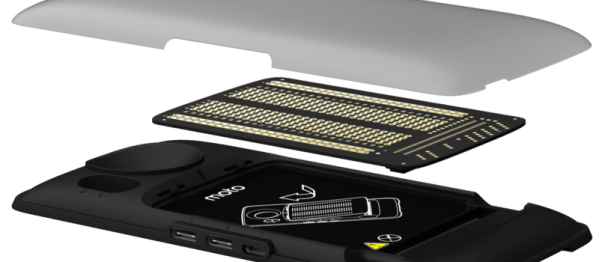
Turn Your Motorola Android Phone Into A Raspberry Pi

In the surest sign that hardware hacking is the new hotness, Motorola and Farnell/Element 14 have developed an add-on board and SDK that will let you connect virtually anything to your mobile phone. Motorola is calling it the “Moto Mods” system, and it looks like its going to be a dedicated microcontroller that interfaces with the computer inside the phone and provides everything from GPIOs to DSI (video). Naturally, I2C, I2S, SPI, UART, even two flavors of USB are in the mix.

dev-config-diagram-5

The official SDK, ahem Mods Development Kit (MDK), is based on the open Greybus protocol stack (part of Google’s Project Ara open phone project) and it’s running on an ARM Cortex-M4F chip. It’s likely to be itself fairly hackable, and even if the suggested US $125 price is probably worth it for the convenience, we suspect that it’ll be replicable with just a few dollars in parts and the right firmware. (Yes, that’s a challenge.)

The initial four adapter boards range from a simple breadboard to a Raspberry-Pi-hat adapter (hence the title). It’s no secret that cell phones now rival the supercomputers of a bygone era, but they’ve always lacked peripheral interfaces. We wish that all of the old smartphones in our junk box had similar capabilities. What do you say? What would you build with a cellphone if you could break out all sorts of useful comms?

Via HackerBoards, and thanks to [Tom] for the tip!

Ask Hackaday: What Are Magnetic Gears (Good For)?

Magnetic gears are surprisingly unknown and used only in a few niche applications. Yet, their popularity is on the rise, and they are one of the slickest solutions for transmitting mechanical energy, converting rotational torque and RPM. Sooner or later, you’re bound to stumble upon them somewhere, so let’s check them out to see what they are and what they are good for.

Continue reading “Ask Hackaday: What Are Magnetic Gears (Good For)?”

Google Unveils Their Experimental Plan For Wireless Broadband Service

Two years ago, the FCC, with interested parties in Microsoft, Google, and many startups, created the Citizens Band Radio Service (CBRS), a rule that would open up the 3550-3650 MHz band  to anyone, or any company, to create their own wireless backbone between WiFi access points. It is the wireless solution to the last-mile problem, and last year the FCC enthusiastically endorsed the creation of the CBRS.

In a recently released FCC filing, Google has announced their experimental protocol for testing the new CBRS. This isn’t fast Internet to a lamp pole on the corner of the street yet, but it lays the groundwork for how the CBRS will function, and how well it will perform.

Google will be testing the propagation and interference of transmissions in the 3.5 GHz band in places around the US. Most of the Bay Area will be covered in the tests, as well as Boulder, CO, Kansas City, Omaha, Raleigh, NC, Provo, UT, and Reston, VA. Tests will consist of a simple CW tone broadcast in the 3.5 GHz band.

The 3.5 GHz band is already allocated to shipborne navigation and military radar systems, posing an obvious problem to any wireless broadband system using this spectrum. To this end, the FCC is proposing a novel solution to the problem of coexistence between the CBRS and the military. Instead of simply banning transmissions in the spectrum, FCC Chairman Wheeler proposes, “computer systems can act like spectrum traffic cops.” A computer is able to direct the wireless traffic much more effectively than a blanket ban, and will allow better utilization of limited spectrum.

Google’s FCC filing is just for testing propagation and interference, and we have yet to hear anything about how a network built on 3.5 GHz spectrum will be laid out. One thing is for certain, though: you will not have a 3.5 GHz USB networking dongle for the same reason you don’t have a Google Fiber input on your desktop.

A Trove Of 3D Printer Filament Test Data

We’re not sure what a typical weekend at [Walter]’s house is like, but we can probably safely assume that any activity taking place is at minimum accompanied by the hum of a 3D printer somewhere in the background.

Those of us who 3D print have had our experiences with bad rolls of filament. Anything from filament that warps when it shouldn’t to actual wood splinters mixed in somewhere in the manufacturing process clogging up our nozzles. There are lots of workarounds, but the best one is to not buy bad filament in the first place. To this end [Walter] has spent many hours cataloging the results of the different filaments that have made it through his shop.

We really enjoyed his comparison of twleve different yellow filaments printed side by side with the same settings on the same printer. You can really see the difference high dimensional tolerance, the right colorant mix, and good virgin plastic stock makes to the quality of the final print. Also, how transparent different brands of transparent actually are as well as the weight of spools from different brands (So you can weigh your spool to see how much is left).

The part we really liked was his list every filament he’s experienced in: PLA, ABS, PETG, Flexible, Nylon, Metal, Wood, and Other. This was a massive effort, and while his review is naturally subjective, it’s still nice to have someone else’s experience to rely on when figuring out where to spend your next thirty dollars.

We’re Fans Of Dave’s Fans

Hackaday.io contributor extraordinaire [davedarko] gets hot in the summer. We all do. But what separates him from the casual hacker is that he beat the heat by ordering four 120 mm case fans. He then 3D printed a minimalistic tower frame for the fans, and tied them all together with a ULN2004 and an ESP8266. The whole thing is controlled over the network via MQTT. That’s dedication to staying cool.

We really like the aesthetics of this design. A fan made up of fans! But from personal experience, we also know that these large case fans can push a lot of air fairly quietly. That’s important if you’re going to stand something like this up on your desk. While we’re not sure that a desk fan really needs networked individual PWM speed control, we can see the temptation.

Now that they’re individually controlled, nothing stops [davedarko] from turning this into a musical instrument, or even using the fans to transmit data. The only thing we wouldn’t do, despite the temptation to stick our fingers in the blades, is to complicate the design visually. Maybe that would finally teach the cat not to walk around on our desk.

Hacking When It Counts: Spy Radios

World War II can be thought of as the first electronic war. Radio technology was firmly established commercially by the late 1930s and poised to make huge contributions to the prosecution of the war on all sides. Radio was rapidly adopted into the battlefield, which led to advancements in miniaturization and ruggedization of previously bulky and fragile vacuum tube gear. Radios were soon being used for everything from coordinating battlefield units to detonating anti-aircraft artillery shells.

But it was not just the battlefields of WWII that benefitted from radio technology. From apartments in Berlin to farmhouses in France, covert agents toiled away over sophisticated transceivers, keying in coded messages and listening for instructions. Spy radios were key clandestine assets, both during the war and later during the Cold War. Continue reading “Hacking When It Counts: Spy Radios”