How Did Pocket NC Survive And Thrive?

We had a chance to talk to Matthew Hertel of PocketNC at the Bay Area Maker Faire this year. During the conversation, he answered some questions I’d had about the project since I saw it on Kickstarter, and told a cool story while he was at it.

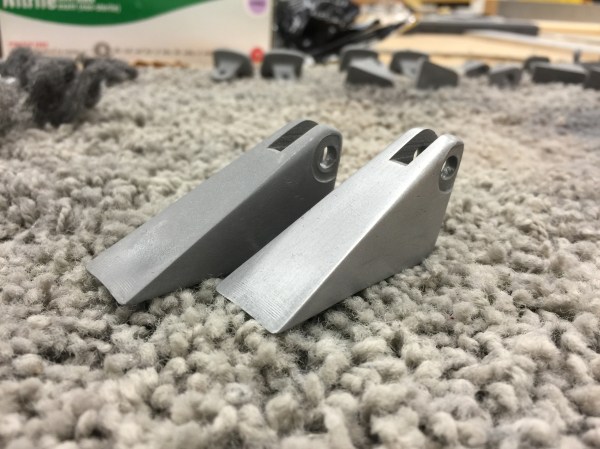
When the Pocket NC 5-axis Tabletop CNC Mill KickStarter came out, I immediately chocked it up as a failure out of the gate. I figured that there would never be a single delivered unit. It just seemed too impossible. The price was too low for a machine with that many large machined aluminum pieces. It had real linear guides. It had a real spindle and housed a beagle bone black running linuxCNC. It just couldn’t be that cheap. Ends up, I’m quite happy to be wrong. Pocket NC is doing well, delivering their first units, and taking new orders.

The CNC equivalent of a brag track on a hip-hop record.

It’s easy to get jaded with the Kickstarter and IndieGoGo scams that are out there. Or even the disappointing behavior of projects that could be legitimate. People often do failure analysis of companies, but it is also worth investigating what people did right when they are successful.

Continue reading “How Did Pocket NC Survive And Thrive?”

Long-Term Review: Weller Magnastat Soldering Iron

One of the things you find yourself doing as a young engineer is equipping yourself with the tools of your trade. These will be the foundations upon which your career is built in a way that a diploma or degree certificate will never be, for the best degree in the world is less useful if the quality of your tools renders you unable to capitalise upon it. You may be lucky enough to make some of them yourself, but others you’ll lust after as unaffordable, then eventually put the boat out a little to buy at the limit of your meager income.

Your bench may have a few of these lifetime tools. They could be something as simple as screwdrivers or you may have one of those indestructible multimeters, but in my case my lifetime tool is my soldering iron. At some time in 1992 I spent about £60($173 back then), a lot of money for a student, on a mains-powered Weller Magnastat. The World Wide Web was still fairly fresh from Tim Berners-Lee’s NeXT in those days, so this meant a trip to my university’s RS trade counter and a moment poring over a telephone-book-sized catalogue before filling in an order slip.

The Magnastat is a simple but very effective fixed-temperature-controlled iron. The tip has a magnet on its rear end which holds closed a power switch for the heating element. When the tip has heated to the Curie temperature of the magnet, it loses its magnetism and the switch opens. The temperature falls to below the Curie temperature and the magnetism returns, the switch closes, the tip warms up again, and the cycle repeats itself. The temperature of the tip is thus dictated by the magnet’s Curie temperature, and Weller provides a range of tips fitted with magnets for different temperatures.

The result is an iron with enough power to solder heat-sucking jobs that would leave lesser irons gasping for juice, while also having the delicacy to solder tiny surface-mount components without destroying them or lifting tracks. It’s not a particularly small or lightweight iron if you are used to the featherlight pencil irons from today’s soldering stations, but neither is it too large or heavy to be unwieldy. In the nearly quarter century I have owned my Magnastat it has had a hand in almost everything I have made, from hi-fi and tube amplifiers through radio transmitters, stripline filters, kits, and too many repairs to mention. It has even been pressed into service plastic-welding a damaged motorcycle fairing. It has truly been a lifetime tool.

Continue reading “Long-Term Review: Weller Magnastat Soldering Iron”

The Most Powerful Diesel Engine

Ever. Literally.

A gearhead friend of ours sent along a link to a YouTube video (also embedded below) promising the world’s most powerful engine. Now, we’ll be the first to warn you that it’s just an advertisement, and for something that you’re probably not going to rush out and buy: the Wärtsilä 14RT marine engine.

A tiny bit of math: 96 cm cylinder diameter times 250 cm piston stroke = 1,809,557 CC. And it generates around 107,000 HP. That’s a fair bit, but it runs at a techno-music pace: 120 BPM RPM. With twelve cylinders, we’d love to hear this thing run. Two-strokes make such a wonderful racket! Wonder if they’ve tried to red-line it? It’s a good thing we don’t work at Wärtsilä.

Continue reading “The Most Powerful Diesel Engine”

How To Fail At Laser Cutting

Laser cutters are CNC power tools, which means an operator uploads a job digitally and then pushes START to let the machine do all the work while they lie back in a hammock sipping a margarita, occasionally leaping out in a panic because the sound coming from the machine changed slightly.

Like other power tools, laser cutters are built around doing one thing very well, but they require an operator’s full attention and support. The operator needs to handle all the other things that go on before, during, and after the job. It’s not too hard to get adequate results, but to get truly professional and repeatable ones takes work and experience and an attention to detail.

People often focus on success stories, but learning from failures is much more educational. In the spirit of exploring that idea, here are my favorite ways to fail at laser cutting and engraving. Not all of these are my own personal experience, but they are all someone’s personal experience.

Continue reading “How To Fail At Laser Cutting”

Path To Craftsmanship: The Art Of Throwing It Away

Some hackers build sharp, mildly toxic nests of parts, components, and thrifty finds around themselves. These nests, while not comfortable, are certainly comforting. They allow the hacker’s psyche to inhabit a locale as chaotic as their minds. Within these walls of stuff and clutter, stunning hacks pour out amid a small cloud of cursing. This article is not for them.

http://www.computerhistory.org/atchm/an-analog-life-remembering-jim-williams/
Very few of us can actually function in a workplace such like that of the venerable Jim Williams (photo from linked article). Thanks to the commenters for mentioning him in the previous article.

For the rest of us, clutter is a Zen destroying, seemingly unconquerable, monster that taunts our poor discipline and organizational skill from the dark corner of our minds. However, there is an easy solution that is oft overlooked. Somewhat obviously, most organization problems can be solved by simply not having things to organize.

It’s taken me a very long time to realize the source of my clutter woes. My first tactic was to blame myself for my inability to keep up with the mess. A more superior human would certainly be able to use their effortless discipline to keep a space organized. However, the clutter was a symptom of a problem completely separate from my actual ability to keep a space clean.

Continue reading “Path To Craftsmanship: The Art Of Throwing It Away”

Radio Shack Returns

In February 2015, Radio Shack–an icon in American malls and towns–filed for bankruptcy. You could say a lot of critical things about Radio Shack, but in many parts of the country, it was the only place you were going to go find electronic components on short notice. A lot of people of a certain age got their exposure to electronics via Radio Shack kits and parts.

Radio Shack did close a lot of stores. In fact, from 4,000 stores they are down to about 1,700. A New York hedge fund named Standard General bought all the Radio Shack assets and formed a new company (also called, oddly enough, Radio Shack). They just named [Dene Rogers] as CEO. He’s a veteran at retail sales, having been with Target in Australia and Sears in Canada.

Continue reading “Radio Shack Returns”

Autonomous Truck Teaches Itself To Powerslide

When you’re a teenager new to the sensations of driving, it seems counterintuitive to “turn into the skid”, but once you’ve got a few winters of driving under your belt, you’re drifting like a pro. We learn by experience, and as it turns out, so does this fully autonomous power-sliding rally truck.

Figuring out how to handle friction-optional roadways is entirely the point of the AutoRally project at Georgia Tech, which puts a seriously teched-up 1/5 scale rally truck through its paces on an outdoor dirt track. Equipped with high-precision IMU, high-resolution GPS, dual front-facing cameras, and Hall-effect sensors on each wheel sampled at 70 Hz, the on-board Quad-core i7 knows exactly where the vehicle is and what the relationship between it and the track is at all times. There’s no external sensing or computing – everything needed to run the track is in the 21 kg truck. The video below shows how the truck navigates the oval track on its own with one simple goal – keep the target speed as close to 8 meters per second as possible. The truck handles the red Georgia clay like a boss, dealing not only with differing surface conditions but also with bright-to-dark lighting transitions. So far the truck only appears to handle an oval track, but our bet is that a more complex track is the next step for the platform.

While we really like the ride-on scale of this autonomous chase vehicle, other than that there haven’t been too many non-corporate self-driving vehicle hacks around here lately. Let’s hope that AutoRally is an indication that the hackers haven’t ceded the field to Google entirely. Why let them have all the fun?

Continue reading “Autonomous Truck Teaches Itself To Powerslide”