Ask Hackaday: Selling CAD Prints That Are Not Yours

[Louise] tried out her new E3D Cyclops dual extrusion system by printing a superb model dragon. The piece was sculpted in Blender, stands 13cm tall and can be made without supports. It’s an impressive piece of artwork that reflects the maker’s skill, dedication and hard work. She shared her creation on the popular Thingiverse website which allows others to download the file for use on their own 3D printer. You can imagine her surprise when she stumbled upon her work being sold on eBay.

It turns out that the owner of the eBay store is not just selling [Louise]’s work, he’s selling thousands of other models taken from the Thingiverse site. This sketchy and highly unethical business model has not gone unnoticed, and several people have launched complaints to both Thingiverse and eBay. Now, there are lots of things to talk about here, but the 800 pound high voltage transformer in the room is the legality of the whole thing. What he’s doing might be unethical, but is it illegal?

When [Louise] politely asked the eBay store owner to remove her work, he responded with:

“When you uploaded your items onto Thingiverse for mass distribution, you lost all rights to them whatsoever. They entered what is known in the legal world as “public domain”. The single exception to public domain rules are original works of art. No court in the USA has yet ruled a CAD model an original work or art.”

Most of the uploaded CAD models on Thingiverse are done under the Creative Commons license, which is pretty clear in its assertion that anyone can profit from the work. This would seem to put the eBay store owner in the clear for selling the work, but it should be noted that he’s not properly attributing the work to the original creator. There are other derivatives of the license, some of which prohibit commercial use of the work. In these cases, the eBay store owner would seem to be involved in an obvious violation of the license.

There are also questions stirring with his use of images.  He’s not taking the CAD model and making his own prints for images. He lifting the images of the prints from the Thingiverse site along with the CAD files. It’s a literal copy/paste business model.

With that said,  the eBay store owner makes a fairly solid argument in the comments section of the post that broke the news. Search for the poster named “JPL” and the giant brick of text to read it. He argues that the Thingiverse non-commercial license is just lip service and has no legal authority. One example of this is how they often provide links to companies that will print a CAD design on the same page of a design that’s marked as non-commercial. He sums up one of many good points with the quote below:

“While we could list several other ways Thingiverse makes (money), any creator should get the picture by now-Thingiverse exists to make Stratasys (money) off of creators’ designs in direct violation of its very own “non-commercial” license. If a creator is OK with a billion-dollar Israeli company monetizing his/her designs, but hates on a Philly startup trying to make ends-meet, then they have a very strange position indeed.”

OK Hackaday readers, you have heard both sides of the issue. Here’s the question(s):

1.  Is the eBay seller involved in illegal activity?

2. Can he change his approach to stay within the limits of the license? For instance, what if he credits the                      original maker on the sale page?

3. How would you feel if you found your CAD file for sale on his eBay store?

Imperial Shuttle Drone Is Sure To Scare The Cat

[Adam Woodworth] tries to build some kind of RC plane every month. He’s been at it for almost a decade, and he’s getting pretty damn good at it. By day, he’s a Hardware Engineer at Google, though he went to MIT for Aerospace Engineering. Coincidence? We think not.

His latest project is an Imperial Shuttle drone, or to be specific, a Lambda class imperial shuttle — the infamous Shuttle Tydirium. You have to watch this thing unfold.

Using paper model plans, [Adam] printed out the shuttle on a combination of 3mm and 6mm thick foam board (Depron), and then assembled it. This kept the model light enough that the set of quad rotors would have more than enough power to fly it around.

Continue reading “Imperial Shuttle Drone Is Sure To Scare The Cat” →

Waiting For China To Re-Open, From Huaqiangbei

The Chinese New Year is something we keep in mind at least half of the year, and probably still don’t plan for properly. In case you’re new to the situation: The Chinese New Year celebration empties out Shenzhen of its more than 12 million residents for the better part of a month. It’s the one time of year that manufacturing sector workers (and everyone that supports that ecosystem) travels home to visit family.

For those involved in manufacturing goods in Shenzhen, this part of the year leaves us cut off from one of our vices and we count the days until our tracking numbers and order confirmations start to show signs of life. It’s an inconvenience of an entirely different nature if you are one of the lonely few that stays in the city during the holiday. [Ian] over at Dangerous Prototypes wrote a blog post from his office in Huaqiangbei which is a sub-district of Shenzhen, China to share the experience with us.

Shenzhen is uniquely a migrant-worker city, and when emptied of the factory employees there are not enough people to patronize local services like markets and restaurants so they also shut down. But an empty city offers its own interesting entertainment like wicked fireworks sessions. As always, [Ian] does a great job of sharing this peculiar part of Shenzhen culture. He also kindly points out some of the offensive offers that come through the inter-webs from desperate customers who have poorly planned around the holiday.

Variable Instruction Computing: What Is Old Is New Again

Every twenty to twenty-five years, trends and fads start reappearing. 2016 is shaping up to be a repeat of 1992; the X-files is back on the air, and a three-way presidential election is a possibility. Star Trek is coming back, again. Roll these observations back another twenty-five years, and you have The Outer Limits, Star Trek, and riots at the DNC convention in Chicago.

History repeating itself is not the exclusive domain of politics and popular culture. It happens with tech, too: the cloud is just an extension of thin clients which are an extension of time-sharing. Everything old is new again.

For the last few years, Soft Machines, a fabless semiconductor company running in stealth mode, released the first preview for an entirely new processor architecture. This new architecture, VISC, offers higher performance per Watt than anything available on the market. If you’ve been paying attention for the last decade or so, the future of computing isn’t 200-Watt space heaters that also double as powerful CPUs. The future is low power machines that are good enough to run Facebook or run some JavaScript. With servers, performance per Watt is possibly the most important metric. How will Soft Machines upend the semiconductor market with new processors and new architectures? If you know your history, it shouldn’t be a surprise.

Continue reading “Variable Instruction Computing: What Is Old Is New Again” →

ATtiny Watch Is Tiny

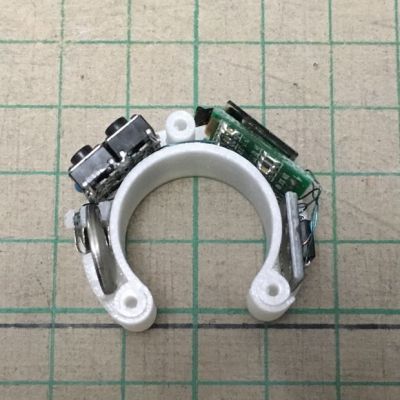
[陳亮] (Chen Liang) is in the middle of building the ultimate ring watch. This thing is way cooler than the cheap stretchy one I had in the early 1990s–it’s digital, see-through, and it probably won’t turn [陳]’s finger green.

watch-gutsThe current iteration is complete and builds upon his previous Arduino-driven watch building experiences. It runs on an ATtiny85 and displays the time, temperature, and battery status on an OLED. While this is a fairly a simple build on paper, it’s the Lilliputian implementation that makes it fantastic.

[陳] had to of course account for building along a continuous curve, which means that the modules of the watch must be on separate boards. They sit between the screw bosses of the horseshoe-shaped 3D-printed watch body, connected together with magnet wire. [陳] even rolled his own coin cell battery terminals by cutting and doubling over the thin metal bus from a length of bare DuPont connector.

If you’re into open source watches but prefer to wear them on your wrist, check out this PIC32 smart watch or the Microduino-based OSWatch.

The Contrarian Response To Apple’s Need For Encryption

On December 2, 2015, [Syed Rizwan Farook] and [Tashfeen Malik] opened fire at a San Bernardino County Department of Public Health training event, killing 14 and injuring 22. This was the third deadliest mass shooting in the United States in recent memory, and began a large investigation by local, state, and federal agencies. One piece of evidence recovered by the FBI was an iPhone 5C belonging to one of the shooters. In the days and months after the shooting, the FBI turned to Apple to extract data from this phone.

A few days ago in an open letter to customers, [Tim Cook], CEO of Apple, stated they will not comply with FBI’s request to build a backdoor for the iPhone. While the issue at hand is extracting data from an iPhone recovered from the San Bernardino shooting, [Cook] says building a new version of iOS to extract this data would allow the FBI to unlock any iPhone. Needless to say, there are obvious security implications of this request.

Apple does not publish open letters to its customers often. Having one of the largest companies on the planet come out in support of privacy and encryption is nearly unprecedented. There is well-founded speculation this open letter to the public will be exhibit A in a supreme court case. Needless to say, the Internet has gone a little crazy after this letter was published, and rightly so: just imagine how better off we would be if AT&T said no to the NSA in 2002 – [Snowden] might just be another IT geek working for a government contractor.

CalvinThere is a peculiar aspect of public discourse that doesn’t make any sense. In the absence of being able to say anything interesting, some people have just decided to add a contrary viewpoint. Being right, having a valid argument, or even having evidence to support assertions doesn’t matter; being contrary is far more interesting. Look at any comment thread on the Internet, and you’ll find the longest comment chain is the one refuting the parent article. Look up the ratings for a cable news channel. You’ll find the highest rated show is the one with the most bickering. When is the last time you saw something from the New York Times, Washington Post, or LA Times on Facebook or your favorite news aggregator? Chances are, it wasn’t news. It was an op-ed, most likely one that was espousing a view contrary to either public opinion or public policy.


As with any headline event on the Internet, the contrarians have come out of the woodwork. These contrarians are technically correct and exceedingly myopic.

Continue reading “The Contrarian Response To Apple’s Need For Encryption” →