Make PCBs With DLP, OMG!

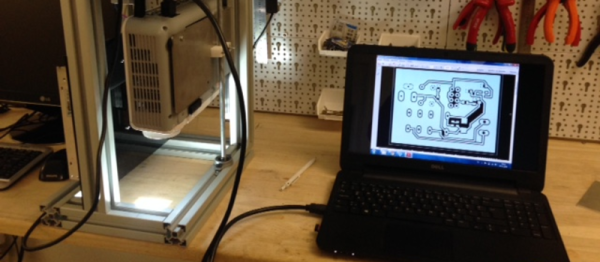
There’s so many ways to skin the home-fabrication-of-PCBs cat! Here’s yet another. [Nuri Erginer] had a DLP projector on hand, and with the addition of some reducing optics, managed to turn it into a one-shot PCB exposer.

If you’ve ever used photo-resist PCB material before, you know the drill: print out your circuit onto transparency film, layer the transparency with the sensitized PCB, expose with a UV light for a while, dissolve away the unexposed resist, and then etch. Here, [Nuri] combines the first three steps in one by exposing the board directly from a DLP projector.

The catch is that the projector’s resolution limits the size of the board that you can make. To fab a board that’s 10cm x 10cm, at XGA resolution (1024×768), you’ll end up with a feature size of around 0.004″ in the good direction and 0.005″ in the other.

For DIP parts, that’s marginal, but for fine-pitch or small SMT parts, that won’t do. On the other hand, for a smaller board, optimally one in the same 4:3 ratio, it could work. And because it exposes in one shot, you can’t beat the speed. Cool hack, [Nuri]!

When you need more precision, strapping a UV laser to an accurate 2D robot is a good way to go, but it’s gonna take a while longer.

The Most Plausible Apollo Moon Landing Conspiracy Ever Devised

The Internet is polluted with craziness, and there is no better example than YouTube. If you’ve ever wondered what would happen when you give everyone on the planet the power to show everyone else on the planet their innermost thoughts, desires, and insane ramblings, you need only look at YouTube.

One of the biggest offenders of incoherent ramblings is the subject of spaceflight. Simply search ‘space shuttle’ on YouTube, and you’ll find accusations of the crew of Columbia being abducted by aliens. Crazy, incoherent, and somewhat insulting. Accusations of a moon landing conspiracy are unavoidable in the ‘related videos’ section and are similarly filled with videos from people with either a tenuous grasp of reality or too much time on their hands.

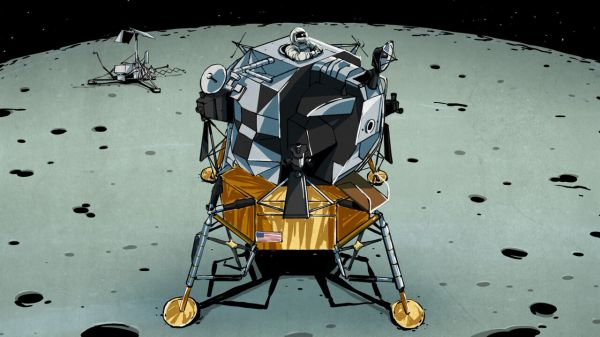
A broken clock is right twice a day, a broken calendar is right every twenty-eight years or so, and every once in a while, simply from the volume of videos on the subject, one conspiracy theorist will present a new and novel idea. Here we present perhaps the only moon landing conspiracy theory that makes sense, is consistent with physical laws, and that may actually be true.

Continue reading “The Most Plausible Apollo Moon Landing Conspiracy Ever Devised”

The 3D Printers Of CES

CES, the Consumer Electronics Show, is in full swing. That means the Hackaday tip line is filled to the brim with uninteresting press releases, and notices that companies from the world over will be at CES.

3D printing has fallen off the radar of people who worship shiny new gadgets of late, and this is simply a function of 3D printing falling into the trough of disillusionment. The hype train of 3D printing is stuck on a siding, people are bored, but this is the time that will shape what 3D printing will become for the next ten years. What fascinating news from the 3D printing industry comes to us from CES?

Continue reading “The 3D Printers Of CES”

Ten Mile Raspberry Pi WiFi (with A Catch)

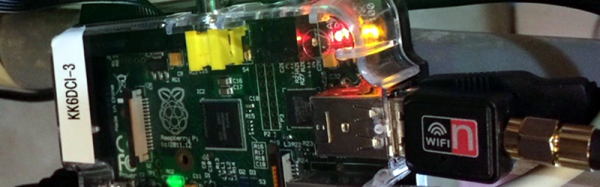
How would you like to have a WiFi connection that covers 10 miles? Or how about an even wider network made up of a mesh of multiple nodes? It is possible, but there is a catch: you probably need a ham radio license to do it (at least, you do in the United States).

What makes it possible is the realization that conventional WiFi channels 1-6 are inside an existing US ham band. That means (if you are a ham) you can elect to use FCC part 97 rules instead of part 15 that governs WiFi routers. That means you can use more power and–even more importantly–better antennas to get greater range.

Traditionally, hams have used custom firmware for Netgear routers or Ubiquiti hardware. However, [WZ0W] recently posted his experience using Raspberry Pi boards as mesh nodes. The code (which also works with some other single board computers) is available on GitHub (with details on the project blog). [WZ0W] points out that, unlike using a consumer router, using a Pi provides a reasonably powerful computer for hosting services as well as hosting the network.

Continue reading “Ten Mile Raspberry Pi WiFi (with A Catch)”

WiFi Alliance Introduces 802.11ah

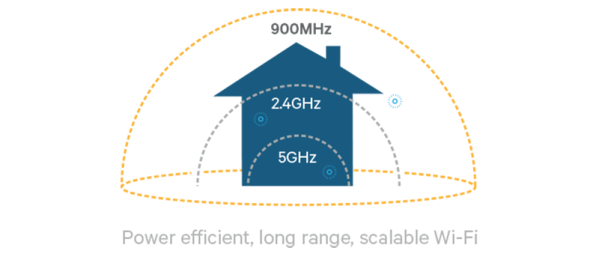
For the last decade or so, wireless networking has been entirely about short range, high speed communications. The type of networking needed by an Internet of things is fundamentally incompatible with WiFi, and the reason for this is due to the frequencies used by WiFi networking gear. 2.4 and 5 GHz are very fast, but cannot penetrate through walls as easily as lower frequencies.

This week the WiFi alliance introduced IEEE 802.11ah into the WiFi spec. It’s called WiFi HaLow (pronounced like angel’s headwear), and unlike other versions of 802.11, WiFi HaLow uses low frequencies for low bandwidth but a much larger range.

WiFi HaLow uses the 900 MHz ISM band to communicate, divided into 26 channels. The bandwidth is low – a mere 100 kbps, but the range is huge: one kilometer, or about four times the approximate range of 802.11n.

This is not the only WiFi spec aimed at the Internet of Things. In 2014, the WiFi alliance introduced 802.11af, a networking protocol operating in unused TV whitespace spectrum between 54 and 790 MHz. 802.11af has a similar range as 802.11ah – about one kilometer – but products and chips utilizing 802.11af have been rare and hard to find.

Henry Smolinski And The Flying Pinto

Anyone who has ever been stuck in gridlock has probably daydreamed about pushing a button on the dashboard that turns their car into a plane. Imagine how much more relaxing a weekend getaway would be if you could take to the open sky instead hitting the congested highway. For as long as there have been aircraft and automobiles, man has tried to combine the two. The proper term for this marriage is ‘roadable aircraft’, and a successful one requires attention to the aerodynamics of flight as well as the rigors of motoring.

One promising attempt at a roadable aircraft came from Henry Smolinski, an aeronautical engineer in Van Nuys, California. He along with his friend Harold Blake started a company in 1971 called Advanced Vehicle Engineers (AVE) to produce the AVE Mizar. This flying car combined the lightweight Ford Pinto with the wings and partial fuselage of a Cessna Skymaster.

Continue reading “Henry Smolinski And The Flying Pinto”

Paddy Neumann’s Bounce Per Ounce Is Better Than NASA’s

[Paddy Neumann] is an Australian physicist and founder of Neumann Space, a space start-up with a record-breaking ion drive.

The team at Neumann Space built an ion engine that broke the previous specific impulse (bounce per ounce) record. NASA’s HIPEP thruster previously held this record with a specific impulse of ~9600 seconds (+/- 200 seconds). The Neumann Drive’s specific impulse as recorded by the University of Sydney was ~14,690 seconds (+/- 2,000 seconds). This all equates to better efficiency by the Neumann Drive, however its acceleration does not match that of the HIPEP.

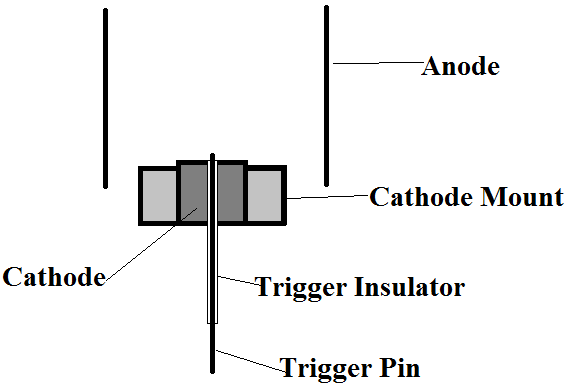
CathodeGraphic
Simplified ion engine diagram courtesy of Neumann Space

The Neumann Drive has another unique advantage in its range of usable fuels. In comparison to the HIPEP which uses Xenon gas as fuel the Neumann Drive accepts a variety of metals including: Molybdenum, Magnesium, Aluminum, Carbon, Titanium, Vanadium, Tin, last and also least according to Neumann Space is Bismuth.

Interestingly, Neumann offered his intellectual property (IP) to the University of Sydney, since the research was done at the University but they passed on the offer. This allowed the IP to be returned to Paddy and he subsequently applied for a patent and began the search for funding for continued research.

Here at Hackaday we like space, in fact we’ve offered to send you to space more than once with the Hackaday Prize. We also enjoy amateur rocketry and young rocket scientists.