Shmoocon 2016: Computing In A Post Quantum World

There’s nothing more dangerous, so the cryptoheads say, than quantum computing. Instead of using the state of a transistor to hold the value of a bit as in traditional computers, quantum computers use qubits, or quantum information like the polarization of a photon. According to people who know nothing about quantum computers, they are the beginning of the end, the breaking of all cryptography, and the Rise of the Machines. Lucky for us, [Jean-Philippe Aumasson] actually knows a thing or two about quantum computers and was able to teach us a few things at his Shmoocon talk this weekend, “Crypto and Quantum and Post Quantum”

This talk is the continuation of [Jean-Philippe]’s DEF CON 23 talk that covered the basics of quantum computing (PDF) In short, quantum computers are not fast – they’re just coprocessors for very, very specialized algorithms. Quantum computers do not say P=NP, and can not be used on NP-hard problems, anyway. The only thing quantum computers have going for them is the ability to completely destroy public key cryptography. Any form of cryptography that uses RSA, Diffie-Hellman, Elliptic curves is completely and totally broken. With quantum computers, we’re doomed. That’s okay, according to the DEF CON talk – true quantum computers may never be built.

The astute reader would question the fact that quantum computers may never be built. After all, D-Wave is selling quantum computers to Google, Lockheed, and NASA. These are not true quantum computers. Even if they’re 100 Million times faster than a PC, they’re only faster for one very specific algorithm. These computers cannot simulate a universal quantum computer. They cannot execute Shor’s algorithm, an algorithm that finds the prime factors of an integer. They are not scalable, they are not fault-tolerant, and they are not universal quantum computers.

As far as true quantum computers go, the largest that has every been manufactured only contain a handful of qubits. To crack RSA and the rest of cryptography, millions of qubits are needed. Some algorithms require quantum RAM, which nobody knows how to build. Why then is quantum computing so scary? RSA, ECC, Diffie-Hellman, PGP, SSH and Bitcoin would die overnight if quantum computers existed. That’s a far scarier proposition to someone hijacking your self-driving car or changing the display on a smart, Internet-connected thermostat from Fahrenheit to Celsius.

What is the verdict on quantum computers? Not too great, if you ask [Jean-Philippe]. In his opinion, it will be 100 years until we have a quantum computer. Until then, crypto is safe, and the NSA isn’t going to break your codez if you use a long-enough key.

Wolfenstein In 600 Lines Of Code

What’s more impressive, the fact that this Wolfenstein-like game is 600 lines of code, or that it’s written in AWK?

AWK is a language primarily used for text processing. But if you can write code the world bows to your wishes. [Fedor Kalugin] leverages the ability of a Linux terminal’s color options to draw his game. The 3D aspect is produced through ray-casting which generates a 2D image from 3D coordinates.

Trying out the game is extremely simple, install gawk, clone the repo, and play:

Continue reading “Wolfenstein In 600 Lines Of Code” →

Software Controlled Hard Drive Solenoid Engine

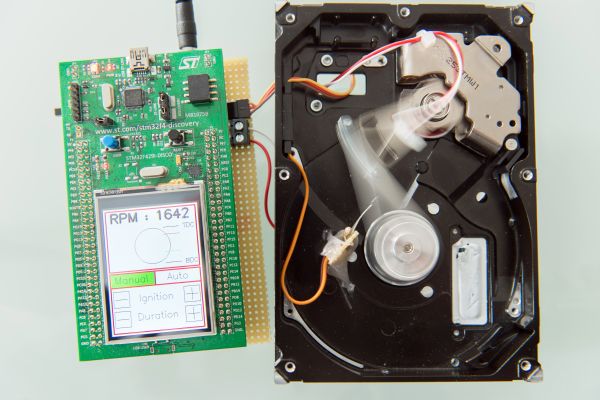
[Fabien-Chouteau] submitted his interesting solenoid engine. In an internal combustion, steam, or pneumatic piston engine, the motive force is produced by expanding gas. In [Fabien]’s little engine it is produced by the arm of a hard drive. Solenoid engines are usually just for show, and come in all shapes and sizes. If you want to move something using electricity an axial motor is probably a better bet. But if you want a challenge and a learning experience, this is hard to beat.

[Fabien] had some problems to solve before his motor made its first revolution. Just like a piston engine the timing needed to be exact. The arm firing at the wrong time could cause all sorts of trouble, the equivalent of backfire in a combustion engine. A STM32f4 discovery board was coupled with a Hall-effect sensor and a MOSFET. When the board read that the arm has moved back to the most efficient position for firing it sent a pulse through the coil. Just like a regular engine, getting the timing right makes all the difference. Once [Fabien] got it tuned up his motor could spin around at a steady 3000 rpm.

Continue reading “Software Controlled Hard Drive Solenoid Engine” →

Failaffle

Fail Of The Week: Not All Mold Releases Release All Molds.

I’m writing a series of articles on resin casting as an extension to my experiences with the instructions found in the wonderful Guerrilla Guide. However, mistakes were made. Having run out of my usual mold release I went to a back-up jar that was lying around from a casting project long, long ago in a workshop far, far away.

GLUE
Never much for readin’ the nutrition facts myself.

I’m refining a technique of making a mold the quick and dirty way. Everything was going well, the sprues looked good and the master released from the silicone. It was time to do the second half of the mold. As usual I applied a generous amount of mold release. Since it was the first time this mold was to be used I went ahead and did all the proper steps. Rubbing off the dried release and applying a few more coats just to be sure.

I was completely unaware that I was applying mold release designed for urethane molds only. In other words I thoroughly covered my silicone mold in silicone bonding agents. I remained unaware until trying to separate the halves of the mold and found them thoroughly joined. After going through the stages of grief I finally figured out where it all went wrong.

Oh well. I’m ordering some of my regular pick, Stoner A324, and that should do the trick. There’s also Mann- Ease Release 200. While having probably the best name a release agent can have, it doesn’t work as well and needs approximately 100 years to dry. After this setback I’d rather just, grudgingly, learn my lesson and order the correct thing.

I wonder if the smooth-on description can say URETHANE RUBBER a few more times.
Oh. Yes I see. Urethane… Urethane…

So now that we know the right way to fix this is to order the right product, is there a hack to get around it? Does anyone have a homebrew trick for release agent that can be used in a pinch? Leave your comments below.

My Payphone Runs Linux

For the 20th anniversary of the Movie “Hackers” [Jamie Zawinski], owner of DNA Lounge in San Francisco, threw an epic party – screening the movie, setting up skating ramps and all that jazz. One of the props he put up was an old payphone, but he didn’t have time to bring it alive. The one thing he didn’t want this phone to do was to be able to make calls. A couple of weeks later, he threw another party, this time screening “Tank Girl” instead. For this gathering he had enough time to put a Linux computer inside the old payphone. When the handset is picked up, it “dials” a number which brings up a voice mail system that announces the schedule of events and other interactive stuff. As usual, this project looked simple enough to start with, but turned out way more complicated than he anticipated. Thankfully for us, he broke down his build in to bite sized chunks to make it easy for us to follow what he did.

This build is a thing of beauty, so let’s drill down into what the project involved:

Continue reading “My Payphone Runs Linux” →

Hams In Space: Project OSCAR

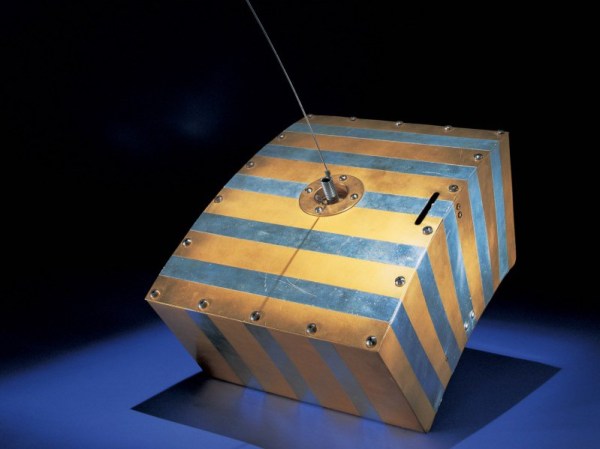
In early December 1961, a United States Air Force rocket took off from Vandenberg Air Force Base in California carrying a special payload. The main payload was a Corona surveillance satellite, but tucked just aft of that spacecraft was a tiny package of homebrew electronics stuffed into something the looked like a slice of cake. What was in that package and how it came to tag along on a top-secret military mission is the story of OSCAR 1, the world’s first amateur radio satellite.

Continue reading “Hams In Space: Project OSCAR” →

Inject Packets With An ESP8266

[Kripthor] sent us a link to his blog where he writes the Hello World of low-level networking. Basically he’s constructing his own packet and sending it. By itself this isn’t a bad thing. You could use this power for all sorts of networks-diagnostic good. And so, despite the ominous name of his blog post “ESP8266 Jamming”, he’s not really doing anything that bad — he’s just creating many fake WiFi beacon frames and sending them out every so often.

Which can apparently do bad things to some vulnerable routers. Who knew? Want to test yours?

Naturally we wanted to see how he was doing it, and we opened up the Arduino code in GitHub. It turns out that Espressif has written a wifi_send_pkt_freedom() function that just sends out whatever packet you’d like to the network. That was easy.

It also turns out that the ESP8266 will enter monitor mode, where it listens to all WiFi traffic regardless of the MAC address that it’s directed toward. [Pulkin] seems to have done the work for us and posted the code in his GitHub. Now things get nasty. Combining promiscuous monitor mode with some carefully constructed management frames can end up with a classic WiFi deauth denial-of-service attack on a $2 piece of hardware.

We think it’s tremendously cool that the ESP8266 packs such power, and we beg you all to use it responsibly. The last thing we want to see is the world littered with WiFi-DOS throwies. And the last thing you’d want is a visit from the FCC.