Learning Verilog For FPGAs: Hardware At Last!

Getting into FPGA design isn’t a monolithic experience. You have to figure out a toolchain, learn how to think in hardware during the design, and translate that into working Verliog. The end goal is getting your work onto an actual piece of hardware, and that’s what this post is all about.

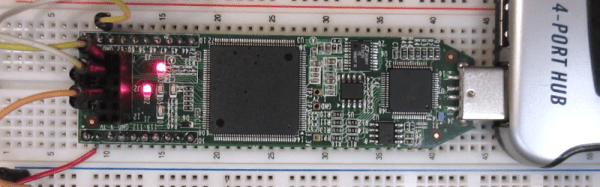
In the previous pair of installments in this series, you built a simple Verilog demonstration consisting of an adder and a few flip flop-based circuits. The simulations work, so now it is time to put the design into a real FPGA and see if it works in the real world. The FPGA board we’ll use is the Lattice iCEstick, an inexpensive ($22) board that fits into a USB socket.

Like most vendors, Lattice lets you download free tools that will work with the iCEstick. I had planned to use them. I didn’t. If you don’t want to hear me rant about the tools, feel free to skip down to the next heading.

Continue reading “Learning Verilog For FPGAs: Hardware At Last!”

Ubuntu Core Supports Raspberry Pi 2 I/O

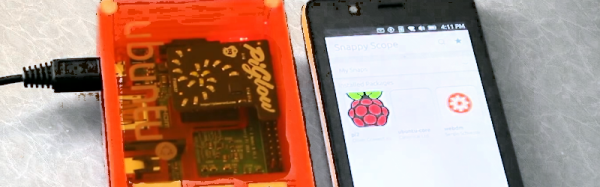
Although it isn’t official, Ubuntu Core–the tiny Internet of Things version of Ubuntu–now runs on the Raspberry Pi 2. There are prebuilt binaries as well as instructions for how to roll your own, if you prefer. You can even access GPIO

Ubuntu Core abandons the old-style Debian packages, in favor of Snap, a new version of the Ubuntu phone’s Click package manager. Snap offers transactional updates. The idea is that all of these “things” on the IoT need to be updated to patch security holes or fix other issues.

Continue reading “Ubuntu Core Supports Raspberry Pi 2 I/O”

Sphero Riding Strandbeest Is A Robot With An Exoskeleton

[Theo Jansen] makes awesome things called Strandbeests; wind-driven automatons that roam beaches and art galleries. It has long been one of our favorite mechanisms. Newer, but also a favorite is the Sphero smartphone controlled orb. The combination of the two is epic!

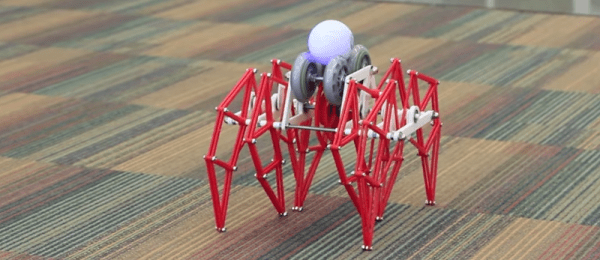
You may remember seeing Sphero used to create a tiny BB8 replica. Inside the orb is a tiny robot capable of rolling itself hamster-wheel-style in any direction. It’s a rather powerful bot and that makes Sphero fast. The high RPM is what makes this hack possible. Sphero spins rapidly while perched on some rollerblade wheels. Gearing converts this to the rolling motion of the Strandbeest.

The original concept was posted a year ago but it was just now brought to our attention by [fhareide]  who is working on his own smaller Strandbeest driven by a Sphero. Since there are no assembly details on the original posting, you can follow along with [fhareide’s] documentation in order to complete your own build. So far [fhareide] imported the STL model into Autodesk Inventor, printed out one set of gears to insure the printer resolution could handle it, and assembled one set of legs.
We think of this as a kind of exoskeleton for a Sphero. We’ll keep an eye on this through the assembly, testing the drive mechanism and then the point where the whole thing becomes self-aware and either runs away to hide or terminates him.

Continue reading “Sphero Riding Strandbeest Is A Robot With An Exoskeleton”

Raspberry Pi Halt And Catch… Well, Halt

As far back as we can remember, there have always been hacks, exploits, and just curiosity about undocumented CPU instructions. The Z80 had them. Even the HP41C calculator had some undocumented codes. The HCF (Halt and Catch Fire) instruction was apocryphal, but we always heard the old video controller chips could be coaxed into blowing up certain monitors. You don’t hear too much about things like that lately, perhaps because fewer people are working in assembly language.

[Sergi Àlvarez i Capilla] not only works in assembly language, he was writing an ARM assembler when he noticed something funny. Instructions are built in a regular pattern and some of the patterns were missing. What to do? [Sergi] lost no time trying them out.

Continue reading “Raspberry Pi Halt And Catch… Well, Halt”

Two New FPGA Families, Designed In China

The two largest manufacturers of FPGAs are, by far, Altera and Xilinx. They control over 80% of the market share, with Lattice and others picking up the tail end. The impact of this can be seen in EE labs and alibaba; nearly every FPGA dev board, every instructional, and every bit of coursework is based on Altera or Xilinx chips.

There’s a new contender from the east. Gowin Semiconductor has released two lines of FPGAs (Google translate) in just under two years. That’s incredibly fast for a company that appears to be gearing up to take on the Altera and Xilinx monolith.

The FPGA line released last week, the GW1N family, is comprised of two devices with 1,152 and 8,640 LUTs. These FPGAs are built on a 55nm process, and are meant to compete with the low end of Altera’s and Xilinx’ offerings. This adds to Gowin’s portfolio introduced last May with the GW2A (Google translate) family, featuring devices ranging from 18,000 to 55,000 LUTs and DSP blocks. Packages will range from easily solderable QFN32 and LQFP100, to BGA packages with more pins than an eighteenth century seamstress at the royal ball.

For comparison, Xilinx’ Spartan-6 LX family begins with devices featuring 3,840 LUTs and 216kb of block RAM, with larger devices featuring 147,443 LUTs and up to 268kb of block RAM. Altera’s Cyclone IV E devices are similarly equipped, with devices ranging from 6,272 to 114,480 LUTs. Between the two device families introduced by Gowin recently, nearly the entire market of low-end FPGAs is covered, and they’re improving on the current offerings: the GW1N chips feature random access on-chip Flash memory. Neither the low-end devices from Altera nor devices from Lattice provide random-access Flash.

The toolchain for Gowin’s new FPGAs is based nearly entirely on Synopsys’ Synplify Pro, with dedicated tools from Gowin for transforming HDL into a bitstream for the chip. This deal was inked last year. As for when these devices will make it to market, Gowin is hoping to send out kits to well-qualified devs soon, and the devices may soon show up in the warehouses of distributors.

Gowin’s FPGAs, in contrast to the vast, vast majority of FPGAs, are designed and fabbed in China. This gives Gowin a unique home-field advantage in the land where everything is made. With LVDS, DSP, and other peripherals these FPGAs can handle, Gowin’s offerings open up a wide variety of options to developers and product engineers a few miles away from the Gowin plant.

The GW1N and GW2A families of FPGAs are fairly small when it comes to the world of FPGAs. This limitation is by capability though, and not number of units shipped. It’s nearly tautological that the largest market for FPGAs would be consumer goods, and Gowin is focusing on what will sell well before digging in to higher end designs. We will be seeing these chips show up in devices shortly, and with that comes a new platform to tinker around with.

If you’re looking to make your mark on the world of open source hardware and software, you could do worse than to start digging into the synthesis and bitstream of these Gowin chips. Just months ago, Lattice’s iCE40 bitstream was reverse engineered, and already there are a few boards capitalizing on a fully open source toolchain for programmable logic. With more capable FPGAs coming out of China that could be stuffed into every imaginable product, it’s a golden opportunity for hardware hackers and developers alike.

[Thanks for the tip Antti]

Robots Are Coming For Our Jobs. Just Not All Of Them.

There is a lot to be said for replacing certain kinds of jobs with robots. Most people would agree that replacing physical human labor with automation is a good thing. It’s especially good to automate the dangerous kinds of labor like some facets of factory work. What about automation in fields that require more mental labor, where physical strain isn’t the concern? Is replacing humans really the best course of action? A year ago, a video called Humans Need Not Apply set forth an explanation of how robots will inevitably replace us. But that narrative is a tough sell.

Whether it is even possible depends on the job being automated. It also depends on how far we are able to take technology, and the amount of labor we are willing to offload. Automation has been replacing human workers in assembly and manufacturing industries for years. Even with equipment and upkeep expenses, the tireless nature of robotic workers means dramatically lower overhead for businesses.

Many of the current forms of factory automation are rather dumb. When something goes wrong and their task is compromised, they keep chugging away. That costs time and money. But there are companies out there producing robots that are better on many levels.

May Your Robot Overlords Be Cute and Cuddly

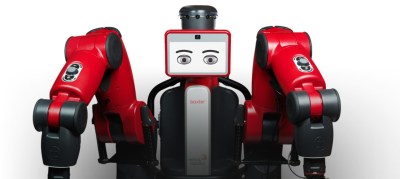
baxter-heroIn 2013, Rethink Robotics started filling orders for a new line called Baxter. They are a class of general purpose robot that can be programmed to do many kinds of manual tasks. Baxter bots have vision, and they can learn how to do a job simply by watching. They don’t need to be programmed in the traditional sense.

Baxter even has a face – a screen that shows different expressions depending on his state. When he’s in the midst of a task, his eyes are cast downward. If something goes wrong, he stops what he’s doing. His cartoon face appears sort of shocked, then sad. He goes into safe mode and waits to be fixed.

Continue reading “Robots Are Coming For Our Jobs. Just Not All Of Them.”

Hilarious DARPA Robots Falling Video

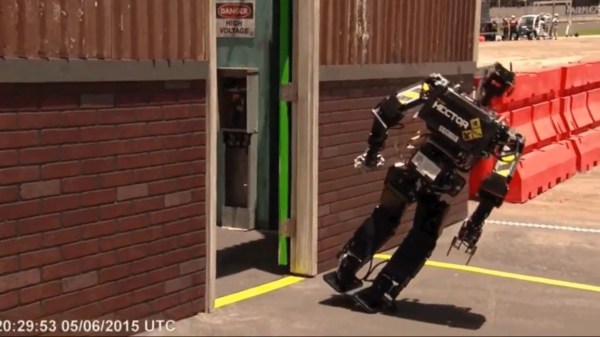
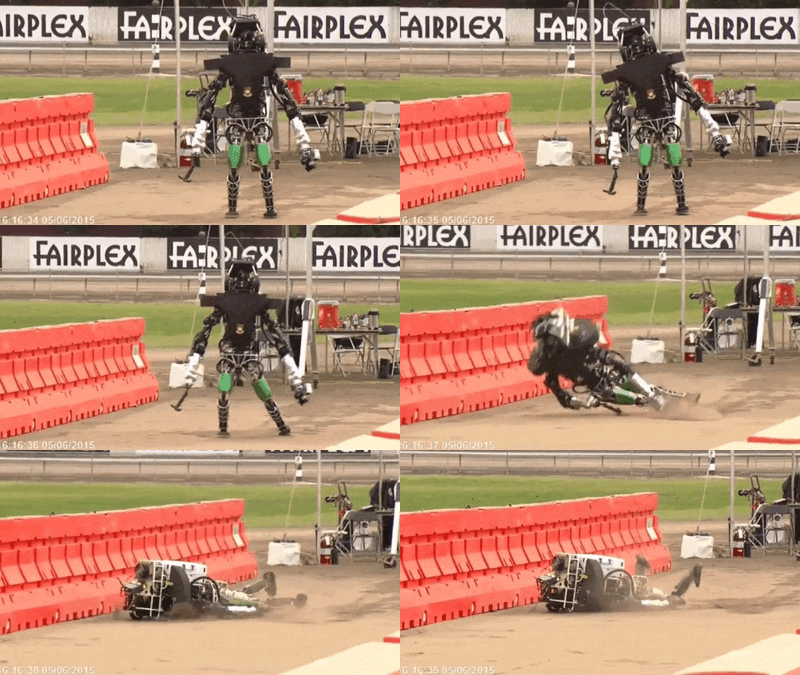
If you’re worried about Skynet, take a quick gander at the outtakes reel (YouTube, inlined below the break) from the DARPA Robotics Challenge (DRC) and you’ll feel a lot better. The IEEE Spectrum reporters assigned to the DRC took a break from their otherwise serious coverage and made this funny compilation of all the multi-million dollar robotic fails to go along with this article.

robot_fallingIt’s hard not to empathize with the robots, and we’ll admit that we winced a little bit with the first couple falls. (But after three or four, started breaking out in maniacal laughter.)

Continue reading “Hilarious DARPA Robots Falling Video”