Police LiDAR Tear Down

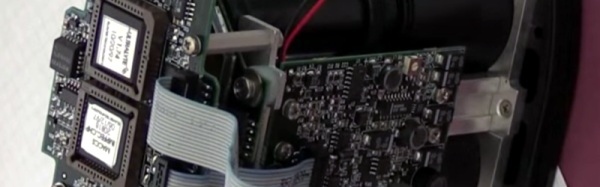
Most police departments made a big switch from RADAR to LiDAR after consumers starting buying RADAR detectors. A lot of those LiDAR units are now out there on the surplus market. If you don’t have $500 or so to buy a LiDAR gun just to see what makes it tick, you are in luck. [Alexei Polkhanov] spent an hour tearing down a  UltraLyte LTI 20-20 LR 100 so you don’t have to.

An hour seems like a lot for a tear down video, but [Alexei] speeds up through the boring parts, and spends a lot of time talking about the optics and how the device works (with a lot of hand drawn diagrams). He also puts it back together and connects  a scope to show the electronic operation of the device.

He mentions the display and control board uses a serial interface to talk to the controller board. There is also an unpopulated header on the main board that is clearly a serial port, probably for reprogramming the onboard microcontroller. With a little reverse engineering work, this LiDAR gun ought to be highly hackable.

In addition to the display and control board, the unit contains a high voltage supply for the laser and the photodiode. Making a power supply to drive the laser that is clean enough not to disturb the sensor is one of the design drivers and it shows. The power supply is a large and complex board by comparison to the other boards in the system.

Continue reading “Police LiDAR Tear Down”

A Bridge Made Of Aircraft Carriers Will Make [William Gibson] Proud

If you’ve ever visited the Puget Sound (the area in and around Seattle, Washington) one thing becomes clear very quickly; It’s not easy to get around when there’s water everywhere. Perhaps that’s why Washington State operates the largest ferry system in all of the U.S., carrying about 23 million passengers each year. It’s not uncommon here to drive (or walk) onto a ferry for a nice boat ride before getting to wherever you need to be.

Another thing the Puget Sound has is naval ship yards. The U.S. Navy has a strong presence here. It’s where many submarines and aircraft carriers come for regular maintenance, as well as decommissioned ships that are stripped of their top secrets parts and nuclear bits. At any given time there can be four or five “slightly used, previously owned” massive aircraft carriers that are that are considered to be in the “reserve fleet” (that is, they can be brought back into service in the case of war.) But usually after a few years pass, and a new carriers are built, the Pentagon will send the floating air field to be dismantled.

Well, someone put two and two together and came up with the idea to use them as a floating bridge – and it’s an interesting hack indeed. Currently the State of Washington is studying the idea, but hasn’t made any firm plans just yet. They have their eye set on a span of water that would need 2-3 aircraft carriers to cover, and that is near the Puget Sound Naval Shipyard. The massive size and over hangs of the ships will still allow for tidal moment, and for local sail boats and pleasure craft to pass between. The hope is that it will be both a traffic solution, and a tourist attraction; not to mention preserving 50 year old ships, that are in many cases, are part of naval history.

We’re not sure if such an idea is practical or not, but our inner Top Gun “Maverick” would love to see such a hack pulled off. And it’s really hard not to make the association with some of the locales imagined in [William Gibson’s] epic work. Will we see the should-be-science-fiction bridge become real? Ooooh how we hope so!

[via dailymail.co.uk]

29 Year Old Apple Computer Finally Gets An OS Update

The Apple IIGS is the 16 bit upgrade to the popular 8 bit Apple II computer line, and with its massive boost in graphics, an Ensoniq sound system, and backwards compatibility with the 8 bit machines makes this box desirable to many retro enthusiast. The last OS update, 6.0.1, was released over 22 years ago. While it worked well for the early 90s, it was by no means perfect.

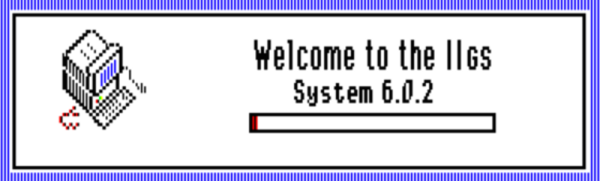
Last Sunday, a post popped up on callapple.org, announcing Apple IIgs System 6.0.2. Updates include a driver for the unreleased Apple II Ethernet card,  fixes various bugs in the file system translation system, various bugfixes to existing system programs,  fast drawing and animation tools, and of course an update to the finder to show the new revision number.

With a hope for even more bug fixes in a possible 6.0.3 revision its good to see people still giving the old Apple II line some love, as the old Apples don’t have as large of a following as their Atari and Commodore brethren.

How To Build A ProxyHam Despite A Cancelled DEFCON Talk

A few days ago, [Ben Caudill] of Rhino Security was scheduled to give a talk at DEFCON. His project, ProxyHam, is designed for those seeking complete anonymity online. Because IP addresses can be tied to physical locations, any online activities can be tracked by oppressive regimes and three letter government agencies. Sometimes, this means doors are breached, and “seditious” journalists and activists are taken into custody.

With the ProxyHam, the link between IP addresses and physical locations is severed. ProxyHam uses a 900MHz radio link to bridge a WiFi network over miles. By hiding a ProxyHam base station in a space with public WiFi, anyone can have complete anonymity online; if the government comes to take you down, they’ll first have to stop at the local library, Starbucks, or wherever else has free WiFi.

[Ben Caudill] will not be giving a talk at DEFCON. It wasn’t the choice of DEFCON organizers to cancel the talk, and it wasn’t his employers – [Ben] founded and is principal consultant at Rhino Security. The talk has been killed, and no one knows why. Speculation ranges from National Security Letters to government gag orders to a far more pedestrian explanations like, “it doesn’t work as well as intended.” Nevertheless, the details of why the ProxyHam talk was cancelled will never be known. That doesn’t mean this knowledge is lost – you can build a ProxyHam with equipment purchased from Amazon, Newegg, or any one of a number of online retailers.

Continue reading “How To Build A ProxyHam Despite A Cancelled DEFCON Talk”

New Part Day: The ESP8266 Killer

Around this time last year we first heard of the ESP8266 WiFi module. It’s still a great little module, providing WiFi connectivity for all those Internet of Things things at a price point of just $5. It’s an attractive price for a great module with a huge community pumping out a lot of projects for the platform.

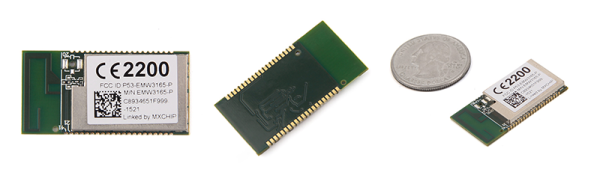
Now there’s a new kid on the block. It’s called the EMW3165, and like the ESP it provides WiFi connectivity for a bunch of wireless projects. It’s much, much more capable with an STM32F4 ARM Coretex M4 microcontroller, a ‘self hosted’ networking library, more RAM, more Flash, and more GPIOs. How much, you’re probably asking yourself. It’s a dollar more than the ESP8266.

The datasheet for the module goes over all the gritty details. While this chip has 3.6V I/Os, there are some 5V tolerant pins – a boon for the Arduino crowd. It’s also surprisingly low power for something that connects to an 802.11n network. The real bonus here is the STM32F4 core – that’s a very, very powerful microcontroller, and if you want a 2-component WiFi webcam build, this is the part you should use. There will be a lot of interesting builds using this part. It’s also passed FCC certification. Very cool.

Micro:bit — BBC Gets A Million Kids Into Embedded Dev

In the Early 1980s, the BBC launched a project to teach computer literacy to a generation of British schoolchildren. This project resulted in the BBC Micro, a very capable home computer that showed a generation exactly what a computer could do. These children then went home, turned on their ZX Spectrums, and became a generation of software engineers. Still, the BBC Micro is remembered fondly.

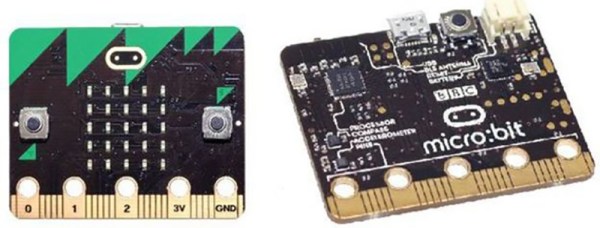
The computer revolution is long over, but today we suffer a sea change of embedded processors and microcontrollers. With Arduinos and Raspberry Pis, the BBC has decided it’s time to put the power of an ARM microcontroller into the hands of a million 11- and 12-year olds. The result is the Micro:bit. It’s a small microcontroller board with an ARM processor, an IMU, buttons, Bluetooth and a 5×5 LED array – exactly what you need if you’re teaching a million kids how to blink an LED.

Although the BBC has finalized the design for the Micro:bit, there are no specs at all. However, a few educated guesses can be made. The USB controller is provided by Freescale, who also provide the digital compass and magnetometer. Programming is done through a web-based, Arduino-like IDE with what appears to be a decent Micro:bit specific library. The board is also mbed compatible. Bluetooth, and apparently the ARM Cortex M0 core, is provided by a Nordic nRF51822. There are only three alligator clip-compatible I/Os, and its doubtful any student will be building anything that would be too complex for an entry level ARM. It’s also 3V logic; finally, the tyranny of 5V has fallen.

The Micro:bit is best seen as a tool that enables the relatively recent addition of a computer science curriculum in UK schools. There is now a requirement for seven-year-olds to understand algorithms and create simple programs. Previously computer education in the UK has consisted of PowerPoint. Now, secondary school students will be learning Boolean logic.

While the Micro:bit is utterly useless as a tool for doing real work, education is not real work. For blinking a few LEDs, having a device react to movement, playing with Bluetooth, and other lesser evils of electronics, the Micro:bit is great. Not everyone will become the digital technologists this initiative is trying to create, but for those who have an inclination towards semicolons and electrons, this is a great introduction to technology.

Logic Noise: Ping-pong Stereo, Mixers, And More

So far on Logic Noise, we’ve built up a bunch of sound-making voices and played around with sequencing them. The few times that we’ve combined voices together, we’ve done so using the simplest possible passive mixer — a bunch of resistors. And while that can work, we’ve mostly just gotten lucky. In this session, we’ll take our system’s output a little bit more seriously and build up an active mixer and simple stereo headphone driver circuit.

For this, we’ll need some kind of amplification, and our old friend, the 4069UB, will be doing all of the heavy lifting. Honestly, this week’s circuitry is just an elaboration of the buffer amplifiers and variable overdrive circuits we looked at before. To keep things interesting we’ll explore ping-pong stereo effects, and eventually (of course) put the panning under logic-level control, which is ridiculous and mostly a pretext to introduce another useful switch IC, the 4066 quad switch.

At the very end of the article is a parts list for essentially everything we’ve done so far. If you’ve been following along and just want to make a one-time order from an electronics supply house, check it out.

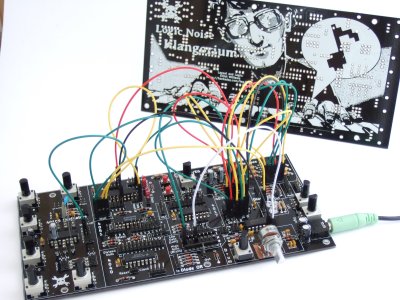
klangoriumIf you’re wondering why the delay in putting out this issue of Logic Noise, it’s partly because I’ve built up a PCB that incorporates essentially everything we’ve done so far into a powerhouse of a quasi-modular Logic Noise demo — The Klangorium. The idea was to take the material from each Logic Noise column so far and build out the board that makes experimenting with each one easy.

Everything’s open and documented, and it’s essentially modular so you can feel free to take as much or as little out of the project as you’d like. Maybe you’d like to hard-wire the cymbal circuit, or maybe you’d like to swap some of the parts around. Copy ours or build your own. If you do, let us know!

OK, enough intro babble, let’s dig in.

Continue reading “Logic Noise: Ping-pong Stereo, Mixers, And More”