Operation Backfire: Witness To The Rocket Age

As the prospects for Germany during the Second World War began to look increasingly grim, the Nazi war machine largely pinned their hopes on a number of high-tech “superweapons” they had in development. Ranging from upgraded versions of their already devastatingly effective U-Boats to tanks large enough to rival small ships, the projects ran the gamut from practical to fanciful. After the fall of Berlin there was a mad scramble by the Allied forces to get into what was left of Germany’s secretive development facilities, with each country hoping to recover as much of this revolutionary technology for themselves as possible.
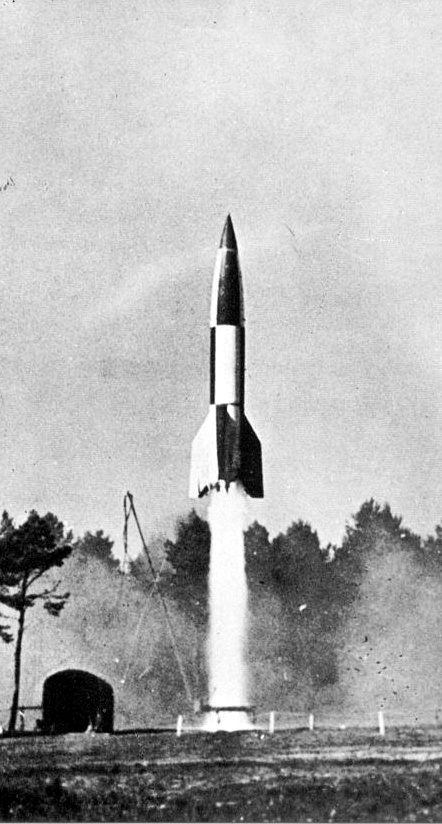
V-2 launch during Operation Backfire

One of the most coveted prizes was the Aggregat 4 (A4) rocket. Better known to the Allies as the V-2, it was the world’s first liquid fueled guided ballistic missile and the first man-made object to reach space. Most of this technology, and a large number of the engineers who designed it, ended up in the hands of the United States as part of Operation Paperclip. This influx of practical rocketry experience helped kick start the US space program, and its influence could be seen all the way up to the Apollo program. The Soviet Union also captured V-2 hardware and production facilities, which subsequently influenced the design of their early rocket designs as well. In many ways, the V-2 rocket was the spark that started the Space Race between the two countries.

With the United States and Soviet Union taking the majority of V-2 hardware and personnel, little was left for the British. Accordingly their program, known as Operation Backfire, ended up being much smaller in scope. Rather than trying to bring V-2 hardware back to Britain, they decided to learn as much as they could about it in Germany from the men who used it in combat. This study of the rocket and the soldiers who operated it remains the most detailed account of how the weapon functioned, and provides a fascinating look at the incredible effort Germany was willing to expend for just one of their “superweapons”.

In addition to a five volume written report on the V-2 rocket, the British Army Kinematograph Service produced “The German A.4 Rocket”, a 40 minute film which shows how a V-2 was assembled, transported, and ultimately launched. Though they are operating under the direction of the British government, the German soldiers appear in the film wearing their own uniforms, which gives the documentary a surreal feeling. It could easily be mistaken for actual wartime footage, but these rockets weren’t aimed at London. They were being fired to serve as a historical record of the birth of modern rocketry.

Continue reading “Operation Backfire: Witness To The Rocket Age”

The Thrill Of Building Space Hardware To Exceptionally High Standards

It’s fair to say that the majority of Hackaday readers have not built any hardware that’s slipped the surly bonds of Earth and ventured out into space proper. Sure we might see the occasional high altitude balloon go up under the control of some particularly enterprising hackers, but that’s still a far cry from a window seat on the International Space Station. Granted the rapid commercialization of space has certainly added to that exclusive group of space engineers over the last decade or so, but something tells us it’s still going to be quite some time before we’re running space-themed hacks with the regularity of Arduino projects.

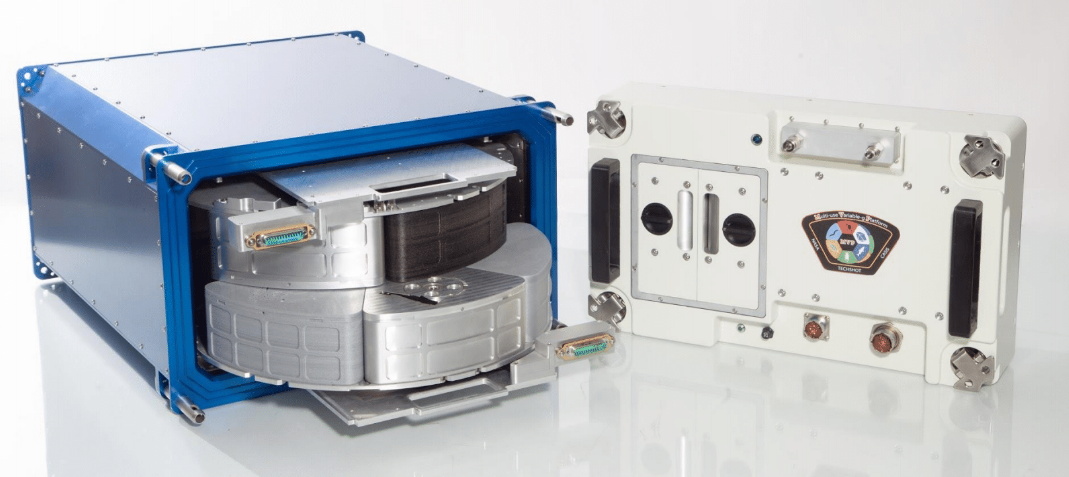
Multi-use Variable-G Platform

That being the case, you might assume the protocols and methods used to develop a scientific payload for the ISS must seem like Latin to us lowly hackers. Surely any hardware that could potentially endanger an orbiting outpost worth 100+ billion dollars, to say nothing of the human lives aboard it, would utilize technologies we can hardly dream of. It’s probably an alphabet soup of unfamiliar acronyms up there. After all, this is rocket science, right?

There’s certainly an element of truth in there someplace, as hardware that gets installed on the Space Station is obviously held to exceptionally high standards. But Brad Luyster is here to tell you that not everything up there is so far removed from our Earthly engineering. In fact, while watching his 2018 Hackaday Superconference talk “Communication, Architecture, and Building Complex Systems for SPAAACE”, you might be surprised just how familiar it all sounds. Detailing some of the engineering that went into developing the Multi-use Variable-G Platform (MVP), the only centrifuge that’s able to expose samples to gravitational forces between 0 and 1 g, his talk goes over the design considerations that go into a piece of hardware for which failure isn’t an option; and how these lessons can help us with our somewhat less critically important projects down here.

Check out Brad’s newly published talk video below, and then join me after the break for a look at the challenges of designing hardware that will live in space.

Continue reading “The Thrill Of Building Space Hardware To Exceptionally High Standards”

The Short And Tragic Story Of Life On The Moon

The Moon is a desolate rock, completely incapable of harboring life as we know it. Despite being our closest celestial neighbor, conditions on the surface couldn’t be more different from the warm and wet world we call home. Variations in surface temperature are so extreme, from a blistering 106 C (223 F) during the lunar day to a frigid -183 C (-297 F) at night, that even robotic probes struggle to survive. The Moon’s atmosphere, if one is willing to call the wispy collection of oddball gasses including argon, helium, and neon at nearly negligible concentrations an atmosphere, does nothing to protect the lunar surface from being bombarded with cosmic radiation.

Von Kármán Crater

Yet for a brief time, very recently, life flourished on the Moon. Of course, it did have a little help. China’s Chang’e 4 lander, which made a historic touchdown in the Von Kármán crater on January 3rd, brought with it an experiment designed to test if plants could actually grow on the lunar surface. The device, known as the Lunar Micro Ecosystem (LME), contained air, soil, water, and a collection of seeds. When it received the appropriate signal, LME watered the seeds and carefully monitored their response. Not long after, Chinese media proudly announced that the cotton seeds within the LME had sprouted and were doing well.

Unfortunately, the success was exceptionally short-lived. Just a few days after announcing the success of the LME experiment, it was revealed that all the plants which sprouted had died. The timeline here is a bit hazy. It was not even immediately clear if the abrupt end of the LME experiment was intentional, or due to some hardware failure.

So what exactly do we know about Chang’e 4’s Lunar Micro Ecosystem, and the lifeforms it held? Why did the plants die? But perhaps most importantly, what does all this have to do with potential future human missions to that inhospitable rock floating just a few hundred thousand kilometers away from us?

Continue reading “The Short And Tragic Story Of Life On The Moon”

The 1859 Carrington Event

Like many Victorian gentlemen of means, Richard Carrington did not need to sully himself with labor; instead, he turned his energies to the study of natural philosophy. It was the field of astronomy to which Carrington would apply himself, but unlike other gentlemen of similar inclination, he began his studies not as the sun set, but as it rose. Our star held great interest for Carrington, and what he saw on its face the morning of September 1, 1859, would astonish him. On that morning, as he sketched an unusual cluster of sunspots, the area erupted in a bright flash as an unfathomable amount of energy stored in the twisted ropes of the Sun’s magnetic field was released, propelling billions of tons of star-stuff on a collision course with Earth.

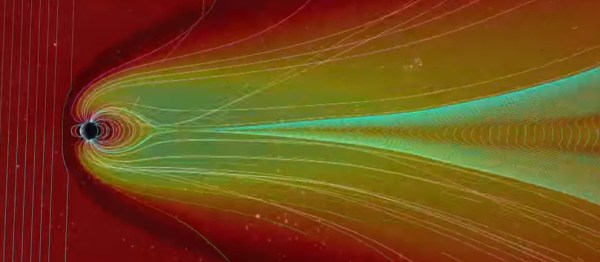
Carrington had witnessed a solar flare, and the consequent coronal mass ejection that would hit Earth just 17 hours later would result in a geomagnetic storm of such strength that it would be worldwide news the next day, and would bear his name into the future. The Carrington Event of 1859 was a glimpse of what our star is capable of under the right circumstances, the implications of which are sobering indeed given the web of delicate connections we’ve woven around and above the planet.

Continue reading “The 1859 Carrington Event”

Radio Telescopes Horn In With GNU Radio

Who doesn’t like to look up at the night sky? But if you are into radio, there’s a whole different way to look using radio telescopes. [John Makous] spoke at the GNU Radio Conference about how he’s worked to make a radio telescope (PDF) that is practical for even younger students to build and operate.

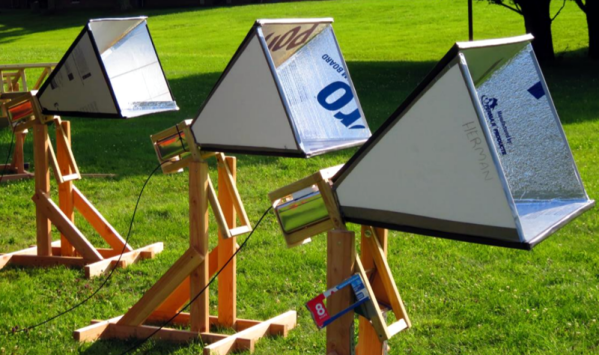
The only real high tech part of this build is the low noise amplifier (LNA) and the project is in reach of a typical teacher who might not be an expert on electronics. It uses things like paint thinner cans and lumber. [John] also built some blocks in GNU Radio that made it easy for other teachers to process the data from a telescope. As he put it, “This is the kind of nerdy stuff I like to do.” We can relate.

The telescope is made to pick up the 21 cm band to detect neutral hydrogen from the Milky Way. It can map the hydrogen in the galaxy and also measure the rotational speed of the galaxy using Doppler shift. Not bad for an upcycled paint thinner can. These are cheap enough, you can even build a fleet of them.

This would be a great project for anyone interested in radio telescopes or space. However, it is particularly set up for classroom use. Students can flex their skills in math, engineering, programming, and — of course — astronomy and physics.

Continue reading “Radio Telescopes Horn In With GNU Radio”

3D Printing An Entire Rocket

If you’re ever flying into LAX and have the left side window seat, just a few minutes before landing, look out the window. You’ll see a small airport just below you and what appears at first glance to be a smokestack. That’s not a smokestack, though: that’s a rocket, and that’s where SpaceX is building all their rockets. Already SpaceX has revolutionized the aerospace industry, but just down the street there’s another company that’s pushing the manufacturing of rocket engines a bit further. Relativity Space is building rockets. They’re 3D printing rocket engines, and they’re designing what could be the first rocket engine made on Mars.

Bryce Salmi is an avionics hardware engineer at Relatively Space, and he made it out to the 2018 Hackaday Superconference to tell us all about manufacturing rockets. It’s an entirely new approach to manufacturing rockets and rocket engines with a clean-slate design that could eventually be manufactured on Mars.

Continue reading “3D Printing An Entire Rocket”

DIY Guided Telescope Mount Tracks Like A Barn Door

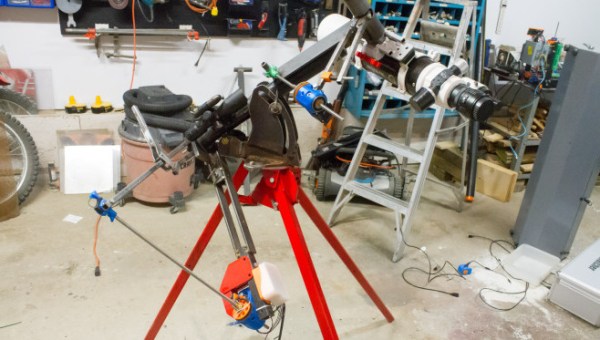
Astrophotography is an expensive hobby. When assembling even a basic setup consisting of a telescope, camera, guiding equipment and mount, you can easily end up with several thousand dollars worth of gear. To reduce the monetary sting a little, [td0g] has come up with an innovative homebrew mount and guiding solution that could be assembled by almost any dedicated amateur, with the parts cost estimated around $100. The accuracy required to obtain high-quality astrophotographs is quite demanding, so we’re impressed with what he’s been able to achieve on a limited budget.

The inspiration for this design comes from an incredibly simple star tracking device known as a barn-door tracker, or Haig mount. Invented by George Haig in the 1970’s, this mount is essentially nothing more than a hinge aligned with the Earth’s axis of rotation. A threaded rod or screw, turned at a constant rate, is used to slowly open the hinge so that a mounted camera tracks the apparent motion of the heavens. As a result, long exposures can show pinpoint images of stars and sharp details of deep-sky objects, instead of curved star trails. [td0g] adapted this technique to drive a more traditional telescope mount, using barn-door-like drive screws on both the right ascension and declination axes. A pair of NEMA 17 stepper motors drive 4-mm pitch Acme threaded rods through toothed pulleys 3D printed from PETG.

Speaking of 3D-printed parts, this build is a good example of judicious use of the technology: where metal parts are warranted, metal parts are used, and printed plastic is relegated to those places where it can adequately do the job. [td0g] has placed the STL files for the printed parts on Thingiverse in case you want to replicate the drive.

The non-linear relationship between the threaded rod rotation and right ascension drive rate usually limits the length of exposure you can reasonably achieve with a barn-door tracker. To adjust for this, [td0g] created a lookup table in firmware to compensate the drive and allow longer exposures. He mentions that the drive will operate for three hours before it hits the end of the screw’s travel and needs to be reset, but if he can manage three hour exposures, his skies must be much darker than ours!

Continue reading “DIY Guided Telescope Mount Tracks Like A Barn Door”