Student Rocket Makes It To Space

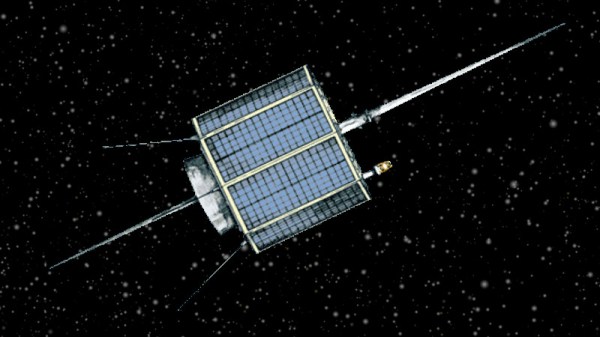
Where does the Earth’s atmosphere stop and space begin? It is tempting to take the approach Justice Potter Stewart did for pornography when judging a 1964 obscenity case and say “I know it when I see it.” That’s not good enough for scientists, though. The Kármán line is what the World Air Sports Federation (FAI) defines as space. That line is 100 km (62 miles or about 330,000 feet) above sea level. A recent student-built rocket — Traveler IV — claims to be the first entirely student-designed vehicle to pass that line.

The students from the University of Southern California launched the rocket from Spaceport America in New Mexico. The new record is over twice as high as the old record, set by the same team. The rocket reached approximately 340,000, although the margin of error on the measurement is +/- 16,800 feet, so there’s a slight chance they didn’t quite cross the line.

Continue reading “Student Rocket Makes It To Space”

Everything We Know About SpaceX’s Starlink Network

When it comes to SpaceX, or perhaps more accurately its somewhat eccentric founder and CEO Elon Musk, it can be difficult to separate fact from fiction. For as many incredible successes SpaceX has had, there’s an equal number of projects or ideas which get quietly delayed or shelved entirely once it becomes clear the technical challenges are greater than anticipated. There’s also Elon’s particular brand of humor to contend with; most people assumed his claim that the first Falcon Heavy payload would be his own personal Tesla Roadster was a joke until he Tweeted the first shots of it being installed inside the rocket’s fairing.

So a few years ago when Elon first mentioned Starlink, SpaceX’s plan for providing worldwide high-speed Internet access via a mega-constellation of as many as 12,000 individual satellites, it’s no surprise that many met the claims with a healthy dose of skepticism. The profitability of Starlink was intrinsically linked to SpaceX’s ability to substantially lower the cost of getting to orbit through reusable launch vehicles, a capability the company had yet to successfully demonstrate. It seemed like a classic cart before the horse scenario.

But today, not only has SpaceX begun regularly reusing the latest version of their Falcon 9 rocket, but Starlink satellites will soon be in orbit around the Earth. They’re early prototypes that aren’t as capable as the final production versions, and with only 60 of them on the first launch it’s still a far cry from thousands of satellites which would be required for the system to reach operational status, but there’s no question they’re real.

During a media call on May 15th, Elon Musk let slip more technical information about the Starlink satellites than we’ve ever had before, giving us the first solid details on the satellites themselves, what the company’s goals are, and even a rough idea when the network might become operational.

Continue reading “Everything We Know About SpaceX’s Starlink Network”

[Ben Krasnow] Makes A DSKY

There are hundreds if not thousands of artifacts from the Apollo program scattered around the globe, some twisted wrecks at the bottom of the ocean, others lovingly preserved and sitting in museums or in the hands of private collectors. All of what’s left is pretty much pure unobtainium, so if you want something Apollo-like, you’re probably going to have to make it yourself.

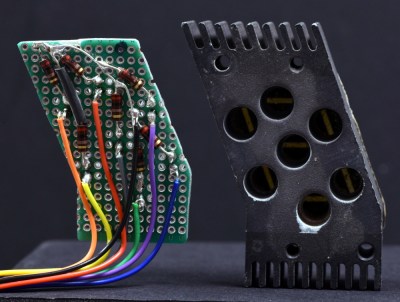
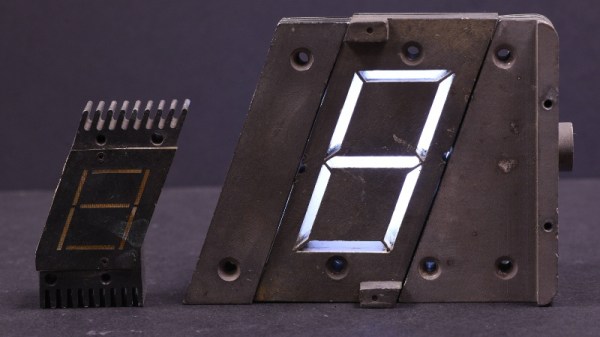
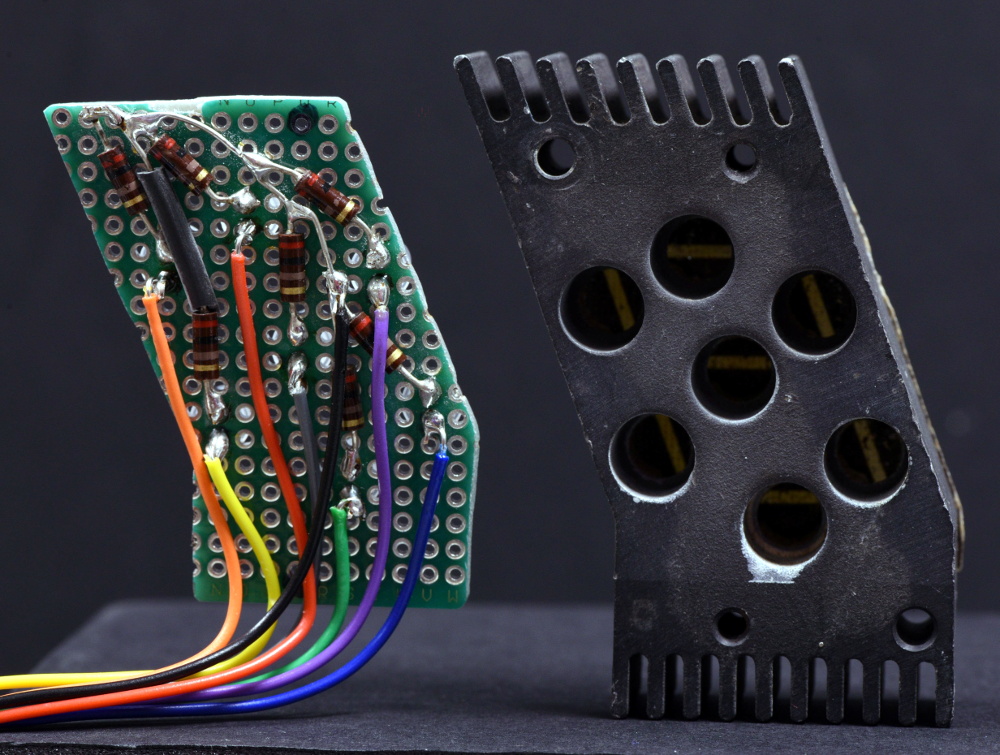
[Ben Krasnow] took up the challenge to make an electroluminescent Apollo-era DSKY display from scratch, with outstanding results. The DSKY, or “display and keyboard”, was the user interface for the Apollo Guidance Computer, the purpose-built digital navigation system that got a total of 24 men there and back again. [Ben] says it took a long time to recreate the display, and we can see why. He needed to master quite a few skills, including screen printing to get the glass-panel display working. The panel is a sandwich of phosphorescent paint, a dielectric, and conductive ink. The ink is silkscreened on the back to form the characters, all applied to indium tin oxide (ITO) conductive glass. A PCB with the same pattern of character segments lays behind that, driving each segment with 300 volts or so through a trio of HV507 high-voltage shift registers. It’s an impressive bit of engineering and gives off a decidedly not-homebrew vibe.

In the video below, [Ben] goes into detail about the trials he experienced on the way to this amazing endpoint, not least of which was frying chip after chip due to ineffective protection diodes in the shift registers. That’s an epic debugging story that’s worth the price of admission all by itself. It’s not the only DSKY in town, of course – [Fran Blanche] has been working on one for a while too – but there’s just something about that blue glow that we really like.

Continue reading “[Ben Krasnow] Makes A DSKY”

Hacking The Ionosphere, For Science

Imagine what it must have been like for the first human to witness an aurora. It took a while for our species to migrate from its equatorial birthplace to latitudes where auroras are common, so it was a fairly recent event geologically speaking. Still, that first time seeing the shimmers and ribbons playing across a sky yet to be marred by light pollution must have been terrifying and thrilling, and like other displays of nature’s power, it probably fueled stories of gods and demons. The myths and legends born from ignorance of what an aurora actually represents seem quaint to most of us, but it was as good a model as our ancestors needed to explain the world around them.

Our understanding of auroras needs to be a lot deeper, though, because we now know that they are not only a beautiful atmospheric phenomenon but also a critical component in the colossal electromagnetic system formed by our planet and our star. Understanding how it works is key to everything from long-distance communication to keeping satellites in orbit to long-term weather predictions.

But how exactly does one study an aurora? Something that’s so out of reach and so evanescent seems like it would be hard to study. While it’s not exactly easy science to do, it is possible to directly study auroras, and it involves some interesting technology that actually changes them, somehow making the nocturnal light show even more beautiful.

Continue reading “Hacking The Ionosphere, For Science”

X-Rays Are The Next Frontier In Space Communications

Hundreds of years from now, the story of humanity’s inevitable spread across the solar system will be a collection of engineering problems solved, some probably in heroic fashion. We’ve already tackled a lot of these problems in our first furtive steps into the wider galaxy. Our engineering solutions have taken humans to the Moon and back, but that’s as far as we’ve been able to send our fragile and precious selves.

While we figure out how to solve the problems keeping us trapped in the Earth-Moon system, we’ve sent fleets of robotic emissaries to do our exploration by proxy, to make the observations we need to frame the next set of engineering problems to be solved. But as we reach further out into the solar system and beyond, our exploration capabilities are increasingly suffering from communications bottlenecks that restrict how much data we can ship back to Earth.

We need to find a way to send vast amounts of data back as quickly as possible using as few resources as possible on both ends of the communications link. Doing so may mean turning away from traditional radio communications and going way, way up the dial and developing practical means for communicating with X-rays.

Continue reading “X-Rays Are The Next Frontier In Space Communications”

Lockheed Wants To Build The Next Lunar Lander

The United States is going back to the moon, and it’s happening sooner than you would think. NASA is going back to the moon in 2024, and they might just have the support of Congress to do so.

Getting to the moon is one thing, and since SpaceX launched a car to the asteroid belt, this future of boots on the moon after Apollo seems closer than ever before. But what about landing on the moon? There’s only ever been one Lunar Lander that has taken people down to the moon and brought them back again, and it’s doubtful that design will be used again. Now, Lockheed has their own plan for landing people on the moon, and they might be able to do it by 2024.

Continue reading “Lockheed Wants To Build The Next Lunar Lander”