Given the sheer volume of science going on as the International Space Station circles above our heads every 90 minutes or so, it would be hard for any one experiment to stand out. ISS expeditions conduct experiments on everything from space medicine to astrophysics and beyond, and the instruments needed to do the science have been slowly accreting over the years. There’s so much stuff up there that almost everywhere you turn there’s a box or pallet stuck down with hook-and-loop fasteners or bolted to some bulkhead, each one of them doing something interesting.
The science on the ISS isn’t contained completely within the hull, of course. The outside of the station fairly bristles with science, with packages nestled in among the solar panels and other infrastructure needed to run the spacecraft. Peering off into space and swiveling around to track targets is an instrument with the friendly name NICER, for “Neutron Star Interior Composition Explorer.” What it does and how it does it is interesting stuff, and what it’s learning about the mysteries of neutron stars could end up having practical uses as humanity pushes out into the solar system and beyond.
From time to time, we see electronics projects for model rocket instrumentation. Those who have been involved in the hobby for many years may remember when 8-bit microcontrollers like the PIC16F84 were the kind of hardware you might fly on a mission. These days, however, there’s little reason not to send a high-powered processor. This is exactly what [Mohamed Elhariry] has done with his PiX project, which turns a Raspberry Pi Zero W into a neat little flight data recorder.
The hardware has what you might expect from a flight recorder, including accelerometer, gyroscope, and pressure sensor. In addition, it carries temperature and humidity sensors, and of course, a camera. A 64 GB microSD card provides the storage, while a LiPo SHIM board allows the whole thing to run from a 150 mAh battery. All of the components are off-the-shelf breakouts, which makes assembly as easy as soldering a few connections and securing the modules with a little tape.
The project is in GitHub, including python code, schematics for the hardware, and detailed instructions. If you ever wanted to get started with instrumenting a model rocket, this looks like a great resource. Also in the repo is a captured video from an actual flight [34 MB GIF] if you just want to see the view from one launch.
For those not familiar with Project Egress, it’s a celebration of the 50th anniversary of the first Moon landing that aims to recreate an important artifact from the mission: the Unified Crew Hatch, or UCH, from the Apollo 11 Command Module Columbia. Forty-four makers from various disciplines have been tasked with making the various pieces of the UCH, and each one is free to use whatever materials and methods he or she wants. [Paul] chose what will probably turn out to be the consensus material – aluminum – and decided to play to his strengths by casting the part.
The handle itself is a chunky affair, as one would expect from something designed to be handled by an astronaut. [Paul] started with a 3D-printed version of the handle and created a two-piece mold in casting sand. The original part was probably machined, which meant that it didn’t have the draft angle that cast parts are supposed to have to make removal from the molding medium easier. [Paul] lucked out and got a perfect mold, and a perfect pour from silicon aluminum to boot. All the casting needed was a little cleanup and some holes to bolt it to the door.
[Paul]’s handle will get shipped to the Smithsonian along with the other parts, like [Fran Blanche]’s latch assembly, so that [Adam] can assemble the hatch live during the 50th-anniversary celebration later this month. Stay tuned for more Project Egress coverage as the parts keep rolling in.
[Fran Blanche] is on the team of elite hackers that has been offered a chance to contribute to [Adam Savage]’s Project Egress, a celebration of the engineering that got humanity to the Moon 50 years ago this month. By the luck of the draw, she landed a great assignment: building a replica of one of the fifteen latches that kept the Apollo Command Module hatch dogged down against the vacuum of space, and she’s doing a great job documenting her build with some interesting videos.
The first video below is mostly her talking through her design process, materials choices, and ideas about fabricating the somewhat intricate pieces of the latch. All 44 makers involved in the project get to choose what materials and methods they’ll use to make their parts, and [Fran] decided to use wood. Her first inclination was to use oak and brass, a nice combination with an 80s vibe, but in the second video, which covers more of the initial fabrication, she explains her switch to walnut. Unfortunately, the only CNC option she has is a Shaper Origin, which presents some difficulties; the handheld tool requires some complicated fixturing to safely machine the small parts needed, and its inability to read STL files means that [Fran] is stuck with a complicated software toolchain to drive the tool.
There are more videos to come as [Fran] gets further into the build, and we’re looking forward to seeing how her part and the rest of the makers’ builds come out.
In the fall of 1957, it seemed as though the United States’ space program would never get off the ground. The USSR had launched Sputnik in October, and this cemented their place in history as the first nation in space. If that weren’t bad enough, they put Sputnik 2 into orbit a month later.
By Christmas, things looked even worse. The US had twice tried to launch Navy-designed Vanguard rockets, and both were spectacular failures. It was time to use their ace in the hole: the Redstone rocket, a direct descendant of the V-2s designed during WWII. The only problem was the propellant. It would never get the payload into orbit as-is.
The US Army awarded a contract to North American Aviation (NAA) to find a propellant that would do the job. But there was a catch: it was too late to make any changes to the engine’s design, so they had to work with big limitations. Oh, and the Army needed it two days before yesterday.
The Army sent a Colonel to NAA to deliver the contract, and to personally insist that they put their very best man on the job. And they did. What the Army didn’t count on was that NAA’s best man was actually a woman with no college degree.
Spaceflight is inherently dangerous. It takes a certain type of person to willingly strap into what’s essentially a refined bomb and hope for the best. But what might not be so obvious is that the risks involved aren’t limited to those who are personally making the trip. The construction and testing of space-bound vehicles poses just as much danger to engineers here on the ground as it does to the astronauts in orbit. Arguably, more so. Far more individuals have given their lives developing rocket technology than have ever died in the cockpit of one of them.
Reddish brown exhaust of hydrazine thrusters
Ultimately, this is because of the enormous amount of energy stored in the propellants required to make a rocket fly. Ground support personnel need to exercise great care even when dealing with “safe” propellants, such as the classic combination of kerosene and liquid oxygen. On the other end of the spectrum you have chemicals that are so unstable and toxic that they can’t be handled without special training and equipment.
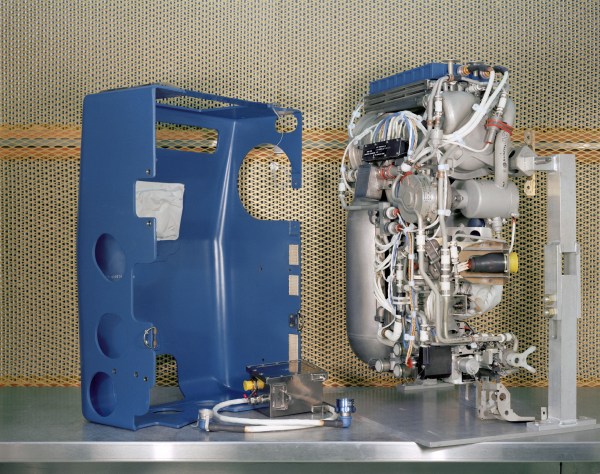
One of the most dangerous chemicals ever used in rocket propulsion is hydrazine; and yet from the Second World War to the present day, it’s been considered something of an occupational hazard of spaceflight. While American launch vehicles largely moved away from using it as a primary propellant, hydrazine is still commonly used for smaller thrusters on spacecraft.
But soon, that might change. NASA has been working on a project they call the Green Propellant Infusion Mission (GPIM) which is specifically designed to reduce modern spacecraft’s dependency on hydrazine. In collaboration with the Air Force Research Laboratory at California’s Edwards Air Force Base, the space agency has spearheaded the development of a new propellant that promises to not just replace hydrazine, but in some scenarios even outperform it.
So what’s so good about this new wonder fuel, called AF-M315E? To really understand why NASA is so eager to power future craft with something new, we first have to look at the situation we’re in currently.