Mike Harrison’s Reverse Engineering Workshop

Hardware teardowns are awesome when guided by experts. One of our favorites over the years has been [Mike Harrison], who has conquered teardowns of some incredibly rare and exquisitely engineered gear, sharing the adventure on his YouTube channel: mikeselectricstuff. Now he’s putting on a workshop to walk through some of the techniques he uses when looking at equipment for the first time.

[Mike] will be in Pasadena a few days early for the Hackaday Superconference and floated the idea of hosting a workshop. We ordered up some interesting gear which he hasn’t had a chance to look at yet. A dozen lucky workshop attendees will walk through the process [Mike] uses to explore the manufacturing and design choices — skills that will translate to examining any piece of unknown gear. He may even delve into the functionality of the equipment if time allows. Get your ticket right now!

To keep things interesting we’re not going to reveal the equipment until after the fact. But follow the event page where we’ll publish the details of his reverse engineering work after the workshop.

[Mike] is the badge designer for this year’s Hackaday Superconference badge. Unfortunately Supercon is completely sold out (we tried to warn you) but you can check out the badge details he already published. And we will be live streaming the Supercon this year — more details on that next week!

This Power Strip Is A Fire Starter

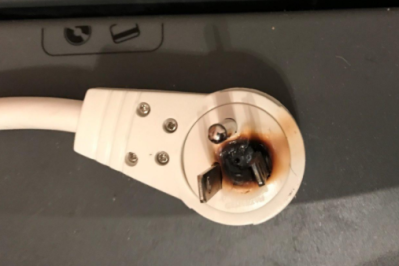
A few weeks ago I needed a power strip in my home office. The outlet in question is located behind a filing cabinet so it would need a low profile plug. I jumped on Amazon to buy a surge suppressor strip. That’s when I noticed strips with rotating plugs. I’ve always had some apprehensions about plugs like that, though I could never quite put my finger on why. Looking at the reviews on this particular plug, I found some scary issues. Photos of melted plugs, melted outlets, and cries of “fire hazard”. So I did what any crazy hacker would do – bought two power strips. One with a fixed right angle plug to use in my office, and one with a rotating plug to tear down.

Failed plug – from Amazon reviews

Surge suppressors, power strips, outlet strips, they have many names. Underwriter’s Laboratories (UL) calls them “Relocatable power taps”. They all have several outlets, most have a circuit breaker of some sort inside, and some have circuits for surge suppression. These are some of the most common devices to find in the modern home. Many of our houses were designed and built before surround sound, cable boxes, computers, modems, cell phone chargers, tablet chargers, and all our other modern conveniences. There weren’t as many electrical loads, so the houses didn’t have many outlets. Power strips solve this problem.

After a couple of days, I had my strips in hand. I expected the plug to rotate once – maybe 270 degrees. That would indicate there were wires connecting the rotating head to rest of the plug. Not so – this plug would spin round and round all day long.

Continue reading “This Power Strip Is A Fire Starter”

Dollar Tree LED Bulb Tear Down

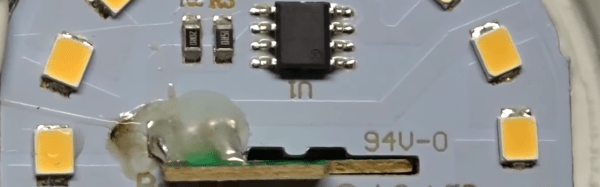
It is hard to remember now, but there was a time when electronics were expensive. [Adrian Black] found some 9W (60W equivalent) LED light bulbs at the Dollar Tree (a U.S. store where everything costs a dollar). Naturally, they cost a dollar, and he wanted to see what was inside of them. You can see the resulting video, below.

Apparently where [Adrian] lives there is a subsidy paid to retailers for selling LED lighting, so you may not be able to get the same bulbs at that price. Still, the price of these bulbs has dropped like a rock over the last few years.

Continue reading “Dollar Tree LED Bulb Tear Down”

Doppler Module Teardown Reveals The Weird World Of Microwave Electronics

Oscillators with components that aren’t electrically connected to anything? PCB traces that function as passive components based solely on their shape? Slots and holes in the board with specific functions? Welcome to the weird and wonderful world of microwave electronics, brought to you through this teardown and analysis of a Doppler microwave transceiver module.

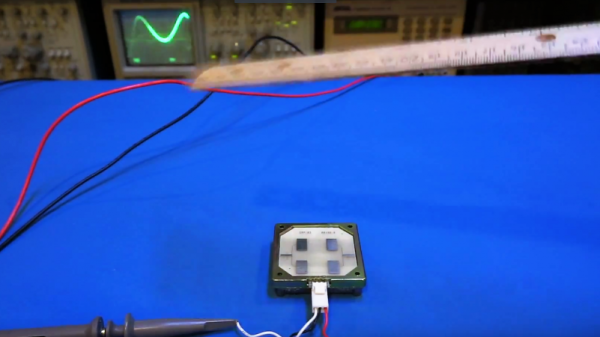
We’ve always been fascinated by the way conventional electronic rules break down as frequency increases. The Doppler module that [Kerry Wong] chose to pop open, a Microsemi X-band transceiver that goes for about $10 on eBay right now, has vanishingly few components inside. One transistor for the local oscillator, one for the mixer, and about three other passives are the whole BOM. That the LO is tuned by a barium titanate slug that acts as a dielectric resonator is just fascinating, as is the fact that PB traces can form a complete filter network just by virtue of their size and shape. Antennas that are coupled to the transceiver through an air gap via slots in the board are a neat trick too.

[Kerry] analyzes all this in the video below and shows how the module can be used as a sensor. If you need a little more detail on putting these modules to work, we’ve got some basic circuits you can check out.

Continue reading “Doppler Module Teardown Reveals The Weird World Of Microwave Electronics”

Horizontal Magnetic Levitation Experiments

Levitating chairs from the Jetsons still have a few years of becoming a commercial product though they are fun to think about. One such curious inventor, [Conor Patrick], took a deep dive into the world of maglev and came up with a plan to create a clock with levitating hands. He shares the first part of his journey to horizontal levitational control.

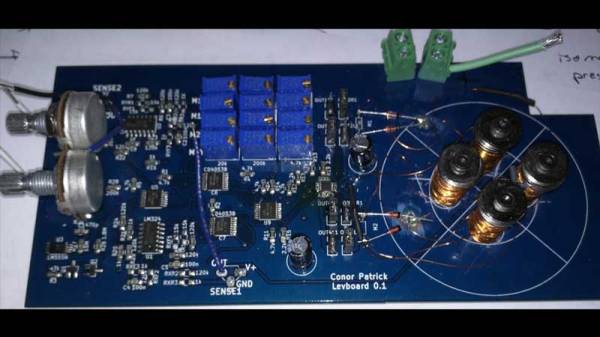
[Conor Patrick] bought an off-the-shelf levitation product that was capable of horizontal levitation. Upon dissecting it he found a large magnet, four electromagnet coils, and a hall effect sensor. These parts collectively form a closed-loop control to hold an object at a specific distance. He soon discovered that in fact, there were just two coils energized by H-bridges. His first attempt at replicating the circuit, he employed a breadboard which worked fine for a single axis model. Unfortunately, it did not work as expected with multiple coils.

After a few iteration and experiments with the PID control loop, he was able to remove unwanted sensor feedback as well as overshoot in control current. He finally moved to a Teensy with a digital PD loop. The system works, but only marginally. [Conor Patrick] is seeking help from the control loop experts out there and that is the essence of the OSHW world. The best part of this project is that it is a journey that involves solving one problem at a time. We hope to see some unique results in the future.

We have covered Acoustic Levitation in the past and the Levitating Clock on a similar beat. We’re certain a more refined approach is on the horizon since many of us are now looking at making one to experiment with on our workbench.

SCiO “Pocket Molecular Scanner” Teardown

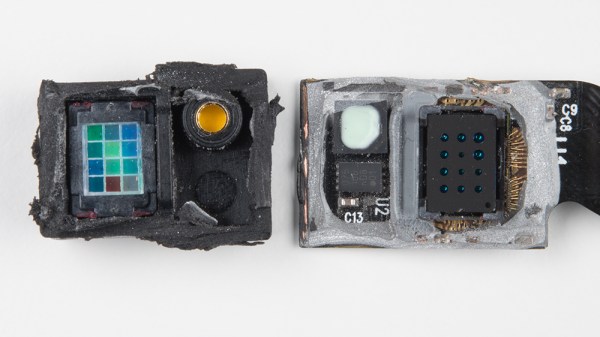
Some of you may remember the SCiO, originally a Kickstarter darling back in 2014 that promised people a pocket-sized micro spectrometer. It was claimed to be able to scan and determine the composition of everything from fruits and produce to your own body. The road from successful crowdsourcing to production was uncertain and never free from skepticism regarding the promised capabilities, but the folks at [Sparkfun] obtained a unit and promptly decided to tear it down to see what was inside, and share what they found.

The main feature inside the SCiO is the optical sensor, which consists of a custom-made NIR spectrometer. By analyzing the different wavelengths that reflect off an object, the unit can make judgments about what the object is made of. The SCiO was clearly never built to be disassembled, but [Sparkfun] pulls everything apart and provides some interesting photos of a custom-made optical unit with an array of different sensors, various filters, apertures, and a microlens array.

It’s pretty interesting to see inside the SCiO’s hardware, which unfortunately required destructive disassembly of the unit in question. The basic concept of portable spectroscopy is solid, as shown by projects such as the Farmcorder which is intended to measure plant health, and the DIY USB spectrometer which uses a webcam as the sensor.

Lethal LED Lantern Leaks Lotsa ‘Leccy

When you take an item with you on a camping trip and it fails, you are not normally in a position to replace it immediately, thus you have the choice of fixing it there and then, or doing without it. When his LED camping lantern failed, [Mark Smith] was in the lucky position of camping at a friend’s compound equipped with all the tools, so of course he set about fixing it. What he found shocked him metaphorically, but anyone who handles it while it is charging can expect the more literal variation.

The lamp was an LED lantern with built-in mains and solar chargers for its Ni-Cd battery pack, and a USB charger circuit that provided a 5 volt output for charging phones and the like. The problem [Mark] discovered was that the mains charger circuit did not have any mains isolation, being a simple capacitive voltage dropper feeding a rectifier. These circuits are very common because they are extremely cheap, and are perfectly safe when concealed within insulated mains-powered products with no external connections. In the case of [Mark]’s lantern though the USB charging socket provided that external connection, and thus access to a potential 120 VAC shock for anyone touching it while charging.

Plainly this lamp doesn’t conform to any of the required safety standards for mains-powered equipment, and we’re guessing that its design might have come about by an existing safe lamp being manufactured with an upgrade in the form of the USB charger. The write-up gives it a full examination, and includes a modification to safely charge it from a wall-wart or similar safe power supply. Definitely one to watch out for!

If you were wondering what the fault was with Mark’s lamp, it was those cheap NiCd batteries failing. He replaced them, but there are plenty of techniques to rejuvenate old NiCds, both backyard, and refined.